CULTURAL CHRONOLOGICAL ASSESSMENTS
North-south or vice versa movements were most likely protracted processes occurring over millennia and centuries and not sudden events. Moreover, they were largely peaceful in character, involving gradual bidirectional assimilation. From a chronological point of view, the precise beginning of these slow but progressive interactions east of the Caspian Sea has been a matter of heated discussion among scholars (see Chapter 17). This is partly due to the fact that archaeological evidence is open to various interpretation, and partly because the chronological framework for the prehistoric steppe cultures was, and still is, somewhat uncertain, based mainly on cross-cultural analogies and formal comparisons.
Central and eastern Kazakhstan as well as the Minusinsk basin along the middle course of the Enisej River and the Altai Mountains in south Siberia were occupied from the mid-qth millennium by the Afanasievo culture, whose communities were characterized by mobility associated with cattle breeding economic activity. The Pontic area, west of the Urals, were occupied by the Repin (from ca. 3700 BC) followed by the Jamnaja or Pit-Grave culture (from ca. 3400 BC). The material culture of the Jamnaja and Afanasievo was very similar and ancient DNA research seems to have confirmed that the two groups were genetically almost indistinguishable (Haak et al. 2015). The Catacomb culture followed the Jamnaja. It is documented in the 3rd millennium in the Ukrainian and southern Russian steppes, while the valleys of the Volga and Kama Rivers north of Samara and the southern Ural hills were occupied in the late 3rd millennium by the Abashevo culture, which played a significant role in the origin of the Sintashta-Arkaim culture. The geographical space between the Pontic region and the Altai Mountains, from the semidesert and desert areas of the Kara Kum and Kyzyl Kum to the deltas of the Amu Darya, Syr Darya, and Zeravshan Rivers, was occupied by the Neolithic and Chalcolithic Kel’teminar culture with communities engaged into a mobile hunting, gathering, and fishing subsistence way of life. The earliest evidence of the Kel’teminar culture (Dar’jasaj phase) is attested already in the late 7th to early 6th millennium, while the latest (Ajakagytma, Dzhambas Kala 5 and 11 and some sites of the Ljavljakan complex) are dated to the late 3rd to the beginning of the 2nd millennium (Brunet 2005). Around the 17th or 16th century BC at least, the alluvial plains of ancient Chorasmia and the Bukhara oasis were inhabited by communities of the Tazabag’jab culture. The archaeological data shows that it combined features of the Kel’teminar


Kargaly.
Arkaim
Ilekshar. (j rof
Petrovka. .Petropavlovsk
.Botai
'Sintashta
.Shagalaly II
Ishim
.Astana
Turgay Depression
Barnaul.
Saryarka
Caspian Depression
Dzhezkazgan
.Kent
. Myr¿h yk
Tagisken
&&&
.Zhambyl
Parkhaj II,
Pirak
Bajuchistan''
Iranian Plateau
,Shahr-i
Sokhta
Aral Sea
Caspian Sea
Indus River Valley
¿/w/Man- Tashkent
.Ajakagytma ' s e
Kara K u m Zeravshan : ç
Zaman Baba. Kar‘nab .Samarkand
fcs. TandYryuk Zm.Kangnrttirt
.Gonur
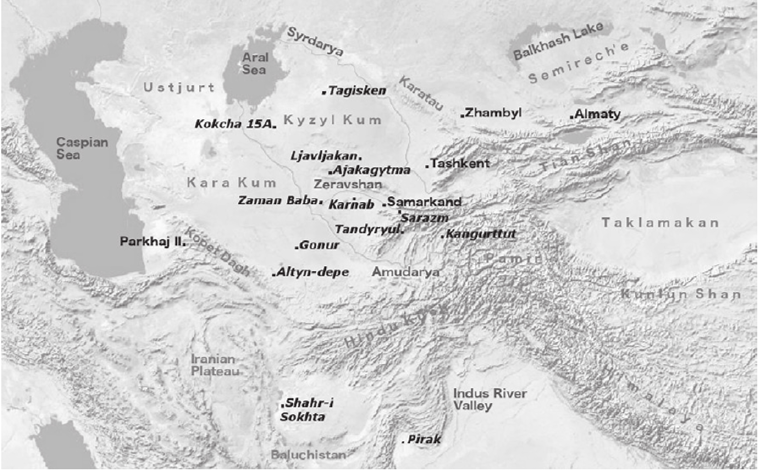
Figure 26.1 Map of Central Eurasia with the location of the main archaeological sites mentioned in the chapter (in italic) and the most important modern cities (in roman, bold) (ESRI software).
substratum, typical elements of the Srubnaja culture in its South Urals variant as well as pottery types and decorative patterns of the Alakul’ and Fedorovo traditions. The Tazabag’jab populations had a mixed economy of cattle breeding and farming. Their pastoralist economy together with irrigation systems distinguish them from the other Bronze Age communities of the Eurasian steppes.
The cultural complexes of the late 3rd millennium BC of the northern Eurasian steppes are today fragmented into numerous archaeological cultures and their related local variants (facies) bearing different names depending on individual scholars and their subjective perception of the archaeological facts. However, there seems to be a general agreement regarding the periodization of the late Middle Bronze Age, or Sintashta-Arkaim period (2100-1800 BC), and the following Petrovka period (1900-1750 BC),2 which marks the beginning of the Late Bronze Age and the start of the Andronovo culture. Sintashta was coeval to the Potapovka and the Late Catacomb culture, while Petrovka was coeval to the Pokrovka; Potapovka and Pokrovka spread out along the middle Volga (see also Chapter 24).
The next phase is represented by two cultures, Alakul’ and Fedorovo, whose area of diffusion overlaps that of the Andronovo complex. To distinguish them is extremely problematic because they share many features. As similar ceramic styles occurred in the same sites and burial grounds, and even in the same semi-subterranean pit house and grave, it is nearly impossible to accurately interpret the formation and evolution of the steppe cultures in the first half of the 2nd millennium BC. Moreover, different scholars have fragmented both cultures into numerous facies, some of which are characterized by an earlier and later phase. For the Alakul’ culture, for instance, the Cheljabinsk, Ujsk-Uvel’, Magnitogorsk, Tobol’sk, northern Kazakhstan (split into the Petropavlovsk and Kokshetav facies), Sol’-Iletzk, and western and central Kazakhstan are mentioned. For the Fedorovo, the Urals, north Kazakhstan, central Kazakhstan, Semirech’e, upper Ob’, middle and upper Enisej River valley, Irtysh valley near Pavlodar, eastern Kazakhstan, Tian Shan, and Pamir are known. The outcome is a very complex mosaic of large and small, intersecting and overlapping “tesserae” that make it troublesome to see and to interpret unequivocally the whole picture.
The Srubnaja or Timber Grave culture was spread in the eastern part of the Pontic Caspian area in the second quarter of the 2nd millennium BC and it is interpreted as the direct result of the evolution of three earlier cultures: Late Catacomb, Poltavka, and Potapovka. The Kozhumberdy and Amangel’dy cultures, respectively in western and northern Kazakhstan, and the Nura along the Ishim River valley pertain to the mid-2nd millennium BC. The whole region of Sarjarka (or central Kazakhstan) was occupied by the Sargary and Alekseevka cultures. The latter produced unique pottery, known as ualikovaja keramika, characterized by an applied band on the shoulders of most of the vessels. The Sargary-Alekseevka complex can be further divided in the facies of Atasu, between Karaganda and Dzhezkazgan, and Tautary along the slopes of the Karatau Mountains. The Begazy-Dandybaj is today regarded as a local variant of the Sargary culture, and the large stone-built hypogeums of Begazy, Aksu Ajuly 2, Buguly 3, Sangru (or Sangyru) 1, Ajbas Darasy, Karazhartas, and Dandybaj are interpreted as monumental burials of the local Sargary elite who controlled and managed the rich local resources (copper ores of Dzhezkazgan and Kenkazgan and huge pastures).
New calibrated radiocarbon dates of steppe materials have been recently achieved, which have extended the old and obsolete periodization leading to alternative “high” chronologies (i.e., 300-500 years earlier than the traditional chronologies established in Soviet times). Although these dates are few and have not been accepted by all scholars, they more properly correspond to the relative chronology. Moreover, they can be confidently linked to artifacts from southern Central Asia, which in turn, in the best scenario, can be related to historical chronologies established for the ancient Near and Middle East. In fact, research and fieldwork in southern Turkmenistan and
Margiana, Uzbekistan, and Tajikistan suggest a “South Asian line of synchronization,” based upon clusters of radiocarbon dates from sites across the Indo-Iranian borderland. This could be the foundation of an acknowledged chronology of the Eurasian steppe in the Bronze Age, from the Caspian Sea to the Tian Shan Mountain and beyond.
From all the gathered data, and though it cannot yet be in agreement with all of it, a chronological correlation between these different cultures is provisionally proposed (Table 16.i).

