Material culture
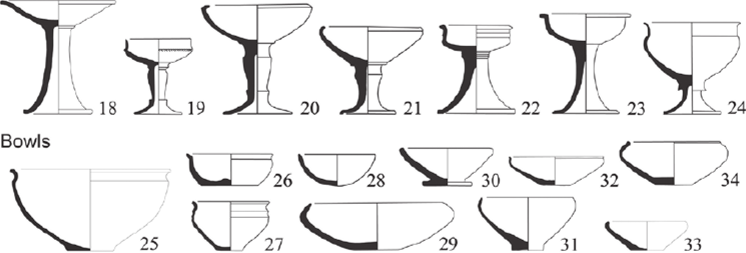
The material culture consists of pottery vessels, as well as metal, stone, unbaked clay, and bone artifacts. Various implements also attest to work with wool, skins, textile, and mineral raw material. The ceramic production is varied with several types of fine, medium and coarse wares identified so far, showing a regional distribution. The range of shapes is large and shifted significantly compared to the previous periods (Figure 18.2). Different techniques were used: handmade shaping by coiling, or from a lump of clay, or over a lump of clay in a cloth; wheel-throwing; and wheel-coiling (i.e., a mixed technique of coiling and wheel at different steps of the chaîne opératoire). Like previously, pottery complexes are mostly dominated by the wheel-made or wheel-coiled pottery, but recent excavations at Saredjar 2 in Tajikistan have brought to light a ceramic corpus where 85% is handmade pottery (Teufer et al. 2014) so that pottery practices need to be reevaluated at the local scale. The pottery related to the Final Bronze Age is mostly said to be red-burnished (Hiebert 1994a: 71), or with a red slip (P’jankova 1993; Pilipko 2010: 232-233), or with incised decorations (curved and straight lines) (Sarianidi 1977: 25). However, first, exhaustive studies at the Dzharkutan necropolis and the settlement of Molali in southern Uzbekistan show that only 20-30% of the vessels are decorated, mostly by polishing, slip, and incisions (Luneau 2014:114-145; Luneau et al. forthcoming). Second, these types of decoration also existed in the previous periods. Even considering regional variation, these features cannot be used as the only criteria of identification for the Final Bronze Age pottery without the precise description of the different pottery complexes through time.
Similarly, for the other materials the types of artifacts significantly changed at the beginning of the Final Bronze Age. The corpus of metal items is characterized by a new phenomenon: the appearance of miniature objects deposited in the graves, especially in southern Uzbekistan and southern Tajikistan, which represent approximately four-fifths of the whole metallic assemblage (Figure 18.3, 1). Although unequally distributed (Figure 18.4), they are present in one-seventh of all the burials recorded for this period, and are connected to all kinds of graves (Luneau 2014: 150-151). Except for these miniature objects, few other metal artifacts have been discovered in the settlements and are related mainly to ornaments, but a few tools and weapons are also present. The great majority (around 90%) is copper-based. Archaeometrical analyses currently attest to the common use of tin bronze (half of the samples in the most eastern areas) in addition to copper alloys.
The stone production mostly concerns implements and weapons (axes, arrowheads, working stones, casting molds for metallurgy, etc.). Ornaments are few, mainly beads. Unlike the previous period, precious and semiprecious stones are rare, even in the
Jars

9

Footed cups
Miniature vessels
C- /35
Particular shapes

0 — — 25cm
Figure 18.2 Examples of pottery types related to the Final Bronze Age. i. Dzharkutan 4A (after Askarov and Abdullaev 1983: 117, fig. LII, 5); 2-3. Molali (©Deutsches Archäologisches Institut, Eurasien-Abteilung); 4. Tandyrjul (after Vinogradova 2004: 131, fig. 9, 5); 5. Dzharkutan 4A (after Askarov and Abdullaev 1983: 116, fig. L, 3); 6. Nurek (after P’jankova 1979: 84, fig. 2, 3); 7. Takhirbaj 3 (after Sarianidi 1990: 266, fig. LXI, 23); 8. Bustan 6 (after Avanesova 1997: 171, fig. 14,1); 9. Molali (after Beljaeva and Khakimovgraves. Beads with an axe shape (made of lapis lazuli or an artificial material) seem characteristic of the period in the eastern sites (Figure 18.3, 2). The same can be said of various unbaked clay objects unknown before (figurines, spindle whorls, miniature cones or spoons, etc.) (Figure 18.3,3). Bone awls and tubes have also been recorded.
Changes compared to the previous periods are clear both in the quantity of artifacts discovered and in their style (Luneau 2014: 165-169). Although the study lacks a detailed comparative study from reliable stratigraphic layers between the different periods (such as that done at Shortughai, see Francfort 1988), the examination of the data from funerary and settlement contexts suggests a rise in the amount of pottery in contrast with a significant decrease in the quantity of artifacts made of other materials. A strong decline in the number of tools, weapons, and ornaments in metal is indeed clearly attested until they almost disappear (at least in the graves). The miniature metal objects that had only appeared around 1800/1700 BC, also progressively decrease throughout the Final Bronze Age and vanish around 1500/1400 BC.
Besides these quantitative changes, others dealing with the shapes and styles are obvious. The ceramic assemblage is affected by a higher variability, possibly in relation with functional and organizational shifts in the pottery production, though the production techniques are the same (clay sources, paste composition, fashioning, firing, etc.) (Luneau et al. forthcoming). Concerning metallurgy, the development of the techniques of bronze metallurgy is attested in southern Uzbekistan. No diachronic evaluation has been made in the other areas. Old analyses also point to possible modifications of the ore supplies throughout the Bronze Age (Ruzanov 1999), raising different interpretations (depletion of sources, geographical preference, changes of commercial partners). Globally, a general trend to less time investment and less skill in the fabrication process is sometimes noticeable but still needs to be evaluated properly. Cultural changes are noticed in the size of items, especially for the metal items (miniaturization), which are more likely connected to symbolic changes than to a raw material shortage,’ but questions remain on the signification of this practice
Figure 18.2 (Cont.)
- 1973: 41, fig. 8,1); 10-11. Dzharkutan 3 (©MAFOUZ-Protohistory); 12-13. Molali (©Deutsches Archäologisches Institut, Eurasien-Abteilung); 14. Bustan 6 (after Avanesova 2007: 86, fig. 16, II, 5); 15-16. Dzharkutan 3 (©MAFOUZ-Protohistory); 17. Takhirbaj 3 (after Masson 1959: 177, fig. IX, 6); r8. Bustan 6 (after Avanesova 1997: 161, fig. 7,1); 19. Dzharkutan 4A (after Askarov and Abdullaev 1983: 115, fig. XLVIII, 11); 20. Dzharkutan 4A (after Askarov 1977: 222, fig. LIX, 3); 21. Dzharkutan 3 (©MAFOUZ-Protohistory); 22. Takhirbaj 3 (after Masson 1959: 177, fig. IX, 3); 23. Dzharkutan 4A (after Askarov and Abdullaev 1983: 115, fig. XLVIII, 9); 24. Dzharkutan 4A (after Askarov and Abdullaev 1983: 115, fig. XLVIII, 3); 25. Molali (©Deutsches Archäologisches Institut, Eurasien-Abteilung); 26. Kangurttut (after Vinogradova et al. 2008: 351, 70, 3); 27. Tandyrjul (after Vinogradova 2004: 131, fig.9, 9); 28. Tandyrjul (after Vinogradova 1980: 67, fig.3, 13); 29. Takhirbaj 3 (after Masson 1959: fig. VII, 8); 30. Kangurttut (after Vinogradova et al. 2.008: 350, 60, 6); 31. Shortughai (after Francfort 1989: pl. 56, 4); 32-33. Dzharkutan 3 (©MAFOUZ-Protohistory); 34. Kangurttut (after Vinogradova et al. 2008: 346, 27, 2); 35. Takhirbaj 3 (after Sarianidi 1990: 266, fig. LXI, 15); 36. Kangurttut (after Vinogradova et al. 2008: 350, 61, 2); 37. Bustan 6 (after Avanesova 2007: 70, fig.6, II, 1); 38. Takhirbaj 3 (after Masson 1959: 174, fig-VI, 16); 39. Namazga Depe/Vyshka (after Khlopina 1972: 208, fig.7);
- 40. Kangurttut (after Vinogradova et al. 2008: 324, fig. 29a, 25).

Figure 18.3 Examples of specific artifacts related to the Oxus Civilization from Uzbekistan in the Final Bronze Age. 1. Miniature artefacts in copper alloy (Bustan 6, after Avanesova 2013: 560, fig. XVI); 2. Beads, especially axe-shape (Bustan 6, after Avanesova 2013: 558, fig.
XIV); 3. Small items in unbaked clay (Bustan 6, after Avanesova 2013: 553, fig. IX).


Legend: Ol-io 010-20 020-10° O'00’200
Figure 18.4 Geographic and quantitative distribution of the miniature metallic items at the Final Bronze Age sites of the Oxus Civilization.
and on the choices of the artifacts that were miniaturized or that have disappeared. Some new types of objects also emerge in the assemblages, such as the small articles in unbaked clay (see Figure 18.3, 3) or specific items related to the northern Central Asian traditions (Figure 18.6). Nevertheless, there is, in addition, a disappearance or sharp rarefaction of numerous types of artifacts considered previously as male prestige goods (ceremonial axes, stone miniature columns, discs and staff, etc.) and female ones (composite figurines, seals, ornaments, cosmetic items, etc.), especially those items requiring long-distance acquisition and long technological operations. The disappearance of the most prestigious and valuable items goes together with a decrease in the volume of exchanges between the cultures of the Near East/Middle Asia (raw materials, prestige goods from the neighboring societies, etc.; Luneau 2.015).
By contrast, one of the new signals for the period is the rise of elements linked with the northern “steppe” Central Asian cultural tradition (Luneau 2014: 151; 2017): one-seventh of the quantity of artifacts in metal and stone (e.g., daggers, molds, and beads; see Figure 18.6),4 millet, domestic stone structures, and funerary stone constructions or cremation, for instance (see Table 18.1). The presence of artifacts stylistically connected with northern Central Asia possibly testifies to a switch in the direction of the exchange network and of intensified relations with the “Andronovo” populations. Since these populations were already located at the fringe of the Oxus Civilization area (Zeravshan, see Chapter 24), in northern Central Asia (Kazakhstan, Kyrgyrzstan, see Chapter 26), but also in southern Central Asia itself (see Chapter 17), the degree of extension and the modalities of the exchanges need to be further examined. This factor surely depended upon the territorial organization of the different communities. In all, these disparate parameters still need to be better investigated and analyzed to further assess a reformulation of the exchanges.

