Creativity utterly lacking: through the Wicket Gate
Introduction
We must begin with the ‘creative spark ... utterly lacking’ ( Feist Publications, Inc. v. Rural Tel. Service Co., Inc., 1991, p. 359), located at the bottom right hand corner of the figure showing the place of creativity in the decision (see Figure 4.1). The ‘creative spark utterly lacking’ (p. 359) is extensively delineated within the ratio decidendi of the decision, or the statement of the principles that determine the outcome of the case (Greenberg, 1997, p. 47).
One analogy for our journey through Feist was The Pilgrim 's Progress. On this model, we have passed through the Slough of Despond, or despair at the apparent complexity of the decision, and elucidated the position of creativity within the decision and have begun to discern the path we must follow. We can now make a new beginning, on the basis on the understanding of the place of creativity in the decision. We must pass through the Wicket Gate (Bunyan, 1678/1985, pp. 12-25) and travel along the narrow and strait path given by the decision and which can be used to obtain a full understanding of the decision.
The judgment gives a full account of the negative of creativity, as ‘so mechanical or routine as to require no creativity whatsoever’ (Feist Publications, Inc. v. Rural Tel. Service Co., Inc., 1991, p. 362). The decision does imply an understanding for creativity by clauses with an antithetical character, most significantly by ‘so mechanical or routine as to require no creativity whatsoever’ (p. 362), which would imply creativity as neither so mechanical nor so ... routine.
The delineation of the negative of, or antithesis to, a complex and difficult concept is consistent with a classic strategy used by the Supreme Court. Confronted with complex or elusive, but inescapable, concepts - ‘the task of trying to define what may be indefinable’ (Jacobellis v. Ohio, p. 197) - the Court has resorted to indirect methods of delineation (Fallon, 2004, p. 46). In one significant instance, concerned with obscenity, further definition of ‘hard-core pornography’ was deliberately avoided and a sufficient test for recognition of it - T know it when I see it’ - substituted (p. 197). In the case of Feist, there is not a comparably clearly articulated avoidance of definition of the complex
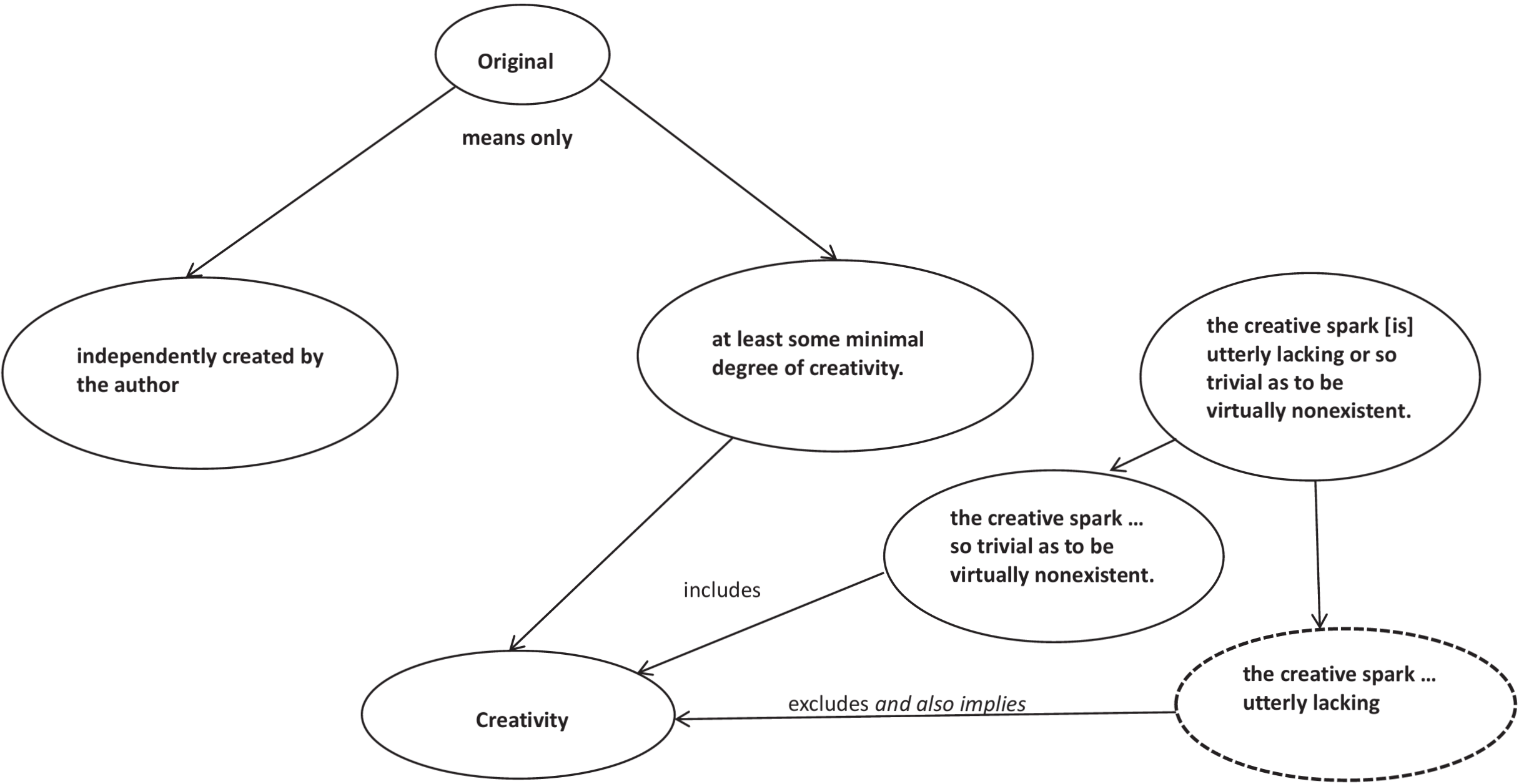
Figure 4.1 Map for the journey
Note: Bold is used for terms and phrases directly derived from the decision. The broken line indicates the current focus for the journey.
Creativity utterly lacking 37 concept, of creativity, or a recourse to recognition. Rather, there is a focus on, and characterization of, the more definite, and possibly, simpler, antithesis to creativity, the absence of creativity, as the final rationale for the denial of property. The problematic history of creativity as a concept in copyright would definitely have been known to the Supreme Court, who cite a seminal case, Bleistein v. Donaldson Lithographing Co. (Feist Publications, Inc. v. Rural Tel. Service Co., Inc., 1991, p. 359), which allowed copyright to inhere in circus posters. The Supreme Court can then be understood as deliberately concentrating on delineating the antithesis to creativity rather than creativity itself, in the knowledge that it was more likely to be open to significant elucidation.
The characterization of the absence of or antithesis to creativity has not been subject to a close exegesis, beyond the recognition of the relative explicitness with which the not original as a whole has been delineated. One commentary at least has contrasted the explicitness with which the not original is characterized compared to the original - ‘[t]he Feist opinion is more explicit in describing what is not original than in delineating what is’ (Ginsburg, 1992, p. 343). Commentaries have not seized upon the characterization for exegesis, or, as a further possibility, recognized it as a resource for the clarification of the decision (Nimmer and Nimmer, 1978/2020). The crucial characterization, ‘so mechanical or routine’, is increasingly frequently cited in widely scattered sources as a central criterion for the absence of property. The combination of recognition of clarity of delineation and the implication of the significance of the clause with an absence of further development promises the potential for a powerful analysis. The analysis can transform the implicit, emerge into the explicit, and integrate and unify scattered, but potentially congruent sources.
Critiques have recognized the existence, but not the potential significance, of the delineation of the absence of a modicum of creativity to the decision. Authors who recognized the focus on what was excluded from copyright in the opinion it simultaneously qualified its value - ‘Where earlier Supreme Court decisions in this century - Bleistein p. Donaldson Lithographing, Mazer v. Stein - told us what subject matter falls within copyright’s embrace, Feist took the hard road of telling what us what subject matter falls outside of copyright’ (Goldstein, 1991, p. 118). Alternatively, recognition is followed by dismissal of the significance of the delineation: ‘The Feist opinion is more explicit in describing what is not original than in delineating what is. ... The Court’s word choice might best be viewed as rhetorical excess’ (Ginsburg, 1992, p. 344). Even the recognition of the extended treatment of the absence of a modicum of creativity has not been consistently sustained by critiques, which have been more concerned with the poor positive definition of creativity as a positive concept (Clifford, 2004; Greetham, 1996; Narayanan, 1993-1994; Raskind, 1991-1992; Resnik, 2003; Strong, 1994; Ver-Steeg, 1995).
The beginning of the ratio decidendi is clearly marked.
The question that remains is whether Rural selected, coordinated, or arranged these uncopyrightable facts in an original way.
(Feist Publications, Inc. v. Rural Tel. Service Co., Inc., 1991, p. 362)
Similarly, its conclusion is also clearly signaled.
We conclude that the names, towns, and telephone numbers copied by Feist were not original to Rural.
(p. 363)
The crux of the decision is, then, captured in ‘not original to’ (Feist Publications, Inc. v. Rural Tel. Service Co., Inc., 1991, p. 363).
‘[N]ot original to’ (Feist Publications, Inc. v. Rural Tel. Service Co., Inc., 1991, p. 363) can be understood as the negation of originality. Originality is constituted by ‘independent creation’ and ‘a minimal degree of creativity’ (p. 346). ‘[N]ot original to’ (p. 363) would be conversely constituted by the absence of independent creation and of a minimal degree of creativity. The absence of a minimal degree of creativity is populated by the ‘creative spark ... utterly lacking or so trivial as to be virtually nonexistent’ (p. 359). ‘[N]ot original to’ (p. 363) is, then, potentially constituted by the absence of independent creativity, the creative spark utterly lacking, and the creative spark so trivial as to be virtually nonexistent.
‘[N]ot original to’ (Feist Publications, Inc. v. Rural Tel. Service Co., Inc., 1991, p. 363) is extensively characterized in a series of consecutive paragraphs between the opening and the conclusion of the ratio decidendi, with crucial clauses proceeding from ‘so mechanical or routine’ to ‘practically inevitable ... time-honored tradition’ (Feist Publications, Inc. v. Rural Tel. Service Co., Inc., 1991, pp. 362-363). The focus of this chapter is, then, on the delineation of‘not original to’ (p. 363), with the aim of isolating the delineation of the ‘creative spark ... utterly lacking’ (p. 359) and developing an understanding of it.

