Creativity: out of the labyrinth
Introduction
This chapter develops an explicit understanding of creativity, from the antithetical clauses in the decision which negatively imply it, which fully meets the requirements for creativity derived from the decision. Crucially, creativity must be understood consistently with its ordinary discourse sense and reach from the lowest to the highest possible levels. We have navigated to the antithetical and dead center of an apparently labyrinthine, but finally simple and compelling, argument - the computational process as the antithesis to creativity. We must now navigate outwards, from the dead center of the judgment to creativity.
For the move towards creativity', creativity utterly lacking is understood as implying creativity fully present as its own opposite or antithesis. Creativity utterly lacking was understood as residing in an automatic mechanical procedure or highly routine process which gave rise to an entirely typical or garden-variety end product. Conversely, creativity' can be understood as not residing in an automatic mechanical procedure or highly routine process which gives rise to an entirely typical or garden-variety' end product.
A not automatic mechanical procedure is then populated, first simply by meaning, supported by the established distinction of semantic from the syntactic in the theory' of computation. Meaning and semantic are then specifically understood as direct human engagement with meaning. Direct human engagement with meaning can gather together items related in meaning, but syntactically, or as expressions, not especially similar, for instance, oranges and lemons. Gathering together captures central aspects of classic concepts of creativity and is also crucial to human indexing of data. Creativity is finally understood as human activity motivated by meaning, above a certain level of routinicity. This concept of creativity corresponds to ordinary discourse understandings of creativity, particularly gathering together, and does apply to very' low and to the highest possible levels of creativity'. It thereby meets the conditions for creativity derivable from the decision,
The chapter then establishes a fully grounded understanding of creativity, for the judgment. Reflection on the formal and substantive qualities of the argument indicates the understanding developed to be very strongly proven.
We must begin by traversing the path along which creativity is implied (see Figure 6.1).
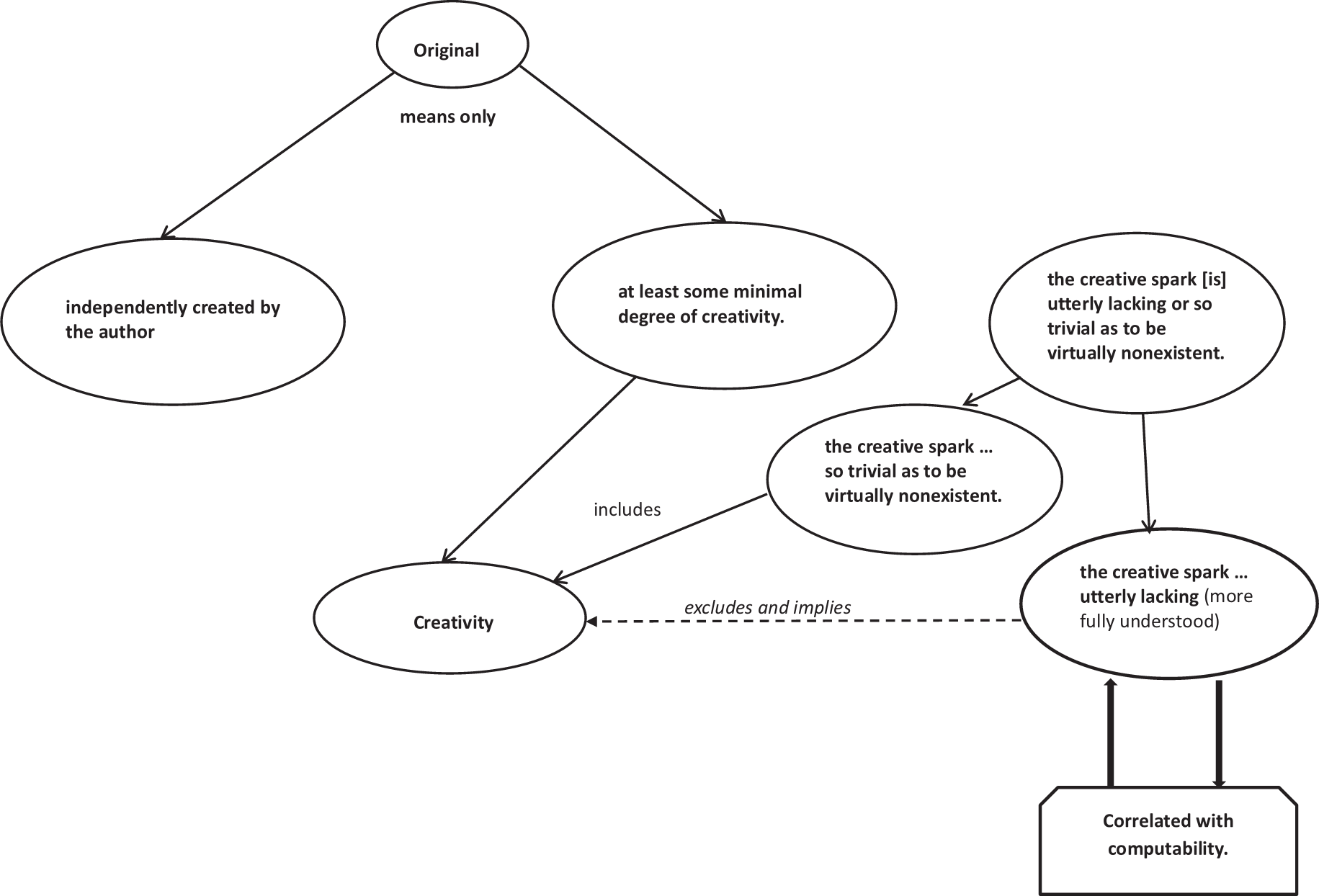
Figure 6.1 Path to be taken
Note. Bold is used for terms and phrases directly derived from the decision.

