Creativity utterly lacking
The delineation of ‘not original to’ (Feist Publications, Inc. v. Rural Tel. Service Co., Inc., 1991, p. 363) can be scrupulously studied, with close attention given to all significant clauses.
So mechanical or routine
The not original is introduced at the beginning of the ratio decidendi.
The question that remains is whether Rural selected, coordinated, or arranged these uncopyrightable facts in an original way. As mentioned, originality is not a stringent standard; it does not require that facts be presented in an innovative or surprising way. It is equally true, however, that the selection and arrangement of facts cannot be so mechanical or routine as to require no creativity whatsoever.
(Feist Publications, Inc. v. Rural Tel. Service Co., Inc., 1991, p. 362)
The clause immediately characterizing the not original is, ‘so mechanical or routine as to require no creativity whatsoever’ (p. 362). The reference of the clause is directly to the absence of creativity, ‘no creativity whatsoever (p. 362)’. As such, it constitutes a characterization of the absence of creativity in its strongest or most central sense, corresponding to the ‘creative spark ... utterly lacking’ (p. 359). The meaning of the content-bearing terms, ‘mechanical’ and ‘routine’ and the relation between them needs to be considered.
Neither mechanical nor routine occur elsewhere in the decision, and in their unique occurrences, are not accompanied by citations or other indications of intended specialized or technical senses. They can then be understood in their ordinary discourse senses. These can be illuminated by definitions taken from a monolingual dictionary, understood as a register of acceptable usages. A culturally and chronologically proximate source is, Webster’s Third New International Dictionary of the English Language, in its immediately preceding edition.
Mechanical is there defined as, ‘done as if by a machine: seeming uninfluenced by will or emotion: automatic, involuntary’ (Webster, 1981). The clause, ‘done as if by a machine’, is given first in the definition, with the other and subsequent clauses acting as elaborations or illuminating qualifications on it. The sense, ‘done as if by machine’ can then be regarded as the primary meaning of mechanical in ordinary' discourse and adopted to interpret its occurrence in the decision. The qualification within the definition, ias i f by machine’, implies the inclusion of processes conducted by direct human work, but by a human acting mechanically, and of direct machine work. The definition of routine, as an adjective corresponding to its use in the decision is, ‘of a commonplace or repetitious character: ordinary, usual’ Webster, 1981), and this sense can also be adopted.
The qualifier ‘so’ in ‘so mechanical or routine’ applies directly to ‘mechanical’ and indicates that the term is to be understood in its most intense sense. It could also legitimately be understood as qualifying ‘routine’. ‘[S]o mechanical’ and ‘routine’, then, are distinct, but not contradictory, in meaning, and have a common referent in ‘no creativity whatsoever’ (Feist Publications, Inc. v. Rural Tel. Service Co., Inc., 1991, p. 362).
The linking of semantically distinct terms by ‘or’ does not strike a native reader of written English as dissonant, but emerges as unusual when compared with other occurrences of or within the decision and with its customary use in written English. The expression or is used within the decision with semantically overlapping or contiguous adjectives or adjectival clauses for instance, ‘humble or obvious’, ‘utterly lacking or so trivial’ (Feist Publications, Inc. v. Rural Tel. Service Co., Inc., 1991, pp. 345, 359). Orin ordinary modern English language written discourse is most commonly used to link semantically strongly overlapping terms (Metaphysics Research Lab, Stanford University, 2020). The unusual linking of semantically distinct terms is significant as it affects the relation and the preferred logical translation for the ‘so mechanical or routine’.
The expression or has been translated from discursive prose into formal logic in two contrasting ways. In early modern logic, with Boole (1854), it was translated as an exclusive disjunction [either (p AND NOT- q) or else (NOT- p AND q)], but this was subsequently transformed into an inclusive reading (p OR q).[1] The inclusive reading includes the exclusive disjunction, but also includes the conjunction or AND, which was excluded from the exclusive disjunction. The crucial point of difference is then the inclusion or exclusion of the conjunction. Studies suggest that uses of or corresponding to exclusive disjunction in ordinary language are not common and that it is normally inclusive (Metaphysics Research Lab, Stanford University, 2020). With formulations with semantically overlapping terms, the expectation would be that the overlap or conjunction of the terms would normally describe most of the referents to be included, with some few only having one characteristic of belonging to the exclusive disjunction of the terms. ‘[S]o mechanical or routine’ contrasts with such uses, as the content bearing terms are semantically relatively distinct rather than immediate alternatives. The expression ‘or’ (p. 362) in the decision would, then, normally predispose a logical translation towards an inclusive reading, but this predisposition must be qualified by the unusual semantic distinctness of the conjoined terms.
The particular logical translation for the ordinary language clause ‘so mechanical or routine’ is crucial as it leads to highly significant contrasts in the scope of the absence of creativity. The most extensive semantic scope would be given by logical OR, with negation, conjunction, and exclusive disjunction more restricted. Alternatives can be progressively considered and eliminated.
- • Negation. Negation of both terms can be definitively eliminated from a reading of the ordinary language expression ‘or’ (p. 362) either as an exclusive disjunction or as inclusive.
- • Conjunction. Conjunction, so mechanical AND so ... routine, can be rejected as an exclusive reading, on the received understanding of or as corresponding to either an exclusive or inclusive disjunction.
- • Exclusive disjunction. A reading that was intended to be restricted to exclusive disjunction could have been easily marked, without departing from ordinary language. An exclusive disjunction could have been phrased as, either so mechanical or else so routine, without loss of clarity or a departure from ordinary discourse. The commonality of reference, to ‘no creativity whatsoever’ (Feist Publications, Inc. v. Rural Tel. Service Co., Inc., 1991, p. 362), also does not favor reading as an exclusive disjunction, which would normally require two separate referents, or a single referent with a dual aspect, to remain true when one term does not apply. Semantically, OR as an exclusive disjunction can be used for exclusive or contradictory terms. The terms mechanical and rotitine were not semantically contradictory or exclusive, on the reading established here. A reading of ‘or’ in ‘so mechanical or routine’ as restricted to exclusive disjunction is then not favored, by a reading of the expression, reference, or semantics of the decision.
- • Inclusive disjunction.The expression oris used elsewhere within the decision in a clearly inclusive sense, although for semantically overlapping or contiguous adjectives or adjectival rather than distinct terms. The absence of a semantic contradiction between mechanical and routine, on the meanings established, still allows for the inclusion of a reading as a conjunction (a contradiction would normally debar a conjunct reading). An inclusive reading, which would include conjunction and exclusive disjunction, can then be accepted, in accord with modern practice.
‘[N]o creativity whatsoever’ (Feist Publications, Inc. v. Rural Tel. Service Co., Inc., 1991, p. 362) is then best understood as something which is so mechanical OR routine, with the qualifier ‘so’ applying directly and strongly to ‘mechanical’ and indirectly to ‘routine’ (p. 362) (see Figure 4.2).
Within so mechanical OR routine, the conjunction, so mechanical AND routine, can be understood as the strongest or most intense sense, as both substantive terms are realized. So mechanical AND NOT routine can be understood as the next most intense sense, as the primary term is realized. So ... routine AND NOT so mechanical can be understood as the least intense sense, as only the secondary term is realized. The relative semantic distinctness of ‘mechanical’ (Feist Publications, Inc. v. Rural Tel. Service Co., Inc., 1991, p. 362) and ‘routine’ has, then, been incorporated and transformed into a recognition of difference intensities of senses within the inclusive OR reading. The different intensities of senses distinguished are also in accord with the normal distribution of combinations in a truth table.
The terms directly qualified by ‘so mechanical or routine’ (Feist Publications, Inc. v. Rural Tel. Service Co., Inc., 1991, p. 362) are the nouns, ‘selection and
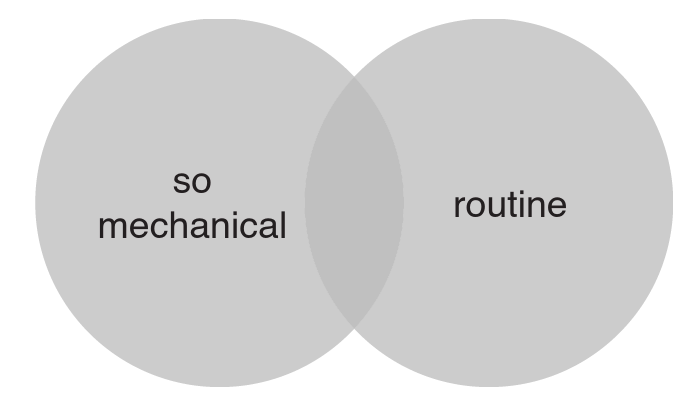
Figure 4.2 Logical representation of so mechanical or routine
arrangement’ (p. 362), which could be understood as both processes and as a product. In turn, these noun forms refer back to the verbs ‘selected, coordinated ... arranged’ (p. 362), directly referring to processes. ‘[S]o mechanical or routine’ (p. 362) and ‘no creativity whatsoever’ (p. 362) must then be understood as having a strong underlying reference to the processes of selection, coordination, and arrangement, but also as qualifying the products of those processes.
In summary, both ‘mechanical’ and ‘routine’ could be understood in central ordinary discourse senses. Intensity was conferred directly on the mechanical by so and indirectly on the routine. An inclusive OR was the preferred logical translation for ‘so mechanical or routine’ (Feist Publications, Inc. v. Rural Tel. Service Co., Inc., 1991, p. 362), with different intensities of combination distinguished within the inclusive OR. The primary concern was with processes lacking creativity.
- [1] Consider the parody of the use of or as an exclusive disjunction by Lewis Carroll (1871/1998, p. 213). ‘It’s long,’ said the Knight, ‘but very, very beautiful. Everybody that hears me sing it - either it brings the tears into their eyes, or else ‘Or else what?’ said Alice, for the Knight had made a sudden pause. ‘Or else it doesn’t, you know.’

