Macroeconomic quantitative analysis
There was a Cambridge contribution to the early empirical work in macroeconomics. In only the fifth ever article to be published with estimates of the parameters in a consumption function,[1] Clark (1938) used quarterly time series data from 1929(Q1) to 1937(Q4) to estimate

The sixth article to be published that estimated consumption functions (Stone and Stone 1938) used both cross-sectional and time series data and experimented with a number of functional forms for different countries: For crosssectional data:
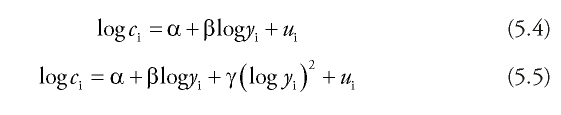
For time series data:

Stone returned to the subject in Stone (1942) where he used annual US time series data to estimate

Further work by Stone and other colleagues will be presented in Section 5, where the work of the DAE is discussed.
Keynes and Econometrics
Most discussions of this topic concentrate on the Keynes versus Tinbergen controversy, but there were some interesting interventions by Keynes before that exchange in the context of two earlier empirical studies of the marginal propensity to consume (MPC).
Keynes and the MPC: In The General Theory, Keynes does provide an algebraic formulation for the propensity to consume, but in very general terms:
We will therefore define what we shall call the propensity to consume as the functional relationship X between Yw a given level of income in terms of wage-units, and Cw the expenditure on consumption out of that level of income, so that

The amount that the community spends on consumption obviously depends (i) partly on the amount of its income, (ii) partly on the subjective needs and the psychological propensities and habits of the individuals composing it and the principles on which the income is divided between them (which may suffer modification as output is increased) (Keynes 1936 [1973]: 90—91; italics in original).
Soon after the appearance of The General Theory in 1936, there were publications by Hans Staehle (Staehle 1937) and Elizabeth Waterman Gilboy (Gilboy 1938) which both accused Keynes of not taking the distribution of income sufficiently into account (see Thomas 1992).
Staehle, in the first published article to estimate a consumption function (see Thomas 1989), set out specifically to test two propositions: first, that the MPC declined as income increased, and secondly, that the distribution of income was important. He set up the regression equation

and using quarterly macroeconomic data for Germany and plausible proxy variables for consumption and the price level he obtained results consistent with his two hypotheses.[2] Staehle argued that ‘the regression equation...shows, as everyone would expect, that the proportion of income spent on consumption goods increases when income ceteris paribus diminishes . The more income is concentrated in the hands of receivers of large incomes, the smaller.. .will be the proportion of total income spent on consumption goods’ (Staehle 1937: 141).
In contrast to Staehle’s use of regression analysis, Gilboy’s approach was less technical: she plotted cross-sectional data on household expenditure and incomes on double logarithmic paper and fitted free-hand curves to estimate the elasticity of expenditure with respect to income. On finding that the best fitting curves were non-linear, she concluded that income distribution would affect consumption behaviour.
Keynes’s reacted to both articles (Keynes 1938a, b, 1939a). His main objection was that both critics had ignored his discussion of the MPC in The General Theory, which clearly allowed for income distribution to have an effect. Both critics accepted this point and in her response Gilboy (1939: 633-634) quoted from a letter Keynes had written to her in which he stated that:
I give reasons for expecting that, as a rule, a greater proportion of income will be saved, as real income rises. This is a mere statement of opinion, which requires more statistical examination than I have given it, not the law which I am taking as my premise; ... My argument does not require, of course, that this rule holds good of every individual or even of every class, but only of the community as a whole; and it is subject to the usual ceteris paribus clause; though I should distrust any statistics which seemed to show the contrary as applying to a whole class.
Keynes versus Tinbergen: This controversy proceeded in three stages: (i) there was correspondence between Keynes and one R. Tyler at the League of Nations after Tyler had sent Keynes a proof copy of Tinbergen (1939) for comment. Keynes’s negative comments were passed on to Tinbergen and there was some correspondence between Keynes and Tinbergen; (ii) the debate became public when Keynes published a critical review of Tinbergen’s book in the Economic Journal, followed by an exchange of comments (Keynes 1939b, 1940; Tinbergen 1940); and (iii) the debate was extended when a number of econometricians wrote to Keynes following the publication of his review and the exchange of comments with Tinbergen.11
While the debate ranged over many issues, the one that Keynes pressed most strongly was that when using time series to estimate the parameters ‘the method requires not too short a series, whereas it is only in a short series, in most cases, that there is a reasonable expectation that the coefficients will be fairly constant’ (Keynes 1973: 294). In addition to this general objection, Keynes raised the following questions and suggestions:
- • How was the functional form to be chosen for a given theory? Was linearity a plausible assumption for economic models?
- • Were the set of explanatory factors a complete or only a partial set?
- • Were all the explanatory factors measureable? What about expectations and the state of confidence relating to the future?
- • Were the explanatory factors independent of each other?
- • Might there be a problem of simultaneity?
- • Given that Tinbergen had data for 40 years, might he not have fitted his model to each decade and compared them with those obtained for the complete period?[3] [4]
The early reactions of mathematical economists and econometricians to Keynes’s criticisms tended to be hostile. Paul Samuelson in his obituary of Keynes (Samuelson 1946)[5] wrote:
I must confess that my own first reaction to the General Theory was not at all like that of Keats on first looking into Chapman’s Homer. No silent watcher, I, upon a peak in Darien. My rebellion against its pretensions would have been complete except for an uneasy realization that I did not at all understand what it was about. And I think I am giving away no secrets when I solemnly aver — upon the basis of vivid personal recollection — that no one else in Cambridge, Massachusetts, really knew what it was about for some 12 to 18 months after its publication. Indeed, until the appearance of the mathematical models of Meade, Lange, Hicks and Harrod there is reason to believe that Keynes himself did not truly understand his own analysis (ibid.: 187—188).
Lawrence Klein (Klein 1951) in reviewing Harrod’s The Life of John Maynard Keynes (Harrod 1951) wrote:
In econometrics Keynes was even less well versed, his presidency of the Econometric Society in 1945 notwithstanding. His review of Tinbergen’s celebrated study for the League of Nations was one of his sorriest professional performances. Many econometricians have remarked on Keynes’s review with the comment that he simply did not understand the methods he was criticizing and failed to see at what Tinbergen was aiming, a type of comment Keynes frequently used to characterize his own critics. Ironically enough, much of Keynes’s greatest support has come from econometric testing and applications of his theory. This work will continue in the future and may play a major role in perpetuating or extending the theory of employment (Klein 1951: 450-451).
More recently, commentators have tended to be kinder to Keynes. For example, Stone (1978), while not accepting Keynes’s criticisms, provides a possible explanation of why Keynes was so violent at times in his criticisms of Tinbergen:
Up to a point the explanation may lie in Keynes’s state of health. In 1937 he had had a severe heart attack; and the summer of 1938, when he received Tinbergen’s proofs, must have been a particularly bad moment for him to be faced with an approach to economics so very different from anything he was accustomed to. But this does not justify the virulence of his remarks. While not pretending to know the full answer to the puzzle, I have three suggestions to offer.
First, Keynes suffered from an irresistible urge to overstate ... Both by temperament and by training he was heir to the great rhetoricians of the nineteenth century ... Second, as I have said, by the thirties Keynes’s mathematics had become pretty rusty ... Third, in my experience Keynes’s reaction to anything new was to look for the weak spots and shoot them full of holes (ibid.: 62—63).
More positive is Hendry (1980):
Forty years after Keynes wrote, his review should still be compulsory reading for all who seek to apply statistical methods to economic observations. Taken literally, Keynes comes close to asserting that no economic theory is ever testable, in which case, of course, economics itself ceases to be scientific — I doubt if Keynes intended this implication. However, his objections make an excellent list of what might be called “problems of the linear regression model”, namely (in modern parlance): using an incomplete set of determining factors (omitted variable bias); building models with unobservable variables (such as expectations), estimated from badly measured data based on index numbers (Keynes calls this the “frightful inadequacy of most of the statistics”); obtaining “spurious” correlations from the use of “proxy” variables and simultaneity as well as (and I quote) the “mine [Mr Yule] sprang under the contraptions of optimistic statisticians”; being unable to separate the distinct effects of multicollinear variables; assuming linear functional forms not knowing the appropriate dimensions of the regressors; mis-specifying the dynamic reactions and lag lengths; incorrectly pre-filtering the data; invalidly inferring “causes” from correlations; predicting inaccurately (non-constant parameters); confusing statistical with economic “significance” of results and failing to relate economic theory to econometrics. (I cannot resist quoting Keynes again — “If the method cannot prove or disprove a qualitative theory and if it cannot give a quantitative guide to the future, is it worth while?”) (ibid.: 396).
Perhaps Hendry is overly generous, but in the light of recent problems with economic modelling and forecasting, his case seems much stronger than that of either Samuelson or Klein.
- [1] See Thomas (1989: 146).
- [2] Here R is an index of retail sales in nominal terms, as a proxy for consumption, YL is aggregate labourincome in nominal terms, Pw is an index of wage rates, and B is a measure of income inequality definedon median incomes. If the MPC declines with increasing income and income distribution matters, thenboth в and P2 should be negative, which they were. Staehle published his data, and when I reran hisregression it yielded stable estimates and performed well against the standard specification tests (seeThomas 1992).
- [3] For the details of the debate, see Garrone and Marchionatti (2004).
- [4] If we contrast Keynes’s negative reactions to the studies of the MPC and to Tinbergen’s business cycleanalysis, the issues targeted are very different. In the MPC exchanges, Keynes’s major concern was toavoid too narrow an interpretation of the MPC and he did not comment on or criticise the statisticalanalysis used in the studies by Staehle and Gilboy. In his response to Tinbergen’s work, his own theoriesare not in question and he was able to take a broader view of the dangers he saw in the application ofmultiple correlation analysis to economic theorising.
- [5] In the opening footnote, Samuelson writes that ‘I owe much in what follows to discussions with myformer student, Dr. Lawrence R. Klein’ (Samuelson 1946: 187, fn.1).

