Inequality Measurement and Atkinson (1970)
The state of the analysis of income distribution prior to the 1970s was well summarised by Tony himself: ‘[D]espite the wide use of [various inequality] measures, relatively little attention has been given to the conceptual problems involved in the measurement of inequality and there have been few contributions to the theoretical foundations of the subject’ (Atkinson 1970: 244). His own analysis remedied this. It is no exaggeration to say that Tony’s path-breaking 1970 Journal of Economic Theory article has totally changed the way in which economists, and more generally social scientists, think about these issues by providing the foundations of the modern theory of inequality measurement.
The 1970 article made three crucial contributions. The first was theoretical—a conceptual breakthrough relative to the tradition. By emphasising the welfare economic foundations of inequality measurement, Tony brought income distribution analysis back into the realm of economic analysis. Tony made his own the observation by Dalton (1920) that some concept of social welfare underlies all measures of inequality. With his arguments for making the normative features of different inequality indices explicit, Tony destroyed any idea that choice of a specific inequality index was a value-free (or irrelevant) ‘statistical’ choice.
Tony proposed evaluation of an income distribution y using a ‘social welfare function’ that is an additively separable and symmetric function of each person’s income:
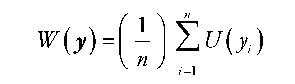
where U(y,) is an increasing and concave function of each person’s income. Thus, social welfare increases if the income of any one person increases, other things being equal (the Pareto Principle). A social preference for equality is also incorporated by the concavity assumption: it means that a rank-preserving income transfer from a richer person to a poorer person increases social welfare, other things being equal (equality preference). When U(y) is taken to represent utility, Tony’s formulation is consistent with the utilitarian social evaluation function that has long been at the heart of most welfare economics, theoretical and applied. But the utilitarian reading is only one possible interpretation of a formulation that is far more general. As emphasised by Tony in later reflections on developments sparked by his 1970 paper, ‘the analysis is quite consistent with a variety of views about principles of economic justice’ (Atkinson 1983: 5).
Tony showed how commonly used inequality indices were special cases of this general specification and how they each quantified assumptions about equality preference in different ways. In particular, some indices are relatively sensitive to income differences at the bottom of the distribution, some are middle-income sensitive, and some are top-income sensitive. Some indices are not consistent with the evaluation function at all.
Tony’s second contribution was also conceptual, but with decisive practical consequences. He devised a straightforward means of checking whether two distributions could be ordered in terms of their inequality according to all standard inequality indices (those consistent with the social welfare function above). In other words, he provided a means of drawing unanimous conclusions about inequality differences even if there was not unanimity about the precise form of the social welfare function—a so-called ‘dominance’ result. Tony proved that unanimous inequality orderings were equivalent to non-intersection of Lorenz curves for each distribution. (The curves introduced by Lorenz (1905) plot cumulative income shares against cumulative population shares, where the population is ordered from poorest to richest and the cumulation is from the bottom upwards.) As a corollary, intersecting Lorenz curves are a warning about the consequences of drawing conclusions from a single inequality index.
The power of Tony’s argument was to show how straightforward graphical devices such as the Lorenz curve and its higher-order derivations have important implications from both a normative standpoint (illustrating the extent of the restrictions of the social preferences that are necessary to order two distributions) and a statistical standpoint (showing why different inequality indices may lead to contradicting results). Although the Lorenz curve had been a well-known tool since its introduction, its normative interpretation had been missed by researchers.
Tonys third contribution was the one with the most explicit practical implications. He provided a new class of inequality measures in which, for the first time, different attitudes to equality preference were incorporated explicitly via a single parameter which could be straightforwardly interpreted as the ‘degree of inequality aversion’: the greater the aversion, the more weight that is given to differences in income at the bottom of the distribution relative to those at the top. To do this, Tony introduced the concept of the equally distributed equivalent level of income (yede) which is ‘the level of income per head which if equally distributed would give the same level of social welfare as the present distribution’ (Atkinson 1970: 250). He proposed measuring the degree of inequality I as the proportionate shortfall of the ‘equally distributed equivalent’ income from the mean income ^ (i.e. the per capita income consistent with complete equality of income):

Tony’s class of inequality measures was derived by combining this specification with a single parameter functional form for the U(.) exhibiting constant relative inequality aversion.
Tony’s article has had a huge influence on subsequent theoretical and empirical analysis. It has stimulated a whole new field of enquiry in which authors have sought to develop his ideas (more about these developments shortly). Empirical researchers now routinely use Lorenz dominance checks and calculate Atkinson’ inequality indices as part of their standard ‘tool box’, whether looking at inequalities of income, wealth, or consumption expenditure. For example, the US Bureau of the Census publishes estimates of three Atkinson indices annually in the US official income distribution statistics (the ‘P-60’ series).
Tony’s application of the most recent advances in the probability distribution theory literature about measurement of risk to income distribution analysis was an exemplar of cross-fertilisation, a remarkable case of how lateral thinking can lead to innovative and original results. His derivation of the link between unanimous inequality orderings and Lorenz curve configurations was new. Some of Tony’s results were derived independently by Serge Kolm (1969) at much the same time, and Tony himself acknowledges this in his article. However, as Lambert (1993: viii) puts it, ‘it was Tony Atkinson who (in 1970) captured the imagination of the profession and showed the possibilities for implementation of the new measurement techniques’.
Before discussing how the profession, and Tony himself, developed the 1970 article’s contributions, it is important to state that they have cross-fertilised other fields in public economics. Analysts often use Tony’s conceptualisation of the social welfare function incorporating different social attitudes parametrically when assessing outcomes in their models. For example, Tony’s discussion of the value judgements implicit in income distribution comparisons resurfaces in contemporary analysis of economics of climate change. (See, for example, Stern’s (2008) Ely Lecture to the American Economic Association which draws on the article subsequently published as Atkinson and Brandolini (2010).)
Tony’s 1970 article has also had a very large impact in economics more generally, as evidenced by frequency of citation. When assessing ‘what has mattered to Economics since 1970?’, Kim et al. (2006: Table 2) report that Atkinson (1970) was the 36 th most cited article among the 146 articles published in 41 prominent economics journals between 1970 and 2002 that had received more than 500 citations up to June 2006 (citations recorded in ISI Web of Science/SSCI). Atkinson (1970) is the most cited welfare economics article in the list.

