Economic Analysis in 'Of Population and Provision'
The Interdependence of 'Provisions' and 'Luxuries'
At the centre of Paley’s argument in ‘Of Population and Provision’ is a clearly thought-out account of the interdependence of production, employment, and population between a rural sector supplying ‘provisions’ and an urban sector (‘flourishing cities...populous towns’ (Paley 1785: 609) supplying ‘luxuries’:
It appears.. .that the business of one half of mankind is, to set the other half at work; that is to provide articles, which, by tempting the desires, may stimulate the industry, and call forth the activity of those, upon the exertion of whose industry, and the application of whose faculties, the production of human provision depends (ibid.).
If a stable equilibrium exists in this system of mutual causation, total population and therefore ‘collective happiness’ may be determined. We can examine this possibility by means of a formal reconstruction of Paley’s text.
Suppose an annual amount of ‘provisions’, P, is produced by the employment of A units of agricultural labour only. Suppose the annual food requirement of each worker is p, a constant of nature. ‘Since the soil will maintain many more than it can employ’ (ibid.: 608), A units of agricultural labour can only be employed if there is an effectual demand for provisions, PD, which exceeds food producers’ own consumption by the amount (P - pA). In a closed economy without government this can come from only two sources: the expenditure on food by workers in other sectors, and the expenditure upon food by landlords for their own and their dependents’ (servants’, retainers’, etc.) consumption.
It is therefore evident that annual production and employment in agriculture can only be sustained if non-agricultural workers and landlords receive and spend the appropriate amounts: ‘The plenty of provisions produced.affords subsistence to individuals only in proportion as it is distributed. Now there is but one principle of distribution that can ever become universal, namely the principle of “exchange”’ (ibid.: 604; italics in original). Hence ‘the sale of provisions depends upon the number.. .of those who have the fruits of some other kind of industry to tender in exchange’ (ibid.: 605-607). Following Paley, who clearly had Mandeville in mind at this point (ibid.: 596; cf. Mandeville (1732 [1988]: Book I, 107-123), we may group all non-provisions as ‘luxury’ goods.
Suppose an annual quantity of ‘luxury’ goods, Q, is produced by the employment of L units of manufacturing labour only. Suppose the annual food requirement of workers in the manufacturing sector, as in agriculture, is p, and the per capita demand for ‘luxury’ goods in each sector is q. Quantities of P goods are measured in bushels of ‘corn’ per annum, and of Q goods in yards of ‘cloth’ per annum. Paley had no explicit theory of production and treated output as demand-determined: ‘the quantity of provision.. .will evidently be regulated by the demand (Paley ibid.: 605; italics added). He recognised that both ‘the husbandman’ and ‘the landowner’ are ‘entitled to [some share of] the produce of the soil’ (ibid.: 609, 610), but he had no theory of rent. We must therefore suppose that rent, R (measured in ‘corn’), is exogenously determined and may treat it as a parameter. Landlords might well spend some of this on the output of the ‘luxury’ goods sector. But to keep the model as simple as possible it will be assumed that all rents are spent on personal services, that all menial servants spend their wages on provisions only, and that Q goods are bought by workers only. The essential ingredients of Paley’s two-sector model of reciprocal demand may therefore be stated as
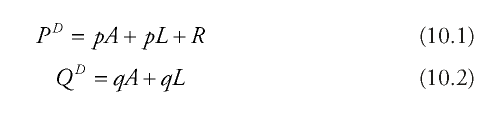
where QD is the quantity of ‘luxury’ goods produced.
It is evident that the amounts of employment in the two sectors, A and L, are the key variables. Also, it is equally evident that Q goods will only be produced if the agricultural sector provides the provisions which L workers require. Paley called agricultural labour productive, manufacturing labour instrumental, but judged ‘both equally necessary, though the one have no other object than to excite the other’ (ibid.: 609).
The question is, what determines employment in each sector? This is not a question Paley was, or could have been, equipped to answer. What follows next therefore is a ‘rational reconstruction’ of his text: not what Paley actually said but what he might have said had he enjoyed the advantages of reading ‘economics’ in present-day Cambridge. Rational reconstruction is not history: but in my opinion, which I have defended elsewhere (Waterman 2003), it can be a useful tool of history.
It is evident that for Paley, employment is an increasing function of the demand for labour, which in turn depends upon the demand for goods. However, it must also depend upon the supply of labour. Paley argued that the supply of labour is a decreasing function of the propensity of workers in each sector to desire ‘luxury’. In a remarkable passage, which is almost certainly the chief source of Malthus’s concept of the ‘preventive check’, Paley noted that ‘men will not marry, to sink their place or condition in society’
(ibid.: 596; italics in original; cf. Malthus (1798: 64ff.). Hence an increase in ‘luxury’ which renders ‘the usual accommodations of life more expensive’ and raises the cost of ‘the established mode of living’, deters marriage and family formation so tending to reduce population and workforce (ibid.: 596).
We may therefore take q as an index of the prevailing degree of ‘luxury’ and suppose that an increase in q (other things being equal) would reduce the supply of labour. Since an increase in PD and QD (other things being equal) would increase demand for labour, we may write sectoral employment as
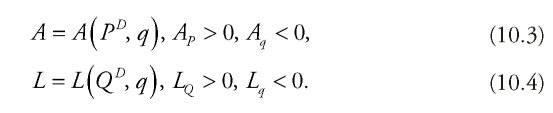
When product demand is satisfied in each sector, we may equate PD with P and QD with Q and represent Paley’s story of the interdependence of provisions and ‘luxury’ goods as
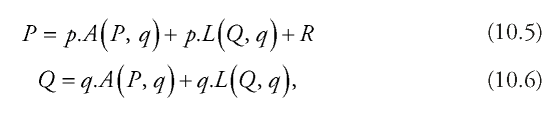
two simultaneous equations in P and Q for given values of the constant of nature, p, the behavioural parameter, q, and the exogenous variable, R.
Let the A and L functions be represented in linear form as A = uP + vq and L = wQ + xq , respectively, where u > 0, v < 0, w > 0 and x < 0 . Let v + x = y, which of course is negative.
Then

where

The simultaneous determination at equilibrium of provisions and ‘luxury’ goods is shown in Figure 10.1, in which the curve labelled P(Q) plots Equation (10.7) and Q(P) plots Equation (10.8). The requirement that Q(P) be steeper than P(Q) is satisfied by the stability condition of the model (see Appendix A).
Given Paley’s social welfare function, ‘rational politics’ must seek to maximise population N, where N = Pip at equilibrium. Therefore, P must be maximised given the biological food requirement, p. In terms of Figure 10.1, this amounts to action which may increase the intercept a, andior increase the slope в, andior increase the (negative) intercept y, andior increase the cotangent S. Since p is biologically determined, we are left with R, with the two technical parameters u and w (which may be regarded as reciprocals of the marginal product of labour in each sector), and the two behavioural parameters y and q, the first of which measures the (long-run) response of population and labour supply to a rise in customary living standards, the second of which is the degree of expected and desired ‘luxury’.
It is clear from Figure 10.1 that an increase in R increases a and hence both P and Q at equilibrium. This is because the greater are rents, other things being equal, the greater the demand for provisions and hence the greater the employment of agricultural workers. Paley argued strongly for private property in land, and for social arrangements which gave incentives to landlords to farm, or at least oversee the farming of their own land, so as to maximise rent (ibid.: 601—603, 633—636).
Paley considered the effects of ‘abridgement of labour’ by ‘mechanical contrivances’ upon employment and population (ibid.: 629-631). Though the immediate effect may be technological unemployment, ‘some more general and remoter consequences’ may ‘increase the demand for work’, hence ‘the quantity of employment, upon the whole, will gain an addition’ (ibid.: 630). Technical progress in agriculture reduces u which lowers a, в, and S, and in ‘luxury’ goods
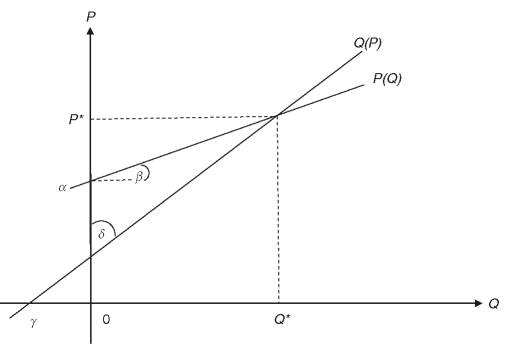
Figure 10.1 The mutual determination of provisions and 'luxury' goods reduces w which lowers в, у, and S. Figure 10.1 therefore captures the initial, technological unemployment, but not the subsequent expansion. This is because the latter depends upon an increase in workers’ incomes, so raising a, the effect of which I have not allowed for in Equations (10.7) and (10.8). For similar reasons the diagram is not able to illustrate Paleys analysis—obviously derived from Hume (1752 [1994]: 118-120)—of the effect of a ‘continual increase’ in the money supply, which keeps wages high while it lasts (Paley ibid.: 619-621).

