The Gladiators: Australians and Cantabrigians
I returned to Cambridge in 1982 to try to carry out one last research project— to document the intellectual history of those we may loosely think of as Keynes’s pupils. I call it ‘Joan Robinson and her circle’, for I want to use her contributions as the focal point around which to put the writings of Kahn, Kalecki, Kaldor, Sraffa, Pasinetti and other gifted people most of whom worked at Cambridge in the Cambridge tradition before and after Keynes’s death (Harcourt 1992: 9).
In this endeavour ‘to carry out one last research project’—as in all his other research projects—GCH was, indeed is, eminently successful. To the six named above, one could easily add, ‘as other gifted people’, David Champernowne, Robin Matthews, Richard Goodwin, Richard Stone, James Meade, Frank Hahn, W.E.G. Salter, Hugh Hudson, Tom Asimakopoulos, John Cornwall, and many others.
Pride of place must, of course, be accorded Joan Robinson (Harcourt and Kerr 2009), whose theories, methods, and visions were brilliantly and as comprehensively—as any one mortal could study this complex, dazzling, scholar—dissected, analysed, and reassembled for relatively easy comprehension, by GCH. In all this there is one diagram that, surely, takes pride of place and, in more ways than can be imagined, for example, by Frank Hahn: the so-called banana diagram (Robinson 1962, figure on p. 48;
1
Harcourt and Kerr 2009: Figure 8.1, p. 130).[1] It is a depiction of almost all the characteristics that define most strands of PKE. Above all, it encapsulates a notion of expectations—what the Swedes like Lindahl and Myrdal called ‘anticipations’—which does not rely on any formalization in terms of conventional probability theories[2]—even logical and subjective ones, including Shackle’s innovative ideas of it, based on ‘potential surprise’.
I believe the whole story of the Keynes-Kalecki-Robinson-based PKE of GCH can be told in terms ofa suitably generalized ‘banana diagram’—including one of the pet topics of GCH: the problem of the trend and cycle.[3] One possible generalization is indicated in Figure 45.1, but I think the ‘full’ dynamics implied in it would be what is called a homoclinic tangle in terms of modern dynamical systems theory. The ‘impredicative’, self-referential, dynamics would imply ‘loops’, curves that ‘cross’ themselves, and this kind of dynamics is alien even to frontier PKE research. But the whole of Chapter II of Robinson (1962) lays out the foundations of GCH-type PKE.
This, I think, is one example of how geometry can encapsulate the thoughts and ideas of scholars like Keynes and Joan Robinson, Harcourt and Kalecki, Wicksell and Myrdal, and many others whose prose was more Forsterian than Bourbakian.
One final point: I believe, almost passionately, that Mabel Timlin was the original Post Keynesian economist. Her geometry in Timlin (1942) was impeccably accurate—perhaps because that geometer par excellence, H.S.M. Coxeter[4] was her ‘draughtsman’! GCH is, I think, in agreement with this view.
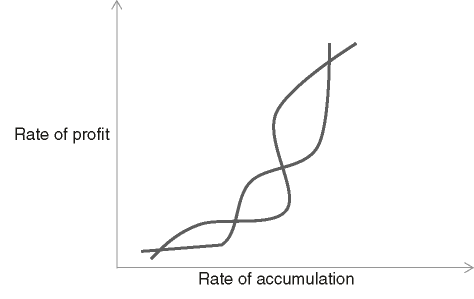
Figure 45.1 A 'generalized' JR-GCH Banana diagram (Source: Cf., also Harcourt and Kerr (2009: Chapter 9, especially Figure 8.1) and Robinson (1962: 48))
- [1] The I curve—a ‘parabola’—in Robinson ‘represents the rate of accumulation as a function of the rate ofprofit that induces it’; it becomes the ‘Animal spirits’ function in Harcourt and Kerr. The A ‘curve’ inRobinson is a straight line, becoming a parabolic arc in Harcourt and Kerr; it ‘represents the expected rateof profit on investment as a function of the rate of accumulation that generates it’, in Robinson. True tothe story of the interaction between the Yogi and the Commissar, Harcourt and Kerr show an interactionbetween actual and realized—really, therefore ex post and ex ante—values of the rate of profit and the rateof growth.
- [2] The most original and knowledgeable review of Keynes (1921) [1973] was by Emile Borel (1924) whoeasily recognized that the formal underpinnings of what came to be known as Keynes’s ‘beauty contestparadox’ was what Poincare called ‘non-predicative definition in the theory of sets’ (ibid.: 58). This is oneother way of characterizing a self-referential statement and no formal theory of probability can deal withit, except algorithmic information theory. It is this formalization that the Post Keynesian economists needto make sense of animal spirits—and Joan Robinson did so, albeit implicitly. She was an intrinsic mathematician, like Sraffa—but a non-orthodox one, again like Sraffa. Goodwin was the only one I am awareof who bracketed the two in this way (Goodwin 1989: 916).
- [3] I am afraid I do not agree with GCH bracketing Goodwin and Kalecki on this; they worked with quitedifferent models and, in fact, Hugh Hudson was more Goodwinian on this issue.
- [4] It was Coxeter who taught Escher the geometry of loops, self-intersecting curves that generate ‘para-doxes’—of the kind that should be common in the PKE underpinned by the economics of Chapter 12

