The development of thinking in childhood
According to the Swiss psychologist Jean Piaget, the evolutionary development of thinking can be seen to continue with the cognitive development of the child. The child's thinking is geared towards adapting to the environment she finds herself in, either by trying to match information in the environment to what the child already knows or by adapting what she knows to cope with novel aspects of the environment. Piaget saw the child's behaviour as based on cognitive structures known as schemas - learned patterns of action or knowledge. An example can be seen in the behaviour of new-born babies whose sucking behaviour is an action schema that gets applied to almost anything that comes near a baby's mouth. This is due to a process he termed assimilation where almost any object becomes transformed into something to be sucked and hence part of the sucking schema. If the baby tries to suck something that is unpleasant or painful then the baby will need to re-evaluate the sucking schema as the new object doesn't seem to fit into it. The child will, therefore, either have to modify the schema to cope with the new object or create a new schema. Piaget referred to this process as accommodation. The way these two processes of assimilation and accommodation balanced out he termed equilibration.
Piaget was interested in the ways in which knowledge developed from neonate to adult (epistemology’), and saw this as coming about through an interplay between cognitive structures, biology, and environment (Piaget & Inhelder, 1958, 1969). Hence, he regarded himself as a ‘genetic epistemologist'. He argued that cognitive development passed through several stages and that intellectual growth was genetically programmed leading to more and more sophisticated forms of thinking. The various stages are shown in Box 2.1.
BOX 2.1 PIAGET’S DEVELOPMENTAL STAGES
Sensorimotor stage: birth to c. two years
In this first stage, babies’ thinking is dominated by the influence of their sensations. They are also far more restricted in their movements and in their ability to interact with their immediate environment than other animals. However, the child is learning about the world by increasing interaction with it through sucking, grasping objects, and gazing at objects and faces. This leads to the ability to play with toys since some toys do interesting things when you hit bits of them or shake them. By the end of this stage, the child has learned that objects are permanent - they still exist even if they cannot be seen.
Preoperational stage: c. two years to c. seven years
The main developmental outcome of this stage is the increasing use of language. By the end of the first year in the previous stage, children can generally use one-word utterances to express complex ideas. These are known as holophrases. ’Mama’ might mean 'where is Mama’, 'Mama is over there’, ‘Mama pay attention to me’, and so on. In the preoperational stage, language becomes much more complex and sophisticated as the child develops.
Also, at this stage, children are learning to manipulate mental representations, although this ability is limited at first to the child’s own point of view (egocentrism). For example, when playing hide and seek, they might hide their eyes while still in full view - if they can't see, then others can’t see either. Certain types of task can be difficult at this stage such as the failure to 'conserve'. When young children in the preoperational stage are shown two rows of marbles (see Figure 2.1) laid out as in row (a) and then the marbles in one row are spaced out as in row (b), they typically say there are now more marbles in row (b) than in row (a). Making mistakes on those problems in everyday life (say, when their brother ends up getting more sweets than they do) eventually creates what Piaget calls disequilibrium: something seems to be jarring in their understanding of the world. To adapt to the world the child will have to accommodate or assimilate new information to get back to equilibrium.
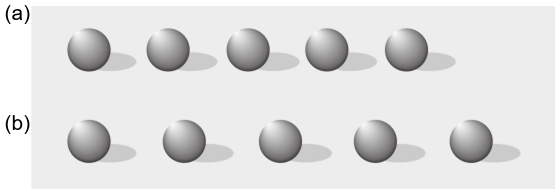
figure 2.1 Preoperational child’s perception of conservation. Very young children will typically say there are more marbles in the bottom line than in the top.
Concrete operational stage c. 7 to c. 11 years
In this stage, children understand that certain kinds of transformations do not alter quantities and volumes which are, therefore, conserved despite transformations. They can, therefore, go beyond the surface appearance of things and can classify objects along more than one dimension such as colour and shape. Their grasp of language and symbolic thought along with an increasing ability to manipulate mental representations allow children to think through sequences of actions leading to a goal before (or without) performing them, or to realize that some actions are reversible - if you can add, then you can also subtract.
Formal operational stage c. 12 years to adulthood
During this stage, children become adults both physically and in their modes of thinking. The phrase formal operations means the ability to perform logical operations on the contents of a mental representation. That is, the young adult can now engage in abstract thought: philosophizing and hypothesizing. Piaget believed that abstract and formal scientific thinking finally develops since thinking becomes more systematic and strategic.
There is plenty of evidence that children's thinking becomes more sophisticated as they develop but, rather than this being due to biologically predetermined stages, it is more likely to be due to developments such as improved psycho-motor co-ordination, increased knowledge of the world, improved information processing speed and efficiency, and automatization - particularly the increasing ease with which children can read (Case, 1985; Halford, 1993). Piaget's description of the stages suggests that nothing much happens in terms of cognitive development after adolescence. However, it is doubtful that a 50 year old sees the world in the same way as a 15 year old. Fortunately. Furthermore, if there are predetermined stages, then practice isn’t going to help as the child will not be ‘ready’. However, there has long been evidence that practice can make a difference in Piaget’s developmental tasks (Baillargeon, 1995; Danner and Day, 1977; Donaldson, 1978). The current information processing view is that many children can demonstrate the abilities Piaget ascribes to a stage at an earlier age than he thought. For example, there is evidence that not only can four- and five-year-old children take the visual perspective of someone else looking at a scene, three-year-old children also show that they know how an object looks to someone else from a different perspective. There can also be large individual differences between children in terms of when children reach certain developmental goals such as object permanence or conservation of number (Field, 1987; Halford, 1982). There can also be differences within children. Egocentrism might be a fleeting event, but conservation might take a while. Other criticisms of Piaget's work include the fact that it was based largely on a small number of children - observations of his own three children (Piaget & Inhelder, 1958, 1969) and those from families of high socioeconomic status. Hence, applying his findings to children in general is not straightforward.
There is also a view that a sizeable minority of adults never reach the stage of formal operations (Gipson, Abraham, & Renner, 1989) while some children get there quite early on. Indeed, very young children are capable of complex deductive inferences in situations that make sense to them. Thornton (1995) presents this example from a child aged about two.
‘Child (very aggrieved): Jack broke my car!
Mother: I'm sure he didn't...
Child: He did! He did! Harry didn't go
there [the playroom] - Jack broke my car!
The interesting point in this accusation is the clear and surprisingly complex chain of inference it involves: if the car is broken, then someone must have done something to break it; if someone broke the car, then they must have been in the playroom (where the car was) at the time. If Jack went into the playroom and Harry didn’t, then only Jack could have broken the car, so he is the main suspect' (Thornton, 1995, p. 14).
Summary
Human thinking is a result of a long evolutionary process, and we can see some antecedents of thought in the animal kingdom. These include tool use, predicting intentions, and a rudimentary theory of mind. Environmental pressures increased the capacity of our brains and hence our capacity to deal with complex cognitive tasks. Our ability to represent the world is so far ahead of other apes that it is qualitatively different. A side effect of larger brains is the time it takes to walk, talk, and learn about the world; defenselessness; and difficulties in childbirth.
Because of the kinds of evolutionary pressures, we encountered in small hunter-gatherer groups, certain topics are more natural to us than others. As a result, we have developed a degree of ‘folk" wisdom and heuristics covering biology, botany, social interaction, and the physical world. These are ‘biologically primary' domains and rely often on Type 1 thinking with Type 2 applied when greater analysis is needed. We also have to adapt the cognitions evolved for biologically primary areas to cope with new ‘biologically secondary' domains such as chemistry, ancient history, statistics, and so on.
While heuristics are viewed as necessary, there are differences of emphasis about their usefulness. On one hand, they might lead to irrational behaviour and on the other, they have helped us survive by making use of stable properties of the environment. According to the EP view, we have evolved a set of specialist cognitive capacities represented by the ‘Swiss Army Knife' whereas the NT view sees our capacities as the coevolution of multiple capacities that are not therefore separate and modular and is represented by the metaphor of the ‘hand’.
The way we have evolved impacts on the ways children’s thinking develops and becomes more sophisticated over time. Piaget proposed a number of stages that children go through to eventually arrive at the stage of ‘formal operations’ where the child can engage in abstract thought and scientific thinking. More recent Neo-Piagetian views see Piaget's stages as developments and improvements in information processing speed and efficiency that come about through maturation.
As we shall see in later chapters, aspects of thinking deemed childlike can persist into adulthood.
Suggested Further Reading
Cosmides, L., & Tooby, J. (2013, 2013/01/03). Evolutionary psychology:
New perspectives on cognition and motivation. Annual Review of Psychology, 64(), 201-229. Retrieved from https://doi.org/10.1146/ annurev.psych. 121208.131628
Geary, D. C. (2005). The origin of mind: Evolution of brain, cognition, and general intelligence. Washington. DC: American Psychological Association.
Heyes, C. (2012). New thinking: The evolution of human cognition [Article]. Philosophical Transactions of the Royal Society B: Biological Sciences, 367(1599), 2091-2096. Retrieved from https://doi.org/10.1098/ rstb.2012.0111

