The new paradigm
Early studies of human reasoning based on the rules of logic did not provide a true picture of the kinds of thinking that humans actually engage in. We rely on what we know about the world rather than, or along with, the syntactic structure
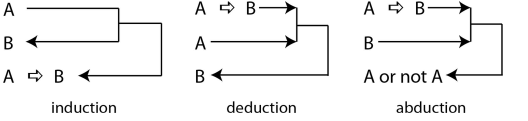
figure 4.2 Diagrammatic representations of different forms of reasoning. In (a) if A is consistently followed by B. then assume A implies B (inductive inference). In (b) given that A implies B. and that A is the case, then B must also be the case (deductive inference). In (c) given that A implies B. and that B is the case, A may or may not be the case.
of arguments, a phenomenon known as belief bias. Since just before the beginning of the century, the focus of research in this area by psychologists has shifted away from the normative rules of logical inference to probabilistic judgements of what a reasonable inference might be, given a set of propositions or premises. This shift of focus has been referred to as a new reasoning paradigm (Elqayam & Evans, 2013) to contrast with the previous deduction paradigm (Evans, 2002). Rather than examining thinking in terms of validity, consistency or truth value, it examines it in terms of our uncertainties when thinking and making decisions. An outcome is not deemed to be binary (will happen - won't happen) but includes a degree of uncertainty (I'm really sure it will happen - I hope it might happen - it probably won't happen), and also what kind of value we place on the outcome (It is really desirable - it could be quite useful - it might be disastrous). It also emphasizes the relative values people place on actions and potential actions.
Elqayam & Evans (2013) describe the new paradigm as being a ‘shift from truth to belief’, from propositions that are either true or false to ‘subjective probability, in which the subject matter is human belief' and where reasoning and decision-making are subject to varying strengths of belief, uncertainty, and subjectivity (Elqayam & Evans, 2013; Elqayam & Over, 2013). People hold beliefs with varying degrees of confidence. Reasoning is, therefore, best understood by taking a Bayesian approach. When we learn to associate A with B through experience or the associations our culture presents us with, we can use them implicitly to make predictions. If our predictions are incorrect, this can lead to confusion. A man rushes to hospital with his son who has been injured. The boy is taken to the operating theatre and the surgeon comes out to look at him and says, ‘I can't operate on him. He’s my son'. If most of the surgeons you have encountered or seen on TV or read about in books are male, then that is the assumption you might make based on prior probabilities. This story is less confusing than it was 40 years ago when there were fewer female surgeons. Bayes' rule is a way of establishing how our prior beliefs or expectations can change as new information comes to light.
Although Bayes' theorem can be used to model changes in beliefs over time with new information, we human beings do not always incorporate new information into our thinking. We diverge from a strict Bayesian description of beliefs and decisions and hence are irrational in that respect. We exhibit biases in our thinking based on prior beliefs that are held quite strongly and when new information is presented that contradict those beliefs we are liable to ignore it or find ways to discredit it. For a person who believes strongly in a God, the prior probability (p) of such a belief would be p= 1. Someone else might have no belief in gods, and so the prior probability of such a belief is p = 0. Donald Trump is someone who does not believe that climate change is real. Volume II of the Fourth National Climate Assessment reported that climate change in the US was already affecting or would affect the environment, the economy, energy production, ecosystems, human health and welfare, and land and water resources. The report was compiled by thousands of people referencing thousands more researchers. Donald Trump said, ‘I don't believe it". His beliefs were not updated after new information was obtained. Sticking to a belief despite contradictory evidence or actively trying to discredit the evidence is an example of confirmation bias and is discussed more fully in the next chapter.

