SOCIETY MADE ME DO IT
Introduction
The representativeness heuristic comes into play when we rely on stereotypes to make judgements such as the probability that a particular person from a defined group has a particular attribute. A stereotype is a collection of associated attributes learned from experience and through cultural transmission. ‘Having a stereotype doesn't make you a racist, sexist, or whatever-ist. It just means your brain is working properly, noticing patterns, and making generalizations' (Payne, Niemi, & Doris, 2018). It is, therefore, very useful but sometimes misleading. Thus, if all the plumbers you have encountered are male, then maleness would be a default attribute when you think of a plumber. Much of the time, this would be a useful culturally derived heuristic which is also indistinguishable from a bias (Hinton, 2017a, 2017b). Representativeness can work in two directions. An individual from a particular group is deemed to inherit the attributes of the group stereotype and hence represent it (see [a] in Figure 6.1). Alternatively, the attributes of a person from a group one is not particularly familiar with can be assumed to represent the attributes of the group (see [b] in Figure 6.1).
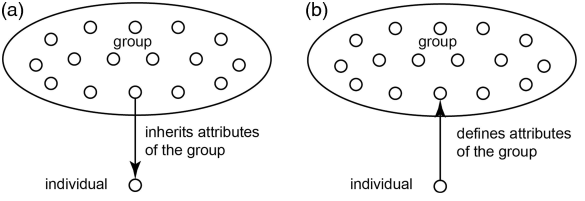
figure 6.i In (a), an individual from a particular circumscribed group is deemed to inherit the presumed attributes of the group (a stereotype). In (b), the attributes of an individual are deemed to be representative of an unfamiliar group the individual comes from.
For example, if you meet a grumpy Bulgarian with no sense of humour, you might conclude: ‘Gosh, aren't Bulgarians grumpy and humourless’. This is an example of the 'liberal induction" we encountered in Chapter 4. Similarly, if a member of a group does something blameworthy, then the group in general may be seen as collectively to blame as often happens, for example, to Muslims. Chinese students in the UK and mainland Europe received racist comments or were even attacked because of the coronavirus pandemic. They somehow 'inherited the attribute' of having the virus due to being part of the same ethnic group as those Chinese citizens 5,000 miles away who had the virus. In April 2020, ISIS gunmen and suicide bombers killed 25 Sikhs in a temple in Kabul in Afghanistan in revenge for India's treatment of Muslims in Kashmir. The Sikhs in Afghanistan inherited the collective blame for what was going on in India. Bias due to stereotyping can affect an individual's judgement of others based on their ethnicity, gender, accent, class, religion, university education, and so on: and judgements of others can have an impact on the success or failure at job interviews or whether they are likely to be stopped and searched by the police. Such biases are often deemed implicit or unconscious and, to ensure that inadvertent discrimination does not take place, there is a perceived need to address them through some form of intervention. To support this endeavour, there are many websites and company development sessions offering ‘diversity training' aimed at helping people overcome their unconscious biases, with race being the primary attribute that tests tend to measure.
There are some assumptions about cognitive biases, both in some studies by Tversky and Kahneman and among those engaged in diversity training. These include the assumption that:
- • They can be measured;
- • Biases are unconscious and that we respond intuitively to information that comes most immediately and automatically to mind;
- • We all possess biases due to the ways our cognitive system operates;
- • They form the basis of much of our attitudes and behaviour;
- • Through diversity training, implicit racial bias can be reduced.
A first stage in some types of diversity training is to measure the strength of any unconscious bias a person might have. This is generally done using an implicit association test (IAT) of some kind (Greenwald, McGhee, & Schwartz, 1998) that measures latencies (slight delays) in responding to words or pictures presented on a computer. Participants might be presented with words for flowers such as ‘rose’ or musical instruments such as ‘violin' on a computer screen and asked to respond as quickly as possible using the word ‘pleasant’, and to respond ‘unpleasant" to insect words such as ‘wasp' or weapons such as ‘hatchet". One might predict that such responses should be quite easy given the nature of the nouns and the attributes implicitly attached to them - such noun-attribute combinations are deemed compatible. There are various ways in which the instructions for this type of measure can be modified; for example, participants might be asked to reverse the associated noun-attribute so that they have to respond ‘unpleasant" to ‘daffodil’ or ‘pleasant’ to ‘gun’. In this case, because these combinations are assumed to be incompatible, the time taken to respond should increase compared to the compatible condition. Results from experiments by Greenwald et al. (1998) showed that significant differences in the latencies between compatible and incompatible word conditions provides evidence that we implicitly associate certain categories of things as being pleasant or unpleasant (experiment 1).
In Experiment 2, they extended this method to assessing evaluative associations between Japanese Americans and Korean Americans since each group were deemed to have negative attitudes towards the other (out-group) due to the historical occupation of Korea by the Japanese in the first half of the 20th century. The stimuli in this case were typical Japanese names and typical Korean names. As expected, the Korean American participants responded more quickly with ‘pleasant' to Korean names than to Japanese names, and with a longer latency when responding ‘pleasant’ to Japanese names.
A third experiment looked at the patterns of attitude difference between Black (African American) and White (European American) subjects again using names typically associated with each group. In this experiment, there was a strong association between White names and ‘pleasant’ rather than Black names and ‘pleasant’. Furthermore, the study included other measures used to compare and evaluate the IAT, the Modern Racism Scale (McConahay, Hardee, & Batts, 1981), and Diversity and Discrimination scales (Wittenbrink, Judd, & Park, 1997). Based on the answers given to these scales, the majority of the White participants had expressed no negative feelings towards African Americans, essentially a Black-White indifference, nevertheless their scores on the IAT suggested a White preference. Thus, the IAT was, arguably, tapping into unconscious bias.

