WHEN THINKING GOES AWRY
BIASES, ERRORS, AND HEURISTICS
Confirmation bias
If you have a belief or assumption about people, objects, situations or whatever, you are likely to notice events or instances that back up that belief or assumption. For example, people mainly read the kinds of blogs, newspapers, Facebook pages, and tweets that say the kinds of things they agree with. You make friends with people who have the same general attitudes as you. When newspapers hear about some finding or other and want to report it, they will often look for examples to back it up. They are unlikely to look for examples that contradict the thrust of their story. Some time ago, there was a newspaper report based on a research finding that successful women in high-power jobs tended to have male offspring. The papers then showed some photographs of successful women in powerful positions who had given birth to boys. They did not provide names or photographs of women in high-profile jobs who had girls.
The tendency to focus on information that appears to back up our beliefs, attitudes, and prejudices is known as confirmation bias, since we do not normally seek to disconfirm them. That said there are some contexts where a belief or hypothesis can be either confirmed or disconfirmed. For example, in law courts, prosecutors present evidence to show that a person is guilty of a crime and defenders present evidence to show that the person is innocent. Scientific method relies on testing a hypothesis on the assumption that there might be evidence against it. If you fail to disconfirm the hypothesis, then you have evidence for it (although not proof). In both cases, law and science, it is the system that ensures that bias is, at least, reduced.
Early studies of confirmation bias
The study of confirmation bias in psychology had its biggest impact in the 1960s when Peter Wason argued that people generally sought to confirm their hypotheses rather than to refute them. A classic study by Wason (1960) was the decision task which involved checking whether a rule was being obeyed. There are many variants, some concrete and some abstract. (The original concrete one used a rule about postage rates in Britain at the time where letters that were sealed required a different postage stamp from letters that were unsealed. Strange but true.) The ‘abstract’ version goes along the lines of the following: There are four cards with letters on one side and numbers on the other. There is a rule that says that if there is a vowel on one side, then there should be an even number on the other. Which card or cards should you turn over to find out if the rule is being obeyed? The situation is shown in Figure 5.1.
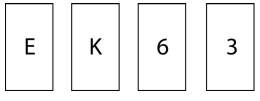
figure 5.1 The Wason decision task.
Most people (about 45% according so some studies) pick the E and the 6 cards. Around 35% pick just the E card. A small number (around 7%) choose the E, 6, and 3 cards. About 4% choose the E and 3 cards. The rest pick a different combination. Let's take them one at a time: The E is a vowel so if there is an even number on the other side, then the rule is being obeyed; if there is an odd number, then it is being disobeyed. So, checking the E card is a good idea. The K. card could have either an odd or an even number since the rule does not mention consonants. Turning the 6 card over could yield a vowel or a consonant but the rule refers only to what happens when there is a vowel - so the 6 card doesn't tell you anything about whether the rule is being obeyed or disobeyed. If you turn over the 3 card and find a vowel then you have shown that the rule is being disobeyed. So, the ones you should turn over are the E and the 3 cards.
As we saw, only about 4% of people get the answer right in this abstract version, but if it is reworded as a more concrete or familiar situation, the choice becomes obvious. Since a version involving postage stamps is no longer familiar, a different everyday version of the task is shown in Figure 5.2. You are a policeman and you are in a pub checking for underage drinking. If a person is under 18, then they should not be drinking an alcoholic drink. There is a table at which are seated a 15 year old and a 45 year old with drinks in front of them, and on the table close by are another two people with another two drinks - a coke and a whisky. What do you check to find out if the rule is being obeyed? In this case, most people have no problem. You would check who is drinking the whisky and what the fifteen year old is drinking to make sure it’s not alcoholic. You are not interested in the 45-year nor in who is
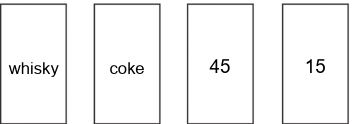
figure 5.2 A concrete version of the Wason task.
drinking the Coke. However, both the abstract version and the concrete one are identical in their structure, so in the abstract version you should turn over the E and the 3 which maps on to the whisky and the 15 year old to see if the rule is being obeyed.
There is a lot more going on psychologically speaking in this task than meets the eye, and many explanations have been put forward for the difficulty of one version versus the easiness of the other. Some have argued that, despite finding the abstract version difficult, we are capable of logical reasoning since we can manage the concrete one. Yet, that simply suggests that we have mechanisms for dealing with specific contexts in the social environment such as permissions and prohibitions (Cheng & Holyoak, 1985) that we have either evolved to deal with or have learned to deal with through repeated experience. If we could deal with the abstract case and hence apply it to any version of the same problem structure, that would make us rational in the logical sense. But we don't. So, we're not. Arguably.

