Types of logical reasoning
Suppose you meet an alien entity called a Zugg. Let’s also suppose, for the purposes of this illustration, that the Zugg ‘squacks’. Later you come across another Zugg and discover that this Zugg also squacks. Later still yet another Zugg crosses your path and - lo and behold! - it too squacks. Sometime after that you meet a fourth Zugg called Gronad. What can you now reasonably assume about Gronad? Why, that it squacks, of course.
To reach that conclusion involves two kinds of reasoning. First, you must have generalized, from the specific examples of squacking Zuggs you have encountered, that Zuggs squack.
You don't even need to know what ‘squack’ means to reason this way. This kind of learning, through your experience of instances of a concept, is an example of inductive reasoning (see also Figure 3.7). However, you didn't stop there. A second type of reasoning enabled you to make the inference that Gronad could squack because you have learned from past examples that Zuggs squack. This kind of inference is a deductive one. Deductive inferences involve applying general rules or laws -what you have learned - to new instances of the learned concept. It is a rational way of reasoning: All Zuggs squack, Gronad is a Zugg, therefore Gronad squacks. It also allows you to assume the conjugation of the verb ‘to squack'. When you encounter new verbs, you can apply what you know about the endings of verbs to the new instance.
Induction is a very powerful mechanism for learning from experience and we are very, very good at it. It is a way of estimating what a population is like based on the sample you have encountered. You end up with an implicit rule such as ‘If it is a Zugg then it squacks’. From experience, we learn similarly that dogs bark, birds fly, swans are white, and so on. Unfortunately, inductive reasoning is not guaranteed to be correct. Some birds don't fly, some swans turn out to be black, and Zuggs don't exist. Furthermore, induction can be either conservative or liberal (or ‘hasty’). If you encounter a Zugg and you recognize that it has certain properties including being greyish in colour, and you encounter a second one that has the features of the first but this one is almost black, is it still a Zugg? You might withhold judgement until you get more information. On the other hand, we can be pretty liberal with our inductions and generalize to what you think an entire population is like based on a single example (see also Chapter 6).
In the figures that follow, an arrow points to an implication (if it rains -» I will get wet) or a state of affairs (-> it is raining). Figure 4.1 represents a situation where, if you encounter A (which could be a Zugg, or lying on a sunny beach, or a lump of coal) and find that it is always accompanied by B (the Zugg squacks; you get sunburn; the coal is black), then you induce a rule that says that when you have A, then you also have B
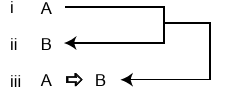
figure 4.1 This represents the fact that when A is the case (line i) and B follows on from it (line ii) as a consequence, then you end up with iii which represents the rule that A implies B.
(if it's a Zugg, then it squacks; if you lie on a sunny beach, then you will get sunburn; if it’s coal, then it's black). That is an inductive inference.
As a result of what you learn about the world through experience or through being told, you can develop rules of this kind. Some of them may well be in the form of a reasonable assumption (John is married to Ekaterina, therefore Ekaterina is married to John), a category (things that happen at committee meetings) or a learned stereotype (what you believe about fundamentalist Christians). Now, there are two things we can do: we can either obey the rule (accept the assumption or stereotype) or we can check whether the rule is indeed valid in which case you are treating the rule as a kind of hypothesis that you can test. Examples might be:
If it rains, then I will get wet
If I ruled the world, every man would be as free as a bird
If I eat my vegetables, then I will live longer
Let us assume for the moment that the statements (the premises) are true and that we want to check the logical consistency of any conclusion we derive from them. Based on such conditional (if...then) statements, we can work out whether something is the case or not. So:
1.
If it rains
Then I will get wet
Given: It is raining
What follows?
I will get wet.
2.
If I ruled the world
Then every man would be as free as a bird
Given: Every man is not as free as a bird
What follows?
I don’t rule the world
Example 1 is valid. The rule says that if it rains then it must follow that I will get wet. Given that it is raining, it must follow that I will get wet. This form of reasoning is called modus po-nens. It's not the kind of reasoning that we tend to get wrong.
Example 2 is valid. Every man is not as free as a bird; therefore, I don't rule the world because if I did rule the world, then every man would be as free as a bird. This is called modus tollens.
Here are some more examples. Again, assume for the sake of the exercise that the original premise in each case is correct. For each one, try to determine whether the conclusion given is valid or invalid.
3-
John keeps going out in the cold without a scarf. If he goes out without a scarf he will catch cold.
Given: John now has a cold
Conclusion: He has again gone out without a scarf. I did warn him!
4-
If you read this book your thinking will be improved
Given: Your thinking is not improved
Conclusion: You read the book, but it didn’t help.
5-
If the animal in front of us meows, then it is a cat.
Given: It doesn't meow
Conclusion: It can’t be a cat
Example 3 is invalid. John may have caught a cold due to not wearing a scarf or for reasons other than not wearing a scarf.
This is a logical fallacy known as affirming the consequent and is one that people fall into when it is disguised and sounds very plausible.
Example 4 is invalid. The statement says that if you read this book, then your thinking must be improved. Therefore, if it has not improved, then you can't have read the book. This is the same argument as Example 2 above. (Bear in mind that we are assuming the premises are correct...).
Example 5 is fallacious. It's the same argument as saying: ‘If I fix people's plumbing then I am employed. I don't fix people's plumbing therefore I am unemployed'. There may be other reasons why the animal in Example 5 doesn't meow. This kind of argument is known as denying the antecedent.
We are capable of judging whether an argument is false or not, but it sometimes involves a lot of effort. It’s a lot easier and less taxing on our poor old WM if we rely on what we are accustomed to, or what we know, or just what seems on the surface to be reasonable. The logical fallacy known as ‘affirming the consequent' (Example 3) is one that we often fall for, but which can often be useful. If A implies B and B is the case, then there may be good reasons to suspect that A is probably the case as well, although this is not guaranteed. It is for this reason that Sherlock Holmes uses this ‘logically invalid" method to reach his conclusions.

