Creative problem-solving
There are some putative differences between ‘normal' problemsolving and creative problem-solving. Many problems have a single solution in the sciences and the goal is to find it. These involve convergent thinking as the aim is to converge on the required solution - the correct answer, in other words. Divergent thinking can involve thinking of multiple possible solutions or exploring a number of options and is often taken as a proxy measure for creative thinking. The distinction was one made by Guilford (1950). There is also a false distinction made between the sciences and humanities where the sciences are seeking ‘the answer" to a problem whereas in the arts, there are multiple answers in novels, paintings, films, and so on. However, this is to confuse an outcome with the process of getting there. There have been many immensely creative scientists, engineers, mathematicians, computer programmers, and so on.
Perhaps a better distinction between creative and everyday well-defined problem-solving is in terms of heuristics and algorithmic processes. Lubart and Mouchiraud (2003) referred to well-defined problems requiring learned procedures or algorithms as ‘canned’ problems. Creative problem-solving produces results or uses methods that are novel, valuable, and ‘non-obvious’ (Amabile, 1996; Simonton, 2011). So, how does one go about doing that? One way is to re-represent the problem, so instead of trying to solve a problem using previously learned methods - what Wertheimer (1945) referred to as reproductive thinking - an understanding of the underlying structure of the problem can lead to productive thinking. An example of this can be seen in Box 3.4.
Problems like the one in Figure 3.8 often require what is usually referred to as ‘insight’. At first, one might try to represent the problem using previous knowledge (reproductive thinking) which would not be useful in this case. You reach an impasse. What's needed is a different way of representing the problem, perhaps by focussing on different features. If you are lucky, you might find a representation that leads directly to the goal, and you have an ‘Aha!’ experience. Gestalt psychologists like Wertheimer believed that insight was a special process as did some later psychologists (Metcalfe, 1986; Metcalfe & Wiebe, 1987). Others believed it could be explained in terms of everyday information processing (Kaplan & Simon, 1990; Ohlsson, 1992; Weisberg, 1986). For example, Ohlsson argued that, based on an initial representation of a problem such as the one in Figure 3.8, we search for mental operators that might apply. If that fails, we reach an impasse and the only way out is to seek another representation, and if that is a useful one then it triggers operators from LTM that we can apply, sometimes quite suddenly. Hence, the ‘Aha!" experience.
BOX 3.4 THE ROSE WINDOW PROBLEM
The problem is to paint the light grey sections surrounding a cathedral's rose window in gold leaf. Unfortunately, gold leaf is very expensive so it’s important to know exactly how much is required which, in turn, requires the painters to calculate the area of the light grey sections (see Figure 3.8).
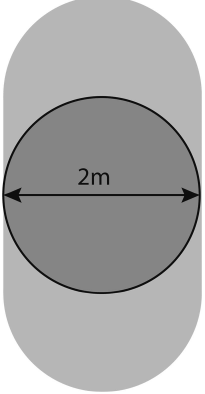
figure 3.8 Calculate the area of the light grey walls. The solution is shown in Figure 3.9.
Another feature of Ohlsson's theory was constraint relaxation. Sometimes we impose constraints on problem-solving that are not there. In the film Men in Black. Will Smith finds himself with a group of applicants for what they believe is a branch of the FBI. They are made to sit in awkward soft armchairs, provided with sharp pencils and told to fill in a form. The Will Smith character realizes that the pencil just pierces and tears the paper so he drags over a very heavy table to his chair so that he can use it to lean on. He has identified an unconscious selfimposed constraint (just sit where you are and fill in the form) and removed it. Needless to say, he gets the job. Insight problems and creative problem-solving often involve getting over such self-imposed constraints. Constraints can also enhance creativity. My children's primary school tried to persuade pupils to walk to school and asked older pupils to write an essay describing their walk - what they saw, heard, or passed on their way. My children lived directly opposite the school gate, so they were obliged to be creative in what they wrote. Problem-solving
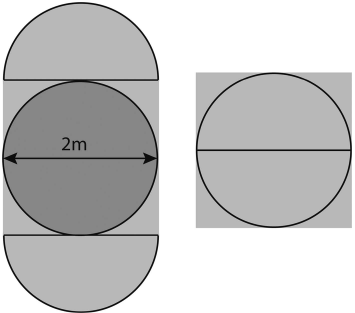
figure 3.9 Solution to the Rose Window problem. The top and bottom of the window form two semicircles 2 meter in diameter. If you imagine them filling the dark circle, you end up with a square 2 meter by 2 meter. So, you need enough gold leaf to cover four square meters.
can therefore be aided by either removing constraints that were incorporated into the initial representation of a problem but weren't explicitly there, or by imposing constraints to enhance creativity such as those, say, in the haiku verse form.
Summary
We are faced with problems of all kinds every day. Whenever you have a goal and you don't know' immediately how to get there, you have a problem. A few are well-defined in that all the information needed to allow you to move through a problem space is provided. You know the initial state, what the goal state should look like, what you are allowed to do to work through the problem (mental operators), and w'hat you are not allowed to do (restrictions or constraints). Most problems, however, are ill-defined and we have to work out what the operators might be and what restrictions there are, and the goal state might be very vaguely defined.
Problems can be hard because our cognitive system is 'bounded' - there are limits to WM, retrieving relevant information from LTM, and so on. They can be made a bit more manageable by breaking them down into sub-goals that are more tractable.
Analogical problem-solving means using a previous problem to help solve a current one. Solving many related problems in a particular domain such as architecture, radiography, and wine-making can lead to the development of a schema for the problem type and, eventually, expertise in the domain.
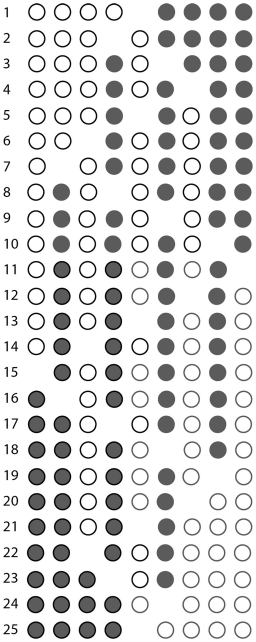
figure 3.10 The solution procedure for the Eight Coins problem.
Creative problem-solving generally involves finding a novel or optimum way of representing a problem. Finding an appropriate analogy, as often happens in poetry, can produce a creative result. Removing constraints that aren't there or imposing new ones can both lead to novel outcomes. For a solution to be deemed creative, it has to be novel, of high quality, non-obvious, and valued by society.
Suggested Further Reading
Newell, A., & Simon. H. A. (1972/2019). Human problem solving (reprint edition). Echo Point Books & Media.
Robertson. S. I. (2017). Problem solving: Perspectives from cognition and neuroscience (2nd ed.). Psychology Press.
Sternberg, R. J., Grigorenko, E. L., & Singer, J. L. (Eds.). (2004). Creativity: From potential to realization. American Psychological Association.

