MOTIVATED COGNITION
MISTAKEN BELIEFS ABOUT
MISTAKEN BELIEFS ABOUT THE WORLD
Naïve physics
You come home on a cold winter's evening to find that your house does not feel warm enough. You have a heating system controlled by a thermostat. What do you do to get warmer? Some people might turn up the thermostat, others might put on a warm jersey. Now, imagine that the thermostat is set at 21 degrees centigrade. The temperature outside the house is below freezing. If you are cold, that would suggest that the heating system is unable to reach 21 degrees. If the temperature cannot reach 21 degrees, then turning the thermostat up to 23 degrees will have no effect since it is not going to reach 23 degrees either. What you end up doing is based on whatever mental model you have of the heating system, and for many of us, this may be based on naive beliefs of some physical systems.
Kempton (1986) argued that people have ‘folk theories' about such systems. He showed evidence that people had either a ‘valve theory' or a ‘feedback theory' of how thermostats work.
The model people had of a thermostat under the valve theory was analogous to a valve in a water pipe. If not enough water is coming through, then open the valve further and more will come out. This is, however, an incorrect model of how a basic thermostat works. It doesn't increase or decrease the amount of heat that comes out, it is simply an on-off switch. (It has been argued that a thermostat has two beliefs: ‘it's not warm enough: switch on' and ‘It’s too warm: switch off". See Thagard, 2014). The feedback model is better related to how a thermostat works. For example, one of Kempton’s interviewees stated: ‘You just turn the thermostat up, and once she [sic] gets up there [to the desired temperature] she'll kick off automatically. And then she'll kick on and off to keep it at that temperature' (p. 80).
A follow-up study of mental models of home heating was conducted by Revell and Stanton (2014). They looked at a much more complicated model of home heating involving the various systems used in the house: gas supply, water supply, boiler (furnace), radiators, boiler control panel, thermostat, etc. They also found valve and feedback mental models being used to understand and interact with the thermostat, as well as other models of the heating system as an ‘integrated set of control devices’. For physical systems, the designer of a device such as a smartphone, or system such as a heating system, has a mental model of how the device should operate. The device itself presents some kind of interface to the user (controls, buttons, computer screen, etc.). Based on the device interface, the user generates their own mental model that may be different from what the designer expected. Three of Revell and Stanton's six participants, for example, had mental models that differed significantly from how the heating system actually worked.
People can have mental models of any number of systems both physical and abstract. Chapter 2 has briefly discussed the idea of‘folk physics’. These are models of how the world works some of which appear to be innate. Yet, despite familiarity with kicking footballs, dropping things, spinning things, and letting them go for dogs to chase, and so on, we can often be unsure of what path the object takes when kicked or dropped or thrown. Box 8.1 has a couple of examples of problems involving motion.
BOX 8.1 LAWS OF MOTION
In Figure 8.1, someone throws a ball into the air. What force is acting on it at A as it rises and what acts on it at B?
Someone holds a high velocity rifle aimed horizontally. A bullet is fired from the rifle and at exactly the same time a bullet is dropped to the ground from the same height as the rifle bullet. Which one hits the ground first?
McCloskey, Caramazza, and Green (1980) wanted to find out what kinds of mental models people with varying degrees of expertise of physics had about simple physical systems. They presented participants with diagrams of curved tubes or of someone swinging a metal ball at high speed above their head. For the curved tubes, they were told that a ball enters at one point and shoots out of the other end (see Figure 8.2). The task was to draw the path the ball would take when it leaves the tube. For the swinging metal ball (see Figure 8.3), they were asked to draw the path the ball would take if it was let go at a particular point. In part (a) in Figure 8.2, two-thirds of
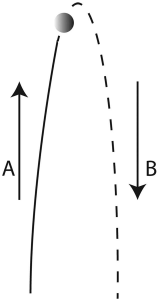
figure 8.1 Path of a ball thrown into the air.
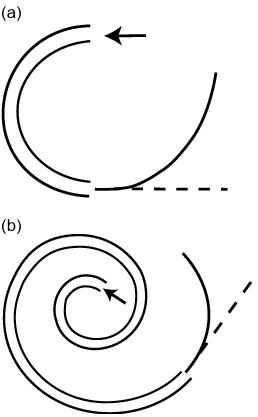
figure 8.2 Examples of figures similar to those used in McCloskey et al.’s studies. A ball enters at the position of the arrow in both figures. Participants are asked to draw the path the ball takes when it shoots out of the curved tubes. These are represented by the solid (curved) lines in the figures. The correct path is shown by the dotted line.
respondents were correct in identifying the straight line path the ball would take on leaving the curved tube (the dotted lines), with one-third drawing a curved path. However, in part (b), more than half assumed the ball would take a curved path. For the spinning ball in Figure 8.3, only slightly more than half indicated the correct path the ball would take. Even some students who had completed physics courses showed evidence of having erroneous laws of motion.
McCloskey (1983, p. 299) argued that naive models of motion were ‘remarkably similar to a pre-Newtonian physical theory popular in the fourteenth through sixteenth centuries'. That is, the mental model people have about moving objects has been attributed to a belief in an ‘impetus theory". Impetus is a kind of force that is acquired from the action of another

figure 8.3 People were presented with the diagram at the top of the figure representing someone spinning a ball on a string above their head. Participants were asked to draw the path of the ball if the string breaks at the point where the ball is in the figure. Slightly over half chose the correct (dotted) path; 30% drew a curved path with a small number drawing other paths.
object such as a hand throwing a ball. This force is passed to the ball and causes it to maintain its motion. According to McCloskey (1983), a folk theory of motion is based on everyday experience, although with some individual differences, and is incompatible with physical principles. Furthermore, the folk theories seem to remain even after physics training. Regarding the faulty model as a theory sounds as if people are consciously applying it, whereas they may simply be relying on their memory of previous experiences. Hence, Kozhevnikov and Hegarty (2001) refer to people using a heuristic rather than a theory. Meanwhile, White (2009) regards this passing of a force as an example of the ‘tendency for the causal object to impose its own properties on the effect object'. For example,
‘someone grasps and lifts an object. Part of what is involved in that causal relation is that the kinematic properties [the direction of motion] of the actor’s hand are imposed on the object' (p. 774). Whichever view one takes, the point is that many people mistakenly see the force acting at point A in Figure 8.1 as something that has been transferred to the ball by the action of the hand causing it to continue to rise. Similarly, the rifle produces a force on the bullet that causes it to continue its motion. In both cases, however, the only force acting on the ball or the bullet is gravity.
Hecht and Bertamini (2000) showed participants a number of diagrams showing a stick figure throwing a ball to another stick figure. These included a semi-circular path, a parabola, a straight line with a vertical drop at the end, a deformed parabola that turns down towards the end of the trajectory, amongst others. People were asked to indicate which path was the most realistic. They were also asked to indicate on a trajectory divided into several sections, where they though the ball was moving fastest. Somewhat to the surprise of the investigators, the point at which people indicated that the ball was moving fastest was at some point after it had left the thrower's hand, often at the apex of its trajectory. In other words, it seemed to have accelerated after leaving the thrower’s hand.
In other more abstract domains, faulty mental models can be dangerous. For example, Meyer (2010) has pointed out that people can have faulty mental models of the damage caused by disasters. People tend to misrepresent the future consequences of not evacuating when a hurricane, flood, or forest fire approaches. Faulty mental models of climate change can have disastrous effects for the entire planet. In a study published in 2007 (but carried out several years earlier), Sterman and Sweeney (2007) reported studies on highly educated MIT graduate students about their understanding of climate dynamics. They found that their mental model of the effects of greenhouse gas emissions caused many of them to favour a wait-and-see policy (much like many politicians):
'Atmospheric CO2 keeps rising even as emissions fall - as long as emissions exceed removal. Because emissions are now roughly double net removal, stabilizing emissions near current rates will lead to continued increases in atmospheric CO2. In contrast, most subjects believe atmospheric CO2 can be stabilized by stabilizing emissions at or above current rates, and while emissions continuously exceed removal. Such beliefs - analogous to arguing a bathtub filled faster than it drains will never overflow - support wait-and-see policies, but violate basic laws of physics’ (p. 236).
Or as Bayne (2013) puts it: ‘beliefs have consequences, and false beliefs can have disastrous consequences’ (see also Chapter 9).
Confirmation bias leads to what Flynn, Nyhan, and Reifler (2017) refer to as ‘directionally motivated reasoning' which is reasoning motivated by one's goals. This can be at the expense of accuracy since goals can distort the choice and evaluation of evidence if they don't fit with our goals (Epley & Gilovich, 2016). Directionally motivated reasoning, therefore, involves both confirmation bias and disconfirmation bias in that it leads people to notice or seek out information that reinforces preexisting attitudes and dismiss and argue against information that contradicts them. As a result, people will find information that backs up their views as more convincing than contrary information.

