Strategic environment and interdependence: Implications on Kenya’s foreign policy interests
The analysis in this section attempts, from a theoretical perspective, to contextualise the factors that determined Kenya’s strategic setting in relation to the strategic environment culminating in the deployment of the KDF in Somalia. In doing so, realism is used as the theoretical point of departure. We specifically proceed from the premise that Kenya’s strategic setting, influenced by the prevailing unstable strategic environment, can be explained within a realist context. By strategic setting, in this context we mean planning and employment of military and economic resources to achieve foreign policy objectives and national interests.16 O’Loughlin (1989: 292) has aptly argued that since the end of the Second World War, “all nations, regardless of location, history, size, political orientations, leadership style, government form, and military and economic strength, were motivated by the same goal—maintenance of world order according to the logic of power". We argue, ceteris paribus, that realism provides useful explanatory values and theoretical tools to epistemologically investigate Kenya’s foreign policy behaviour towards Somalia.
Realism comes into play for two main reasons. First, as we have observed in the chapter, preservation of its territory (sovereignty and territorial integrity) remains the key tangible attribute that has historically influenced Kenya’s foreign policy and foreign policy behaviour in Africa, particularly in the Horn of Africa. Second, as one of the dominant economies (a key national attribute) in the region, stability, peace and security in the Hom of Africa and Somalia in particular are important ingredients for Kenya’s national interest.

Figure 8.1 Strategic environment and its impact on Kenya’s decision to deploy KDF in Somalia. Source: Constructed by the authors (2018).
Figure 8.1 depicts a situation in which the actors such as Kenya and AMISOM are entangled in an interlocking strategic interdependence scenario, by implication influencing their decision to be directly involved in Somalia with the objective of eradicating al-Shabaab and promoting peace and stability as well as the viability and durability of the TFG and the TFIs. Strategic interdependence concerns areas of common interest to actors that influence their individual and collective actions, irrespective of their differences, and which by implication lead to mutually beneficial outcomes for the common good. The multiplicity of actors herein, Kenya included, are directed towards one goal. Specifically, the common good in the context of this study is based on the objective of achieving the Lockean conception of stability, peace and security in Somalia as mandated to the AMISOM by the AU.
By strategic interdependence we mean a systemic environment in which actors (in this case, Burundi, Djibouti, Ethiopia, EU, IGAD, Kenya, Sierra Leone, Uganda and the UN, among others) are interconnected as they pursue their individual and/or collective interests. However, in this study the focus is on Kenya
Kenya's realist foreign policy 127 as the key actor. We take cognisance of the fact that there are more complex geostrategic and geo-political, as well as centrifugal and centripetal factors, involving among other elements, a plethora of actors other than those depicted in Figure 8.1. However, the purpose of Figure 8.1 is mainly to provide a picture of the strategic environment, the strategic interdependence and the strategic setting which have entangled Kenya in its unilateral and multilateral military engagement in its quest to eradicate the key intervening variable, that is, al-Shabaab, and by implication promoting stability, peace and security in Somalia. As demonstrated in Figure 8.1, Kenya, al-Shabaab, and Somalia serve as independent, intervening and dependent variables respectively.
As indicated in Figure 8.1, the individual and/or collective interests include, for example, the elimination of al-Shabaab and the stabilisation of the TFG and its TFIs as well as the promotion and consolidation of peace and stability in Somalia in general. As such, it needs to be reiterated that Kenya’s military involvement in Somalia in 2011 was not a conventional war per se involving state-to-state military exchanges. In other words, Kenya was not at war with Somalia, but was merely engaged in hot pursuit of the al-Shabaab.
The debate surrounding Kenya’s direct military involvement in Somalia centre around a number of the country’s foreign policy interests. Due to uncertainty surrounding the volatility of the TFG that gave space for the growth of al-Shabaab and the movement’s incursions into Kenya, the KDF action can be characterised as falling within the meaning of jus ad bello (just war theory) advanced by St Augustine and St Thomas Aquinas (Kenya, Ministry of Defence, 2014).17
The decision to invoke the right to self-defence against al-Shabaab was approved by the Cabinet Committee on Security and Foreign Relations on 4 October 2011 (Kenya, Ministry of Defence, 2014: 78). When contributing during the debate in parliament on the question of Kenya’s deployment of troops in Somalia, the Minister of State for Defence stated, inter alia:
The KDF in exercise of the right to self-determination under Article 51 of the Charter of the UN engaged the al-Shabaab. This was done in defence of the sovereignty and the territorial integrity of the Republic. Consequently, the KDF launched the Operation Linda Nchi in hot pursuit of al-Shabaab, crossed into Somalia.
(Kenya, National Assembly 2011: at 19)
The deployment of the KDF into Somalia was therefore meant, among other things, to serve the interests of both Kenya and Somalia. Article 51 of the UN Charter places no limitation on "the inherent right of individual or collective self-defence if an armed attack occurs against a Member of the United Nations” (United Nations Secretariat, 1948: Article 51). We argue that where non-state actors carry out terrorist acts across international borders inflicting damage on the sovereignty of the state, as was the case with al-Shabaab against Kenya, the doctrine of self-defence applies. It forms part of general state practice.
The meaning of self-defence and its application as inscribed in Article 51 of the UN Charter, particularly in relation to non-state actors, however, remains contentious among scholars.18 The concepts of self-determination, sovereignty and territorial integrity inscribed in the Minister of Defence’s statement are fundamental for any state’s raison d'etre, including Kenya’s. In practice, states normally invoke the right to self-defence if these same doctrinal principles are threatened by external aggression. Indeed, the protection of citizens is one of the cardinal responsibilities of any sovereign state. In the context of a realist conception of the national interest, military actions conducted in the defence of these same doctrinal principles, implicitly and/or explicitly, promote the prestige of a state in international relations. In its 2014 document, Kenya’s Ministry of Foreign Affairs and International Trade outlined the principles that guide the country’s foreign policy interests and foreign policy behaviour as follows:
Sanctity of sovereignty and territorial integrity of the Republic of Kenya; peaceful co-existence with neighbours and other nations;
resolution of conflicts by peaceful means;
promotion of regional integration; respect for equality, sovereignty and territorial integrity of states; and
respect for international norms, customs and laws
(Kenya, Ministry of Foreign Affairs and International Trade. 2014: 19)
These guiding principles are in line with the general spirit of the Constitutive Act of the AU and the UN Charter among other international instruments recognised under international law.
The Operation Linda Nchi commenced inside Kenya and continued with hot pursuit operations inside Somalia. Later, hot pursuit actions were jointly carried out with TFG forces (Kenya, National Assembly 2011, at 19).19 Principally, instability prevailing in the strategic environment and its inherent ramifications in Kenya influenced the decision to deploy the KDF in Somalia after the frequent al-Shabaab incursions into the country, particularly in the north-eastern and coastal regions of the country. Examples for the latter include attacks at Dadajabula Police Post (2009); the General Service Unit (GSU) in Liboi (2010); Bula Hawa (2011) and Doble (2011); as well as laying mines in Mandera Town (Kenya, National Assembly 2011, at 19). One MP put the threat of al-Shabaab into a broader context, arguing that “the issue of Somalia and al-Shabaab is not a Kenyan problem. It is more of an African, problem, and a world problem” (Kenya, National Assembly 2011, at 19). This suggests that national, regional and global security was simultaneously threatened. The issue of Somalia therefore entangled actors, states or other actors in an interlocking strategic interdependence driven by considerations of realpolitik.
Kenya’s geo-strategic and geo-political interests in the Horn of Africa have remained consistent throughout its independence history (Adar, 2011). The emergence of al-Shabaab and its terrorist incursions in the country explains
Kenya's realist foreign policy 129 this consistency whose historical origins lie in the protracted internal military efforts directed against the shiftas in the 1960s-1970s. In one of its Defence White Papers, the Ministry of Defence outlined Kenya's interests as underpinned by “sovereignty and territorial integrity; national security; economic prosperity and well-being of Kenyans; and national prestige” (Kenya, Ministry of Defence, 2017: 2). The Operation Linda Nchi as explained by one MP was to “protect both our strategic economic interests” (Kenya, National Assembly 2011, at 21). In this context, Kenya’s realpolitik, driven by various attributes of state power which include but is not limited to security, political and economic interests, played key roles in its involvement in Somalia. “The purpose of the operation was to defend the security of the people, the security of the refugees who live among us...; our economy was going to be badly affected” (Kenya, National Assembly 2011, at 22). Specifically, the inflow of refugees into the country from Somalia and the abduction of tourists in Kenya by al-Shabaab had the potential of having a negative impact on Kenya’s economy and the socio-political well-being of the people (Kenya, National Assembly, 2011, at 52).
The inflow of refugees into Kenya from Somalia not only continued to create an economic burden on the country, but the main refugee centres, particularly Dadaab and Kakuma also became the breeding ground for al-Shabaab. Figure 8.2 indicates that by the time the KDF engaged in military operations in Somalia in 2011, the refugee inflow into Kenya had increased markedly, reaching more than 500,000 (after which, between 2013 and 2017, it declined steadily). This is attributable to KDF and AMISOM military operations in Somalia.
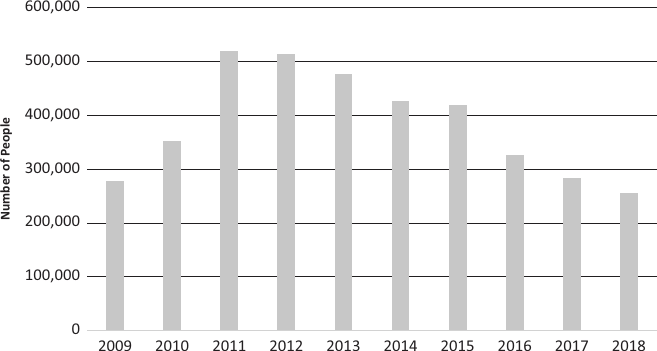
Figure 8.2 Somalia refugee and asylum seekers in Kenya. Source: www.unlicr.org/ke/ wp-content'uploads/sites/2/2018/08/Kenya-Statistics-Package-July-2018.pdf. Accessed 18 November, 2018.
Other than the inflow of refugees into the country, the key concern of Kenya's foreign policy establishment centred on the potentially negative impact of the al-Shabaab incursions on the tourism industry. Some Western countries such as France, the UK and the USA issued official travel warnings to their citizens against visiting Kenya. However, despite this fear, the inflow of tourists remained steady during these years. For example, in 2008, 2009 and 2010, the number of tourists who visited Kenya reached 1,203,224; 1.490,448; and 1,609,110 respectively.20 This accounted for an average of about 4.4% of Kenya’s Gross Domestic Product (GDP). The travel warning by the Western countries as well as the KDF military involvement in Somalia notwithstanding, in 2010 and 2011 the number of tourists who visited Kenya increased from 1,822,900 to 1,873,752 respectively, which amounted to an average of 4.7% of the country’s GDP. These figures declined steadily from 2013 to 2015 (1,434,000 to 1,261,000 to 1,114,000 international visitors respectively) and started rising again in 2016 with 1,268,000 visitors and 2017 with 1,364,000 visitors accounting for an average of 3.9% GDP within this period.
It is important to note that these al-Shabaab related issue areas, with their global, continental and sub-regional (Horn of Africa) strategic interdependence scenarios, characterised by social, economic and political dimensions, have had implications on Kenya’s foreign policy behaviour towards Somalia.
Al-Shabaab remains the key variable that determines strategic interdependence in Somalia, the Horn of Africa and Africa in general, despite the rivalry of the AMISOM troop-contributing countries. In what can be considered as spheres of influence against al-Shabaab in Somalia, the troop-contributing countries are responsible for specific regions within Somalia. In Figure 8.3, while the Burundi National Defence Force (BNDF) contingent is responsible for Bay and Bakool regions (Sector 5), the Djibouti Armed Forces (DJAF) contingent is assigned the Hiiraan and Galgaduud areas (Sector 4). On the other hand, the Ethiopian National Defence Force (ENDF) contingent operates in the Bay, Bakool and Gedo regions (Sector 3), with the KDF contingent responsible for Lower and Middle Juba regions (Sector 2) and the Uganda People’s Defence Force (UPDF) has been assigned Banadir (Mogadishu) and Lower Shabelle areas (Sector 1). The specific areas which the KDF captured between January and September 2012 and controlled thereafter, include Hoosingo town-Lower Juba, the main gateway for al-Shabaab', Fafadun town-Gedo region, Afmadhow town, Miido town, Harbole and Biibi towns, Sooyac and Jana Cabdala towns and Kismayo (Kenya, Ministry of Defence, 2014).
Most of these sectors (as they are known in AMISOM operational and institutional circles) have been liberated, with al-Shabaab engaging in guerilla and terrorist tactics. Kenya’s realpolitik interests shifted from its original unilateral military engagement through the deployment of the KDF in 2011, to one driven by multilateralism and AU AMISOM peacekeeping Track One diplomacy. Track One diplomacy simply means an official or formal interaction of state-to-state, or by representatives of International Governmental Organisations (IGOs) such as the UN, and regional organisations, as well as the Vatican (Mapendere, 2006).

Figure 8.3 AMISOM military contingents’ operational sectors. Source: By Ingoman (James Dahl) own work, public domain, https://c01mn0ns.wikimedia.0rg/w/ index.php?curid=2832784
Kenya joined the AMISOM in 2012 following the adoption of the United Nations Security Council (UNSC) Resolution 2036 (2012) (UNSC Doc. S/RES/2036 (2012)).
Although the short-term objective of Kenya’s military involvement in Somalia was based on the need to protect its territory and citizens from threats posed by the al-Shabaab, the emerging interest in oil exploration along the Kenya-Somalia coastal region was another one of Kenya’s long-term objectives. Conflicts relating to the Exclusive Economic Zone (EEZ) prompted Somalia to sue Kenya in 2014 at the International Court of Justice (ICJ). The TFG argued that its coastal EEZ border is in line with the UN Convention on Law of the Sea (UCLOS). Kenya argued that the ICJ had no jurisdiction over the case. Kenya lost the preliminary case in which the ICJ, inter alia, ruled that it had jurisdiction over Somalia’s application on the delimitation of the maritime boundary dispute between the two countries.21 Notably, this disputed area is contiguous to Jubaland, the KDF operational sector.
Kenya has had a long-term objective and aspiration of establishing a buffer zone between its borders and Somalia, particularly in Jubaland along the Indian Ocean area. The KDF has used the Somali militia in the area, such as the Ogaden Force and the Muaskar Ras Kamboni (Ras Kamboni) Brigade in its war against al-Shabaab. We argue that the multimillion-dollar Lamu Port South Sudan Ethiopia Transport (LAPSSET) corridor, also known as the Lamu Corridor, has also brought a new dimension in the geo-strategic and geo-political strategic interdependence involving the countries in the region. More specifically, the leaders in the region driving the LAPSSET agenda are cognisant of the potential vulnerability of the project arising out of the terrorist activities of al-Shabaab among others, and as such, have to assess their strategic settings carefully in the prevailing strategic environment.22

