Fruits’ Ambiguousness
Critics demonstrate that fruits enjoy no universal acclaim. Their equivocal status may be an evolutionary outcome. An earlier paragraph mentioned that plants use fruit to recruit animals to disperse seeds. This tactic would fail if animals so relished it that they camped by plants to eat all they could stomach. Plants can accomplish the aim of seed dispersal only if they prompt animals to leave after sampling fruit. Tannins, discussed in Chapter 9, and phenols accomplish this goal by imparting bitterness to fruit such that the taste is not pure sweetness.
Fruits’ ambiguities, evident in the juxtaposition of sweetness and astringency and of wholesomeness and harmfulness, were apparent in antiquity (c. 3000 BCE-c. 500 CE). Genesis stated that the Hebrew god Yahweh put the first people in a garden for the man to tend.27 Such language indicated that humans were no longer hunter-gatherers but instead horticulturists. Indeed, the author mentioned nothing about hunting and gathering, as though people had always produced rather than acquired food. If the author meant to convey a time after the hunter-gatherer phase, however, then frugivory was not among Cordain’s “original way of life” from the Hebrew literary perspective. On the other hand, if the author supposed that the first people were gardeners, then frugivory met Cordain’s condition of earliest subsistence within the Hebrew tradition.
The garden had many trees that yielded edibles.28 The writer did not specify them until the woman, answering the serpent, identified them as fruits.29 Even this designation was too imprecise for the exegetes who over the centuries specified several candidates as the forbidden fruit. Most fruits in the garden must have been nourishing, and the author implied that the first people were healthy, the text mentioning neither illness nor death. Yet Yahweh warned against consumption of fruit from a single tree.30 Upon eating it, the woman and man lost their innocence and incurred Yahweh’s anger.31 He expelled them from the garden, made them mortal, decreased the land’s bounty, required them

FIGURE 14.1 Oranges. (Photo courtesy of Library of Congress, https://www.loc.gov/pictures/item/ 2008680464/.)

FIGURE 14.2 Grapefruits. (Photo courtesy of Library of Congress, https://www.loc.gov/pictures/item/ 89712141/.)
to toil for food, and increased the woman’s suffering during childbirth.32 In this story, a single fruit opened Pandora’s box.
Such misgivings have not stopped people from eating fruits, which today are consumed in greater breadth than any other type of food.33 Although American nutritionist Thomas Colin Campbell (b. 1934) urged consumption of whole foods as the best nourishment, as Chapter 13 mentioned, citrus (Citrus species) and apples tend to be imbibed as juice rather than eaten.34 Juices are popular at breakfast, though fiber’s absence prevents them from satiating hunger. Additionally, grapefruit (Citrus paradisi) juice may concentrate medicines—for example, some statins, antianxiety drugs, antihistamines, and hypertension drugs—in the blood and should be avoided without a physician’s approval.35
Nutrients
As noted, many fruits have vitamin C. Chapter 2 discussed its prevention and treatment of scurvy, its antioxidant properties, and its role in helping the body absorb iron. Besides these functions, the body uses vitamin C to synthesize neurotransmitter norepinephrine. Ascorbic acid may improve memory and cognition.36 Although drying increases fruits’ storage, it reduces or eliminates the vitamin.37 Fruits may have additional nutrients, including potassium, carotenoids (vitamin A precursors), and vitamin Bq, though—as witli any food—macro- and micronutrients depend on many factors.
Fruits’ nutritional breadth is evident from the fact that 100 grams of grapes have just 3 milligrams of vitamin C, whereas the same amount of guava (Psidium guajava) has 230 milligrams of it.38 Besides ascorbic acid, Table 14.2 lists fruits with the least and most vitamin B9, potassium, sodium, protein, fat, sugars, (3-carotene, and fiber.39
Such variance does not characterize protein, of which fruits have little, requiring ingestion of nuts, insects, meat, fish, poultry, eggs, dairy, legumes, or kindred items.40 Fruits also tend to be deficient in calcium, iron, and zinc. Sodium’s dearth recommends fruits to consumers whose diets include too much of the salt sodium chloride (NaCl). Beyond nutrients, fruits contain phytochemicals, discussed in Chapter 2, classified as flavonoids and limonoids. Fruit salicylates may reduce pain and retard pathogen growth.
Contrary to critics mentioned earlier, most scientists and medical authorities advise daily fruit consumption to reduce the risk of heart disease, stroke, and “probably cancer.’41 The connection between fruits and disease prevention is not airtight because fruit intake increases with income. Previous chapters acknowledged that wealth tends to confer health and longevity irrespective of other variables. Affluence as much as diet and nutrition may explain fruit eaters’ vitality.
Anticipating later commentary, this section overviews dates’ nutrients. In premodern times, when food was scarce more than plentiful, dates provided calories, a precious commodity in deserts bereft of other nourishment. French historian Delphine Roger emphasized that in this environment,
TABLE 14.2
Nutrient Range for Selected Fruits 100g
|
Nutrient |
Least |
%DV |
Most |
%DV |
|
Protein (g) |
Apple. 0.3 |
N/A |
Passion fruit, 2.6 |
N/A |
|
Fat(g) |
Most fruits, 0.1 |
N/A |
Avocado, 19.5 |
N/A |
|
Sugars (g) |
Olives, 0 |
N/A |
Bananas, 20.9 |
N/A |
|
Fiber (g) |
Watermelon, 0.1 |
N/A |
Guava, 3.7 |
N/A |
|
p-Carotene (mg) |
Lemon, 7 |
N/A |
Mangoes, 700 |
N/A |
|
Minerals |
||||
|
К (mg) |
Watermelon, 88 |
2.5 |
Dates, 696 |
19.9 |
|
Na (mg) |
Peaches, 1 |
0.04 |
Honeydew, 32 |
1.3 |
|
Vitamins |
||||
|
B9 (meg) |
Nectarine, 5 |
1.3 |
Blackberries, 25 |
6.3 |
|
C (mg) |
Grapes, 3 |
5 |
Guava, 230 |
383.3 |
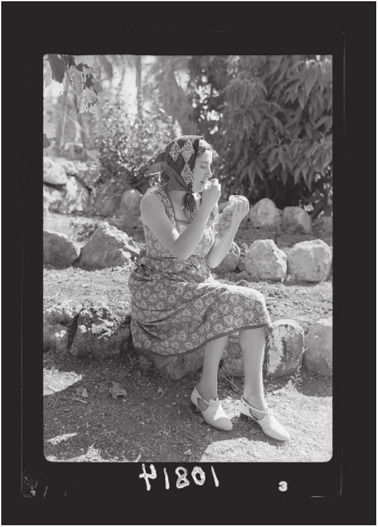
FIGURE 14.3 Grapes. (Photo courtesy of Library of Congress, https://www.loc.gov/pictures/itern/2019710469/.)
dates were “sometimes the only food available.”42 As an energy packet, the fruit is 54 percent sugars by mass and easy to transport, according to The Cambridge World History of Food (CWHF), and easy to preserve, wrote American classicist Stephen Bertman (b. 1937).43 The CWHF recommended it for potassium, iron, magnesium, and vitamins B, and B6.44
Using the Medjool and Deglet Noor varieties as standard, the U.S. Department of Agriculture (USDA) and Table 14.3 list calories and nutrients in 100 grams.45 The USDA calculates the Medjool date as 66.5 percent sugars by mass, a value that differs from the above figure. The USDA number is within American botanist Beryl Brintnall Simpson (b. 1942) and American botanist and science educator Molly Conner Ogorzaly’s range of 60-70 percent sugars per date.46
TABLE 14.3
Nutrients in Dates 100g
|
Nutrient |
Date |
%DV |
|
Calories |
277 |
N/A |
|
Protein (g) |
1.81 |
N/A |
|
Fat(g) |
0.15 |
N/A |
|
Carbs (g) |
74.97 |
N/A |
|
Fiber (g) |
6.7 |
N/A |
|
Minerals |
||
|
Ca (mg) |
64 |
6.4 |
|
Fe (mg) |
0.9 |
5 |
|
Mg (mg) |
54 |
13.5 |
|
P (mg) |
62 |
6.2 |
|
К (mg) |
696 |
19.9 |
|
Na (mg) |
1 |
0.04 |
|
Zn (mg) |
0.44 |
2.9 |
|
Cu (mg) |
0.36 |
18 |
|
Mn (mg) |
0.3 |
15 |
|
Se (meg) |
3 |
4.3 |
|
Vitamins |
||
|
A (IU) |
149 |
3 |
|
B, (mg) |
0.05 |
3.3 |
|
B, (mg) |
0.06 |
3.5 |
|
B, (mg) |
1.61 |
8.1 |
|
B5 (mg) |
0.81 |
8.1 |
|
B„ (mg) |
0.25 |
12.5 |
|
В» (meg) |
15 |
3.8 |
|
Bl2 (meg) |
0 |
0 |
|
C (mg) |
0 |
0 |
|
D (IU) |
0 |
0 |
|
E (mg) |
0.05 |
0.3 |
|
К (meg) |
2.7 |
3.4 |
TABLE 14.4
Nutrients in Bananas 100g
|
Nutrient |
Banana |
%DV |
|
Calories |
89 |
N/A |
|
Protein (g) |
1.09 |
N/A |
|
Fat(g) |
0.33 |
N/A |
|
Carbs (g) |
22.84 |
N/A |
|
Fiber (g) |
2.6 |
N/A |
|
Minerals |
||
|
Ca (mg) |
5 |
0.5 |
|
Fe (mg) |
0.26 |
1.4 |
|
Mg (mg) |
27 |
6.8 |
|
P (mg) |
22 |
2.2 |
|
К (mg) |
358 |
10.2 |
|
Na (mg) |
1 |
0.04 |
|
Zn (mg) |
0.15 |
1 |
|
Cu (mg) |
0.08 |
4 |
|
Mn (mg) |
0.27 |
13.5 |
|
Se (meg) |
1 |
1.4 |
|
Vitamins |
||
|
A (IU) |
64 |
1.3 |
|
B, (mg) |
0.03 |
2 |
|
B, (mg) |
0.07 |
4.1 |
|
B, (mg) |
0.67 |
3.4 |
|
B5 (mg) |
0.33 |
3.3 |
|
B6 (mg) |
0.37 |
18.5 |
|
B, (meg) |
20 |
5 |
|
В и (meg) |
0 |
0 |
|
C (mg) |
8.7 |
14.5 |
|
D (IU) |
0 |
0 |
|
E (mg) |
0.1 |
0.7 |
|
К (meg) |
0.5 |
0.6 |
The second fruit treated later is the banana. As noted, Gundry permitted consumption of only unripe bananas, though the USDA appears to list nutrients for ripe bananas, in Table 14.4, given
53.6 percent of carbohydrates from sugars.47 Comparison of Tables 14.3 and 14.4 reveals that by mass dates have more potassium than bananas despite the latter’s reputation as rich in it. Table 14.2 indicates that dates have the most potassium by mass among fruits. Besides potassium, dates, being dried, have more calories, protein, carbohydrates, fiber, calcium, iron, magnesium, phosphorus, zinc, copper, manganese, selenium, and vitamins A, B,, B„ B5, and К than bananas by mass.
Dates
Dates, Humanity, and Domestication
Possibly the first domesticated fruit, dates are intertwined with the rise of civilization in southwestern Asia, a region earlier chapters mentioned as geographically imprecise.48 Although colloquial use names it the Middle East, this label is unhelpful. If East means Asia, then Middle East should be Asia’s midpoint. But no such location is meant because the Middle East includes the eastern
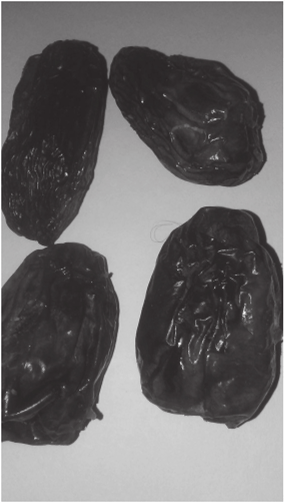
FIGURE 14.4 Dates. (Photo from author.)
Mediterranean basin, which is westernmost Asia rather than the middle. Moreover, the Middle East usually includes Egypt, which is mostly in northeastern Africa, and countries like Libya, which is wholly African, a practice that negates any notion of East as Asia.
Counter to this language, some archaeologists and historians refer to southwestern Asia as the Near East. This label makes sense if an onlooker insists that Europe is the frame of reference because southwestern Asia is just east of Europe. This book rejects Eurocentrism, believing instead that any attempt to define part of Asia should use Asia as the continent of reference. For this reason, Egypt and North Africa cannot be in the Middle East without decoupling the terms East and Asia.
If southwestern Asia is defined in terms of Asia, as seems sensible, Africa must be excluded because no part is in Asia except Egypt’s Sinai Peninsula. From the peninsula, this book—looking east, southeast, and northeast—includes in southwestern Asia all of Arabia and Arab countries Jordan, Syria, and Iraq because they share a common history and ethnicity. From the Sinai Peninsula north to Syria is westernmost Asia, lands known as the Levant and included in this book’s definition of southwestern Asia. From south to north, the Levant is the Sinai Peninsula, Israel, Lebanon, and Syria. To the east, Jordan is usually included in the Levant. Between Israel and Jordan is Palestine. Although journalists often include Turkey and Iran in the Middle East, and so in southwestern Asia, this book does not because Turkey has territory in Europe as well as in Asia and because Turkey and Iran are not Arab nations.
After Africa, southwestern Asia has the longest record of human habitation. Discussing our evolution, Chapter 3 indicated that Homo erectus was the first human to leave Africa, entering southwestern Asia around l .8 million years ago. H. erectus fossils in what is today Georgia on the eastern shore of the Black Sea are about 1.7 million years old.49 Georgia’s colonization implies earlier habitation of southwestern Asia, from where H. erectus moved north and east. Chapter 3 overviewed these migrations.
After H. erectus, the first Homo sapiens—populations designated archaic—penetrated Asia perhaps 350,000years ago.50 Around 60,000years ago, Homo neanderthalensis (Neanderthals or Neandertals) colonized westernmost Asia, occupying parts in what is today Israel.51 Neanderthal fossils demonstrate that the species—whether distinct from H. sapiens cannot be decided here—moved as far east as Iraq. These remains suggest that Neanderthals inhabited all southwestern Asia. Simultaneously, anatomically modern peoples settled these lands, persisting into the present, whereas Neanderthals vanished about 28,000years ago.52
As elsew'here, humans were latecomers to a region populated by plants and other animals. Among florae, the date palm arose at least 50 million years ago in Arabia and North Africa.53 It may have originated from crosspollination between wild species Phoenix reclinata and Phoenix sylvestris.54 French-Swiss botanist Alphonse Louis Pierre Pyrame de Candolle (1806-1893) believed that the tree’s geographic range was greater before than after domestication.55 Humans must have prized the palm, which tolerated intense heat, saline soils, and aridity, because it grew' in deserts, where the climate supported few other resources. Before domestication, nomads in arid lands from India west throughout the Mediterranean likely ate wild dates.56
The tree’s utility recommended it for domestication no later than 5000 BCE, making its edibles the earliest domesticate to satisfy the botanical definition of a fruit.57 The oldest remnants of the domestic date palm, around 7,000years old, came from what are today Kuwait and the United Arab Emirates.58 Their geography suggests earliest domestication in lands northwest and south of the Persian Gulf. Arabian presses for extracting dibs (date syrup) are roughly 3,750years old.59 Arabian pastoralists took the palm north into the eastern Mediterranean, where it hybridized with the w'ild Phoenix theophrasti—native to Turkey and Greek island Crete—around 1000 BCE. These hybrids moved southwest into Egypt and west throughout North Africa. This chronology prioritizes domestication and cultivation in Arabia w'ith later movements into the Levant, Egypt, and North Africa.

