Interpretation of DMT Results in Fine-Grained Soils
The DMT has also been used extensively in fine-grained soils as previously summarized in Table 6.1. In some respects, using a DMT has some advantages over using a CPTU in that deairing of a porous element is not needed. Table 6.3 presents a summary of a number of reported correlations between soil properties and DMT results for fine-grained soils. The following sections discuss interpretation of DMT results in fine-grained soils.
Undrained Shear Strength
A number of methods have been suggested for estimating the undrained shear strength of saturated fine-grained soils from the results of the DMT.
Table 6.3 Reported correlations between soil properties and DMT in fine-grained soils
|
Soil parameter |
DMT index |
References |

|

|
Marchetti (1980) Lacasse & Lunne (1988) Roque et al. (1988) Su et al. (1993) Kamei & Iwasaki (1995) Lutenegger (2006a) Lechowicz et al. (2017) |

|

|
Marchetti (1980) Powell &Uglow (1988) Lacasse & Lunne (1988) Mayne & Kulhawy (1990) |

|

|
Mayne (1987; 1995) Ozer et al. (2006) |

|

|
Marchetti (1980) Davidson & Boghrat (1983) Powell &Uglow (1988) Lacasse & Lunne (1988) Su et al. (1993) Lutenegger (2015) |

|

|
Marchetti (1980) Ozer et al. (2006) Lechowicz et al. (2017) |

|

|
Marchetti (1980) Davidson & Boghrat (1983) Borden et al. (1985) Lutenegger (1988) Su et al. (1993) |

|

|
Kalteziotis et al. (1991) Tanaka et al. (1994) Shibuya et al. (1998) |

|

|
Robertson et al. (1988) Schmertmann (1989) Marchetti &Totani (1989) |

|

|
Robertson et al. (1988) Gabr& Borden (1988) Schmertmann (1989) |

|

|
Borden et al. (1986) |
Marchetti Method (1980)
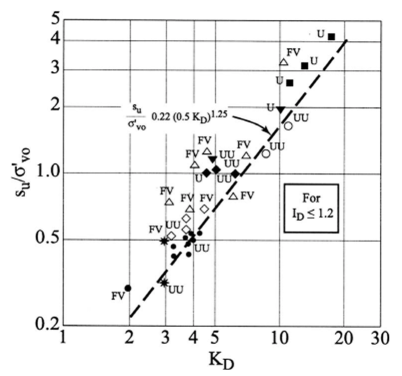
Marchetti (1980) had suggested that a simple empirical relationship could be used to predict the normalized undrained strength of cohesive soils from the DMT lift-off pressure, P0, according to

where
o'vo = vertical effective stress
KD = (P0-uo)/
u0 = in situ pore water pressure
A comparison between Equation 6.13 and the results of laboratory unconfined compression and triaxial compression and in situ field vane tests obtained by Marchetti (1980) provided reasonable accuracy as shown in Figure 6.19. This initial technique has been used by a number of investigators; however, it appears to need site-specific verification and does not provide sufficient accuracy in all soils.
For example, test results presented by Powell & Uglow (1988) indicated that this method could underpredict or overpredict the normalized undrained shear strength. Similar results were presented by Facasse & Lunne (1988) presenting correlations between predicted and measured undrained shear strength in Norwegian clays, using different reference values of strength.
Roque etal. Method (1988)
An alternative approach to estimating the undrained shear strength was presented by Roque et al. (1988) using a simple bearing capacity approach assuming that the blade is rectangular footing loaded in the soil horizontally. In this case, the undrained shear strength is given as follows:

where
P, = DMT 1 mm expansion pressure
oho = in situ total horizontal stress = K0a'V0+u0
Nc = bearing capacity factor.
Values of Nc varying from 5 to 9 were suggested by Roque et al. (1988) as given in Table 6.4.
This procedure resembles the semi-empirical technique used to predict the undrained shear strength from Menard pressuremeter using the limit pressure, PL, as will be previously described in Chapter 7 where

In both Equations 6.14 and 6.15, it is assumed that a yield or limit pressure is obtained during the expansion phase of the test such that Pt = PL. For the pressuremeter, values of N from the literature are often in the range of 5-7, which compares well with values suggested by Roque et al. (1988). This technique requires an evaluation of the original (prepenetration) at rest in situ horizontal stress and some assumption of the soil type to estimate the bearing capacity factor, Nc.
Schmertmann Method (1989)
Schmertmann (1989a) presented further theoretical explanations for an expected trend between KD and the undrained strength based on the limit pressure from cylindrical cavity expansion and suggested that a good approximation for predicting the normalized undrained strength would be as follows:

“Effective” Lift-Off Pressure Method
Since both the normalized shear strength and KD are normalized by o'vo, it is possible to estimate the undrained shear strength directly from P0-uo. This eliminates the need to estimate soil unit weight to estimate ovo but still requires an estimate of u0 at the test location. In this case, the undrained shear strength would be given as follows:

where
(3 = an empirical constant.
Values of (3 should be in the range of 6 to 10.
Table 6.4 Bearing capacity factors suggested by Roque et al. (1988)
|
Soil |
Nc |
|
Brittle clay and silt |
5 |
|
Medium clay |
7 |
|
Nonsensitive plastic clay |
9 |
Larsson & Eskilson (1989) “effective” I mm Expansion Pressure Method
A method for estimating the undrained shear strength in clays using the value of P, was suggested by Larsson 8c Eskilson (1989) as follows:

This is similar to the method previously described using P0. For both organic and inorganic clays in Sweden, Larsson 8c Eskilson (1989) found that F typically is in the order of 10.

