Seismic Dilatometer
The seismic dilatometer (SDMT) may represent the fastest growing in situ test being used in site characterization worldwide. The SDMT combines the standard DMT equipment with a seismic module attached behind the DMT blade for measuring the shear wave velocity, Vs (Martin & Mayne 1997; Marchetti et al 2008; Amoroso et al. 2013). The SDMT was initially used in the field in the late 1990s (Martin & Mayne 1997; 1998) but has quickly gained wide popularity as a simple and rapid method for obtaining Vs as a result of further development of the equipment.
The seismic module is placed in a drill rod immediately behind the blade and is equipped with two receivers spaced 0.5 m apart. Vs is obtained as a true interval as the ratio between the difference in distance between the source and the receivers (s2-s,) and the delay of the arrival of the impulse from the first to the second receiver, At. The pulse is created at the surface in the same way that shear waves are generated for measuring shear wave velocity with the seismic cone or piezocone (SCPT/SCPTU) using a hammer to strike against a fixed plate on the ground surface.
Marchetti et al. (2008) found that the shear modulus, Gmax, obtained from the SDMT Vs values were related to the DMT Modulus, ED, and Lateral Stress Index, KD, but that the relationship was dependent on the soil type, which could be expressed by the DMT Material Index, ID, Figure 6.40. Calculated values of the DMT Constrained Modulus, MDMX, from Ed, were then used to correlate Gg/Mdmt for different soils. Figure 6.41 shows ratios of Gg/Mdmt as a function of KD for different soils identified from the DMT Material Index, ID.
The following correlations were presented by Marchetti et al. (2008):

The correlations may be used to estimate G0 from standard DMT results when shear wave velocity measurements are not available.

Figure 6.40 Dependence of Gmax/ED on KD and lD. (From Marchetti et al. 2008.)
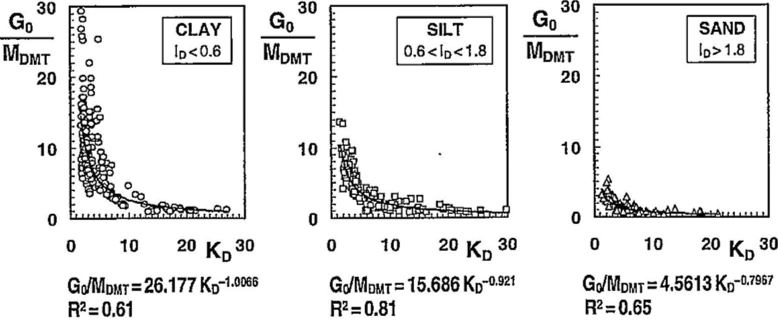
Figure 6.41 Correlations between Gmax/MDMT and KD for different soils. (From Marchetti et al. 2008.)
Design Applications
The DMT has a wide range of applicability in different geologic materials as previously noted in Table 6.1. Most of the current applications of the DMT to engineering design problems make use of conventional soil parameters predicted by the DMT. Therefore, the accuracy of the predictions generally indicates the ability of the DMT to accurately predict properties. The real value of any soil tests is in their ability to accurately predict field performance. In addition to obvious uses as a site-profiling tool and in obtaining predictions of
Table 6.13 Some reported design applications of DMT for design
|
Application |
References |
|
Settlement prediction |
Schmertmann et al. (1986) Hayes (1986) Saye & Lutenegger (1988b) Skiles & Townsend (1994) Steiner (1994) Monaco et al. (2006) Failmezger et al. (2015) |
|
Bearing capacity of shallow foundations |
Lutenegger (2006c) |
|
Laterally loaded drilled shafts and driven piles |
Gabr& Borden (1988) Robertson et al. (1989) Marchetti et al. (1991) Lutenegger & Miller (1993) Gabr et al. (1994) Ruesta & Townsend (1997) Anderson et al. (2006b) |
|
Axially loaded piles |
Marchetti et al. (1986) Gabr et al. (1994) Lutenegger & Miller (1993) Togliani & Reuter (2015) |
|
Liquefaction potential of sands |
Marchetti (1982) Robertson & Campanella (1986) Reyna & Chameau (1991) Totani et al. (1997) Passos et al. (2004) Grasso & Maugeri (2006) Maugeri & Monaco (2006) Marchetti (2016) |
|
Ground improvement |
Schmertmann (1982) |
|
Verification and compaction control |
Schmertmann et al. (1986) Lutenegger(1986) Lacasse & Lunne (1986) Sawada & Sugawara (1995) Miller et al. (2006) Amoroso et al. (2015b) Kurek& Balachowski (2015) |
|
Uplift of anchor foundations |
Lutenegger et al. (1988) |
|
Slope stability |
Rankka (1990) Totani et al. (1997) Peiffer (2015) |
|
Retaining structures |
Anderson et al. (2006a) Cunha & Reyes (2015) Deb&Konai (2015) |
|
Changes in lateral stress |
Peiffer et al. (1994) |
conventional soil properties, several more direct applications of the DMT to specific engineering problems have been reported. Table 6.13 presents a summary. The list is no doubt larger since the application of the DMT is rapidly expanding, and new uses are continually being investigated.
The success of the DMT to accurately predict performance has generally been linked to a design approach based on an accepted engineering practice. Thus, at the current time, conventional design procedures using DMT-derived conventional soil engineering properties are generally being used. This is in contrast to a hybrid design approach, which in often used with other in situ tests; for example, the pressuremeter approach to foundation design based on Em and PL.
Summary of DMT
The DMT has quickly earned a place in the geotechnical profession as a cost-effective tool for conducting routine site investigations. The device has developed to a point where there is now substantial theoretical justification for many of the empirical correlations. The DMT is a simple and efficient test for estimating a number of soil engineering properties in a wide range of earth materials and may also be used as an extremely useful logging device since it allows closely spaced vertical test points. In specific applications, the test may be even more efficient if the engineer chooses to test at a few preselected depths. The recontact pressure, P2, has shown to be a valuable component of the test and should be a routine part of every test.

