Interface Shear Tests
A practical use of the BST is in the determination of shearing characteristics between soil at the borehole wall and a smooth interface like steel. This can be accomplished by substituting the standard serrated plates with smooth mild steel plates having no shear teeth. This is done to promote a shear failure at the interface between the smooth plate and the soil rather than at a soil-soil interface. Measurement of this interface characteristic may be useful in some soils for designing temporary steel casing using an effective stress analysis.
Table 8.5 Factors affecting BST results
|
Factor |
Comments |
|
Consolidation time |
Longer consolidation time promotes more drainage in saturated clays. No effect in soils above the water table. Allow more time if results are in question. |
|
Shearing rate |
Slower shearing rate is better to reduce shear-induced pore water pressures in saturated clays. In all other soils, the normal recommended shearing rates have a minor effect on results. |
|
Borehole disturbance |
Borehole should be prepared with as much care as possible. Severe disturbance at the borehole wall will be reduced by allowing consolidation. Disturbed soils will give lower strength envelope than undisturbed soils. |
|
Shear plate geometry |
Standard shear plates are recommended for most soils except hard clay and soft rock. High-pressure shear plates may be required in these materials to prevent plates from sliding and not shearing the soil. |
|
Multistage testing |
Multistage testing is preferred in most materials except for highly sensitive clays. Single-stage testing is used with high-pressure shear plates in hard soils and soft rock. |
Handy et al. (1985) reported the results of interface friction tests obtained using smooth steel plates during a site investigation for a bridge in Florida. In all cases, the friction angle obtained using the smooth plates was lower than the friction angle obtained from adjacent tests using the standard shear plates with teeth. For three comparative tests in hard clay, they found that the ratio of soil-steel adhesion to soil cohesion, c'/c', varied from 0.06 to 0.17, averaging 0.11, whereas the comparable soil-steel sliding vs. soil internal friction ratio, cp's/(p', varied from 0.5 to 0.9, averaging 0.66.
The results from the smooth shear plate tests also demonstrate how the BST with regular serrated shear plates works to measure the shear strength of the soil. A smooth plate cannot engage the soil but only slides along the interface between the plate and the soil. Apparently, increases in normal stress do not push a failure surface outward into the soil; otherwise, the strength envelope would approach that obtained using serrated plates; i.e., repeated shear still takes place at the interface. This means that in order to actually fail the soil and obtain a soil-to-soil failure envelope, it is necessary to have shear plates with some forms of protrusion or teeth to engage the soil. Figure 8.8 shows the results of regular tests and adjacent smooth steel interface tests in silty sand.
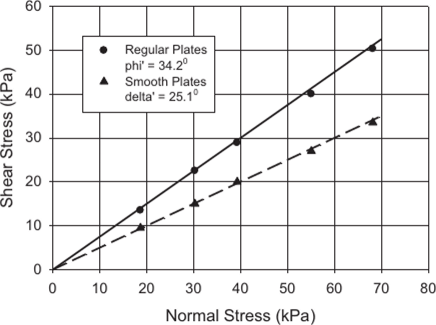
Figure 8.8 Results of regular and smooth steel interface tests in silty sand.
Comparison with Laboratory Tests
In the past, comparisons have been made between the BST results and either laboratory direct shear box test or triaxial compression test. This clearly can present some problems since even the results of different laboratory tests do not give the same result because of differences in stress conditions, stress paths, testing rates etc.
Early experience with the BST gave comparisons between BST results and direct shear box test or triaxial compression test (e.g., Handy & Fox 1967). Typically, the results obtained with the BST fell in between envelopes obtained from the laboratory tests. Other comparisons between BST and laboratory triaxial and shear box tests (e.g., Wineland 1975; Singh & Bhargava 1979; Lambrechts &c Rixner 1981; Lutenegger & Hallberg 1981) have shown a close agreement, usually with cp' within 2°-3°, which is reasonable, considering differences in test procedures and soil variability.
Equipment Modifications
Several modifications have been made to the BST equipment in order to expand the use of the test for particular applications. Modifications have included provisions for measuring pore water pressure at the shear plates (Demartinecourt & Bauer 1983; Lutenegger &c Tierney 1986), measuring the shear deformation (Demartinecourt & Bauer 1983; Lutenegger 1983), measuring the shear head expansion (Johns 1980; Demartinecourt & Bauer 1983), and measuring the soil creep (Lohnes et al. 1972). Figure 8.9 shows the modification to the shear head for measuring pore water pressure, and Figure 8.10 shows a simple arrangement for measuring the shear deformation.
Demartinecourt & Bauer (1983) replaced the hand crank of the base plate with a small variable speed electric motor to provide a constant rate of shear deformation throughout the test. Ashlock & Lu (2012) described a new generation of BST equipment that consists of fully automated equipment.
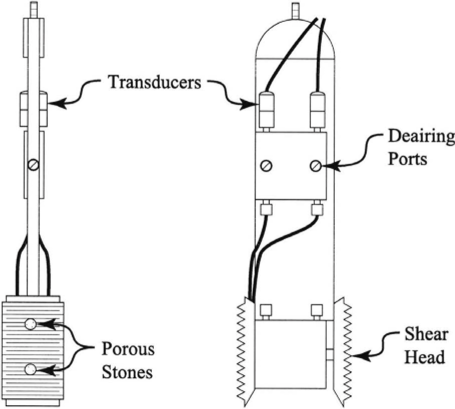
Figure 8.9 Modification to the shear head for measuring pore water pressure.

Figure 8.10 Arrangement for measuring shear deformation.

