Test Procedures
As noted, the BST is performed in two separate phases: (1) a consolidation phase, during which some time is allowed to elapse between the application of normal stress and that of shearing stress, and (2) a shearing phase, during which the shear head is pulled to create the soil shear failure. This procedure is directly analogous to performing a laboratory direct shear box test. A detailed testing procedure that gives a complete description of the test practice has been presented by Lutenegger (1987a). The test is also described in ISO/WD 22476-16. Lutenegger & Timian (1987) demonstrated that the test results obtained by different operators were not statistically different.
Multistage Testing
The normal test procedure used to perform the BST is called multistage testing in that shearing is performed repeatedly in the same soil mass, at successively higher normal stresses. This is similar to laboratory multistage testing. This procedure improves test precision, saves time, and encourages the dissipation of pore water pressures. This procedure is applicable to most soils if the consolidated strength of the soil close to the shear plates exceeds that of the adjacent undisturbed soil; i.e., the previously sheared soil consolidates and builds up a cake of soil that rides with the shear plates during successive shearing. In this way, successive shear surfaces move outward to engage fresh soil with each higher increment of normal stress. This procedure is repeated until 5 or 6 pairs of data points are obtained (normal stress and shear stress), and the shear strength envelope is defined. The result shows

Figure 8.5 Geometry of standard BST shear plates and progressive shear planes in multistage testing.
an exceptionally linear failure envelope in sands, silts, and soft to medium consistency clays. Figure 8.5 shows a schematic of the standard BST shear plates and the formation of successive shear planes.
The use of multistage testing provides for a very rapid testing since the shear head does not have to be removed and cleaned after each test point. Using a typical consolidation time of 10 min for each normal stress increment, a complete test yielding a full failure envelope can be performed in about an hour. Figure 8.6 shows soil adhered to the shear plates after removing the shear head following multistage testing.
As previously noted, multistage testing is intended for use in most soils wherein the failure plane is driven progressively outward into the fresh unsheared soil with each increment of normal stress. In some soils, this doesn’t occur simply because the soil is too strong to allow standard shear plates to bite into the soil and grip the material sufficiently to shear a soil-soil shearing surface. Handy &c Fox (1967) justified the use of multistage testing by showing a close agreement between tests in soils in which both multistage and single-stage tests had been performed. These soils primarily included insensitive softer silty clays, clays, and sand.
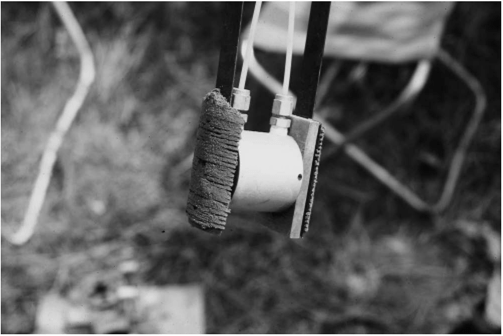
Figure 8.6 Soil buildup on shear plates.
Handy (1975) further rationalized the multistage testing by stating “one possibility is that during or after shearing, the major principal stress causes sufficient compression to ‘seal’ the shear plane and causes it to move outward to a lower stress region. From the typical test behavior, we infer that, after shear failure, the thin layer of soil grains participating in the failure is compacted and added to the cake adhering to the pressure plates. If this is correct, subsequent shearing should occur at the outer surface of the shear cake, in a zone of normally consolidated but otherwise unaltered soil”.
Single-Stage “Fresh” Testing
Schmertmann (1975) pointed out that the multistage testing procedure may not be applicable to all soils. In sensitive or structured soils, the failure envelope may become tipped downward at progressively higher values of normal stress as a result of the accumulation of shear stresses on the same surface. In the single-stage testing, the test is conducted in exactly the same manner as the initial data point for a multistage test. However, at the end of the shearing phase, after a peak value of shear stress has been obtained, the normal stress is released by decreasing the gas regulator on the control console and venting the pneumatic pressure. The shear plates are retracted and the shear head is then removed from the borehole. Once the shear plates have been cleaned, the shear head is lowered back down into the borehole to a new adjacent test location (either just above or just below the initial point) to obtain another test point using a different normal stress.
Several studies have shown that in softer soils, the geometry of the shear plates does not influence the test results substantially (e.g., Lutenegger et al. 1978; Demartinecourt & Bauer 1983). In stiff highly overconsolidated clays and some very dense glacial clay tills, the standard shear plates may not penetrate the soil and the shear teeth will tend to slide over the soil surface and only scrape deeper with each successive pull until the teeth are filled. As a result, no soil cake builds up and the test measures some components of sliding friction of soil on steel or disturbed soil on undisturbed soil. The resulting failure envelope is the result of the successive deepening of the “bite” brought about by higher normal stresses, and filling of the teeth with soil. In hard soils and soft rocks, high-pressure shear plates, as shown in Figure 8.7, should be used.
Lutenegger & Timian (1987) presented the results of single-stage tests conducted in a marine clay and found that there was no statistical difference between the mean friction angle and cohesion obtained with this procedure when compared to adjacent multistage tests in the same material. The linearity of all the tests was also excellent, although the single-stage tests gave slightly lower regression coefficients.
The initial normal stress and subsequent increments of normal stress should be chosen prior to testing so that a sufficient number of data points will be obtained throughout the test to define the failure envelope. In other words, if too high of an initial normal stress increment is chosen, the soil may experience a “bearing capacity” failure from a rapid punching of the shear plates and the test will be meaningless. This can especially be a problem in soft normally consolidated clays. On the other hand, if too low of an initial normal stress increment is chosen, the teeth on the shear plates won’t bite into the soil and the plates will just drag along walls of the soil, and no soil failure will occur. Table 8.1 presents the recommended values of the initial normal stress and normal stress increments for use in different soils.
Table 8.2 gives the suggested consolidation times for various soil conditions. Regardless of the soil and groundwater conditions, the author recommends that a minimum consolidation time of 5 min should be used in all cases to “seat” the shear plates even in those situations where pore water pressures are not expected.

Figure 8.7 BST high-pressure shear plates for hard soils/soft rocks.
Table 8.1 Recommended values of initial normal stress and normal stress increments
|
Soil type |
Initial normal stress, psi (kPa) Normal stress increment, psi (kPa) |
|
|
Very soft clays |
|
|
|
Soft clays |
|
|
|
Medium stiff clays |
3-5 |
5-10 |
|
Loose sand |
(21-34) |
(34-69) |
|
Stiff/dense |
|
|
|
Very stiff/hard heavily Overconsolidated clays Cemented sands |
|
|
|
Clay shales |
||
Table 8.2 Recommended consolidation times for different soils
|
Soil type!condition |
Consolidation time |
|
Moist sands and silts |
5 min |
|
Medium stiff to stiff clays compacted fill |
5 min |
|
Soft clays of low plasticity |
10 min |
|
Soft to very soft high-plasticity clays below the water table |
20 min |

