Presentation of Test Results
The results of PLTs and SPLTs are typically presented as settlement vs. applied plate stress. Figure 9.9 shows the results of four PLTs performed on a compacted sand using plates of different diameter. It can be seen from these results that the response of the plates is different and that both the stiffness and the ultimate bearing capacity appear to be dependent on the size of the plate. The absolute settlement at a given level of applied stress is different for each plate.
It may also be useful to present results in a normalized form where the plate settlement is normalized by the plate diameter, also shown in Figure 9.10. This approach allows a comparison of tests made using plates of different diameter.
Interpretation of Results
As previously indicated, the results of PLTs may be used as a prototype-scale shallow foundation or they may be used to provide estimates of specific soil properties, such as stiffness and strength. The use of PLTs as prototype foundation tests will be discussed in Section 9.6. In this section, the evaluation of specific properties will be described.

Figure 9.8 Screw mechanism for advancing screw plate. (From Kay & Avalle 1982.)
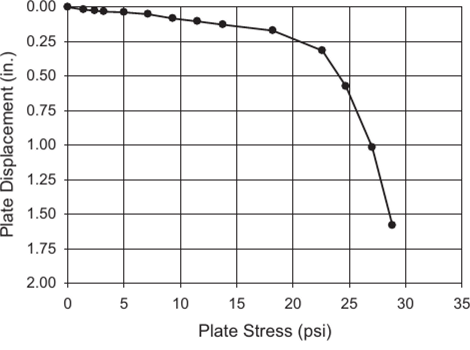
Figure 9.9 Typical PLT in compacted sand.

Figure 9.10 Normalized results from PLT.
Subgrade Reaction Modulus
The modulus of subgrade reaction, ks, may be determined directly from the results of PLTs. This value may be useful for the design of mat foundations and pavements, and has been extensively used by structural engineers. The modulus of subgrade reaction is defined as the slope of the stress vs. settlement curve as:

where
q = applied plate stress 6 = plate settlement
Units of ks are in force/length3.
Subgrade Reaction Modulus is not really a constant but depends on the definition. Several methods have been used for calculating ks based on the results of PLTs. It appears that there is no standard procedure. For example, the U.S. Army Corps of Engineers has defined the value of ks at a fixed applied plate stress of 68.9 kPa (10 psi), while the Portland Cement Association has defined the value of ks at a fixed plate deflection of 1.27 mm (0.05 in.). Neither of these approaches truly gives the elastic response of the plate for all soil conditions, and therefore, neither may be desirable.
In some cases, the value of the subgrade reaction modulus has been defined as a secant slope at plate stresses corresponding to lA to 1/3 the ultimate stress, but this obviously requires that the ultimate stress be evaluated and therefore may be sensitive to the definition of ultimate bearing stress. Alternatively, the initial straight-line portion of the load curve may be used. However, this requires a number of small load increments at the beginning of the test. In any case, the definition of ks appears at this time to be more or less arbitrary. Using the results from the 0.30-m (1 ft)-diameter plate shown in Figure 9.9, the calculated values of ks are 142 lbs/in.3 for PCA and 111 lbs/in.3 for USACE.
There are two problems with the application of Equation 9.1: (1) the load-displacement curve of the most PLTs is nonlinear, and therefore, the value of ks will be dependent on the settlement or stress level where it is defined; (2) test results show that the value of ks, as defined by Equation 9.1, is dependent on the absolute size of the plate and that ks decreases as the plate width increases.
To account for the decrease in subgrade reaction modulus with increasing plate size, Terzaghi (1955) suggested that the subgrade reaction modulus of full-scale foundations with width B, kB, could be obtained from the results of a PLT conducted on a plate with a width of 0.3 m (1ft). This means that a value of ks for any size foundation could be estimated on the basis of test results obtained with a 0.3-m (1 ft)-wide plate. For foundations on sandy soils, it was suggested that:

where
k0 з = modulus of subgrade reaction determined using a 0.3-m (1 ft) plate В = footing width (m)
For foundations on clays, Terzaghi (1955) suggested:

A comparison of some actual test data with the recommendation of Terzaghi (1955) for a series of PLTs conducted by the author on compacted sand using the UASCE definition for ks is shown in Figure 9.11. Figure 9.12 shows a comparison of the normalized values of ks for these tests compared to Terzaghi’s suggestion (Equation 9.2). Except for the smallest plate, the fit appears reasonable.
According to elastic theory and the Boussinesq equation, the settlement of a plate may be related to the average applied stress as:


Figure 9.11 Values of ks from PLTs conducted on compacted sand using different-sized plates.

Figure 9.12 Normalized subgrade reaction modulus measured and predicted by Terzaghi (1955).
Since the coefficient of the subgrade reaction is defined from Equation 9.1 as:
 the subgrade reaction may be written in terms of the elastic modulus as:

Equation 9.6 shows that the coefficient of the subgrade reaction depends on both the elastic properties of the soil and the size of the plate.
The approximation of Terzaghi (1955) assumes a constant value of elastic modulus, which is a simplification to the condition where the elastic modulus varies with depth. This nonhomogeneity has been addressed by a number of studies, including those of Carrier & Christian (1973), Rowe (1982), and Horvath (1983).

