III Practice
Dancing Activism: Choreographing the Material with/in Dementia
Beatrice Allegranti
INTRODUCTION
This chapter introduces feminist interdisciplinary dance movement psychotherapy (DMP)1 and choreographic research, practice2 and activism with people living with the rare diagnosis of young onset dementia (YOD), their families and the artistic team—Beatrice Allegranti Dance Theatre.3 The international project builds on previous practice and research investigating the role of artistic processes in DMP (Allegranti, 2011,2019), with a specific focus on challenging dominant discourses of relating in dementia.
Dementia is a worldwide concern, with an estimated 135 million people living with the diagnosis by 2050. As an umbrella term, the ‘dementias’ include several variations that are characterized not only (and in some instances not even) by loss of memory, as is public perception, but also significant impairment of language and communication and relating in the world.
There has been little impetus to provide specialist services for YOD in the UK, where services for older people can have a detrimental effect on a younger person (Burton-Jones, 2015). The body politics of age reverberate when people are mid-life and mid-career, often with families and living actively at the time of diagnosis. The medicalization of dementia framed as a pathological condition, while intended to reduce stigma and taboo, has often resulted in more stigmatization. A biomedical bias emphasizes cognitive deterioration and does not take into account personal and social experiences where it is understood that affective resonance endures (Allegranti, 2019). Within this complex milieu, the lives of partners, children, parents and friends are impacted, and a new way of relating must be found for all. This account of my work—to creatively reimagine dementia in the arts, health and justice together with notions of what constitutes ‘self’ and ‘bodies’—speaks to these pressing sociopolitical needs in somatic, relational and aesthetic ways. To paraphrase Rosie Braidotti (2013), I seek to put the dancing body back into activism.
The urgency of this dancing activism speaks to dominant discourses across the Western world where dementia is depicted as a devastating ‘loss of self’ or even loss of humanity. A hypercognitive model of dementia equates the notion of ‘self’ with mind and mental function and language residing within bodies as ‘containers’ (Post, 2000). The limits of this 20th-century Anthropocentric humanism predicated on separation and binaries such as body/mind, nature/culture, subjective/objective, maintain the long-held view of the bodies as discrete entities.
Comprehensive critique of this Cartesian view of self/body has been in the area of posthumanism and feminist new materialisms (Harraway, 2016; Braidotti, 2013; Manning, 2013; Barad, 2007) or ‘PhEmaterialism’ as coined by Ringrose, Katie, and Zarabadi (2019), where PhEm refers to the blend of posthumanism and feminisms, materialism from the new materialist movement, and the capital ‘E’ highlighting education. I have adapted this term to include a capital ‘M’: PheMaterialism, thus foregrounding the material multiplicity across conceptual and political discourses that work towards counterhegemonic (anthropocentric) understandings of bodies, affect and relating. In doing so, this writing considers what happens when insights from DMP, choreography and dementia are read through one another—with the aim of opening pathways for alternative narratives of human-environment relations to ethically flourish.
PHEMATERIALISM IN MOTION
Drawing on Erin Manning’s (2013) use of the verb bodying, the PheMaterial Mobius (Figure 11.1), is a specially commissioned illustration offering a starting point for discussing the process of human-environmental relations. Inspired by Karen Barad’s “agental realism: a shift away from representationalism—reflecting on the world from outside—to a way of understanding the world from within and of being of the world in its dynamic specificity” (Barad, 2007, p. 377, author’s emphasis), this mobius moves beyond representation or metaphor for the body. Imagining this strip in motion, where inside and outside are continuous, leans towards a posthuman bodying of permeable, dynamic, dispersed, spatially and temporally specific (contingent) relating.
Bodies, therefore, do not only ‘exist’ in a network of human (bio-psycho-social) forces but are in Barad’s (2007) terms ‘inta-acting’, denoting the mutually constitutive process of
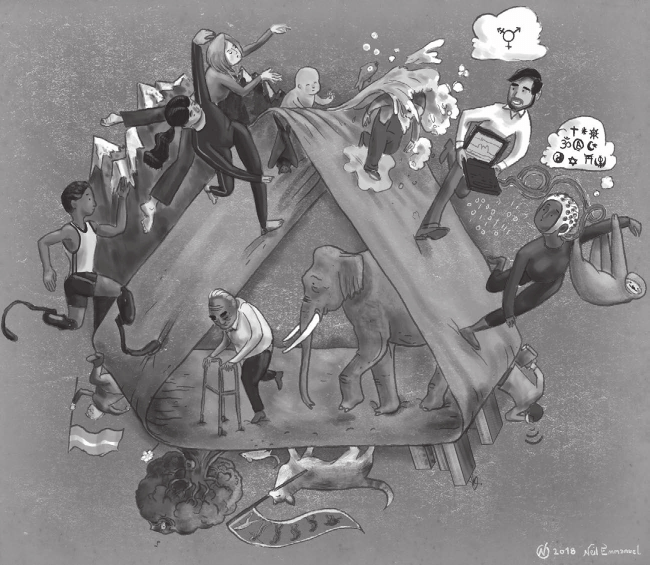
Figure 11.1 PheMaterial Möbius
Artist. Neil Max Emmanuel.
being within and part of the world rather than the interaction of separate entities. Bodying, infolds (Manning, 2016) where the line between body and environment is smudged and ‘life’ can be seen as an ‘entangled’ (Barad, 2007) system of relating. The entanglement includes human and non/more-than human bodies in/ra-acting with/in a network of language, biology, affect, cognition, ecologies, technology, embodied practices and power structures. As Barad states, “[E]xistence is not an individual affair” (2007, p. 3), and all these human and non-human things matter; they are all given equal value in this co-constitutive process.
Consequently, bodying can be described as a material-discursive process. This way, language does not need to be understood in simply discursive terms—but materially, too. Therefore, within DMP and dance practices, language can be considered as a product of material flows where the emphasis is not on what is said in terms of linguistic or speech acts but on “that which constraints and enables what can be said” (Barad, 2007, p. 146).
Working towards understanding the politics of discourse with/in dance and movement-based practices is a crucial counterhegemonic endeavor. A clear example of bodying as a necessarily material-discursive process is the intersectional body politics of age, gender, sex, sexuality, class, race, ethnicity and dis/ability. These material-discursive processes are ever present, subtle, in/visible, intersecting and changing throughout our lifespan. The implicit and explicit power differentials are often taken for granted, inside and outside the therapy room and/or artistic process. Much is at stake, and an ethical imperative involves generating our attention to intersectional body politics as they manifest within therapeutic and/or artistic practices and research. PheMaterialism, then, implies a progressive politics for the ethics of health and well-being with an enlarged sense of community (Braidotti, 2013).
Equally, materiality constitutes the assembling of human and non/more than human bodies such as, objects, entities and forces that together produce agentic power. By not reducing agency to what humans do and say, or to fix meaning based on one’s articulation of ‘experience’, humans can be viewed as part of the wider vital materiality of the world. Given this tangle, I work towards what Alaimo and Heckman (2008) call Zra/w-corporeal understandings: the inseparability of self and environment. In practice, I attend to distributed networks of agency across heterogenous elements and on different spatial and temporal scales, such as choreographic or clinical material (which is always movement material anyway), therapy room, dance studio, a song, objects, gendered bodies, family histories—all these are part of what can be described as an ‘agentic assemblage’ (Barad, 2007; Jackson & Mazzei, 2016). This writing aims to articulate agential relations between the connections of the assemblage (Ringrose et al., 2019) and in doing so, to illustrate how dementia is an ecological process distributed in the environment.
MATERIAL FOR LIFE
Resisting the singular agentic anthropocentric 1/eye in research who authoritatively interprets and presents research findings (Taguchi, 2013), my intent is to present a multiplicity of realities and subjectivities in collaboration with the artistic team and families living with YOD.
Instead of the research ‘data’ and ‘findings’, I conceptualize the combined research and practice as ‘spacetime events’ (Allegranti, 2019). The series of events act as both method and content and do not unfold chronologically, but ‘infold’ (Manning, 2016) across temporal and spatial scales. Past, present and future life stories of people living with YOD, their family carers and the artistic team are archived with/in moving-relating bodies, objects and texts. As such, the content of these events is always already in us as words, experiences, stories, movements, sounds and more-than-human environments (Allegranti, 2019; Jackson & Mazzei, 2016). Hence, of relevance is not only who but what participates in knowledge production. In PheMaterial terms, knowing comes from a direct material engagement with the world. My intent, therefore, is to describe how the profoundly relational nature of ‘knowing’ and ‘being’ are both inseparable and an ethical imperative in this project.
In what follows, I speak to this imbrication of spacetime events that pave the way for constantly evolving material-discursive (affective, bodily and political) changes. In this sense, the events enact micro and macro bodying activism for human others and for the dancer-cho-reographer-therapist-participant who is relating with the (movement and environmental) material.
Listening with Movement
The first spacetime event is interview-conversations in family homes, the hub of intimate relating. The (audio-recorded and transcribed) interviews4 are a material-discursive process: I listen with movement and in doing so hear the ‘vibrant’ material moments (Jackson & Mazzei, 2016) in our exchanges, for example, expressions such as prosody of speech, vocal tension, volume of voice but also the more-than-human processes such as wider social and environmental structures. Also, by modifying my conversational approach to suit the person that I am speaking with (in the same way I might with someone who does not speak the same language as me) my intent is to collaborate in producing knowledges.
With this gesture of listening, I heard the body politics of family life: people living with YOD finding it increasingly difficult to navigate the geography of their own home, couples in their mid-life, single mothers with an adult child caring for them all making sense of their lives with dementia and how this affects their intimate relationships and everyday material engagements. As I listen, I am moved to recognize that the very process of engaging in all these activities are small acts of resistance, an everyday activism.

