CASE STUDY: BROKEN HEART FROM A WOUNDED LAND
This case study provides a description of Minji (a pseudonym), a Korean woman suffering from haan for whom ten sessions of Korean scarf dance were used as a DMT intervention. This case study took place through a nonprofit social service agency which mainly offers mental health services for Asian immigrants in the United States (Ko, 2006).
Description of the Patient
Personal details about Minji have been altered to protect her privacy. Minji was a 40-year-old Korean woman who had immigrated to the United States about two years prior to treatment after marrying a Korean-American man whom she had dated for six months. At the time of treatment, Minji was living alone in a small studio and working as a babysitter. Minji was in the process of obtaining a divorce due to domestic violence that began three months into her marriage. Previously, Minji had lived in a one-bedroom apartment with her husband and mother-in-law. Her husband discussed everything about Minji with his mother, blocked Minji from having social connections, and prevented her from attending English classes. During the initial intake, she complained of chest pains, headaches, muscle tension, and difficulty concentrating. Treatment goals established with Minji were to release suppressed feelings of haan by providing a space for emotional self-expression and to empower herself by finding her inner strength to build up her life in a new environment.
Summary of Sessions
Session 1: “I Cannot Breathe.”
Minji walked into the office quickly and weightlessly. She looked nervous, with lots of tension in her shoulders; she made no eye contact and her hands shook. Minji did not say anything for a while. Suddenly, she took a deep breath and abruptly said, “I do not want to talk about everything all over again,” and started to cry. I evaluated Minji’s feelings and said, “You do not have to tell me.” I then asked, “How are you doing?” Minji replied, “I don’t feel good,” and started to talk about her physical symptoms. “My shoulder is heavy,” she added. I encouraged her to talk more about the pain in her body. Minji responded, “I cannot breathe; I do not have strength in my legs.” This exploration of pain in the body extended to Minji’s recounting her story of her abusive husband. Minji started to talk quickly without breathing, with many tangential run-on sentences and abrupt topic changes. Minji’s verbal rendering of her story mirrored her movement of walking fast, with an indirect use of space and a lack of grounding. I encouraged Minji to bring attention to her body by touching herself where she felt pain. To ground her energy, I had Minji stand up, and encouraged her to feel the ground through her feet by pushing down through them and bending her knees. At the end of the session, Minji described her physical feelings as "I feel like something is going up and down in my body,” and she gestured to her chest area. As her therapist, the impression I had was that Minji had many feelings bottled up and many unspoken stories.
Session 2: ‘A Quiet Voice. ”
Minji shared in a quiet voice how her husband had abused her verbally and emotionally, calling her names like “yellow cab” (a derogatory term for Asian women) or “prostitute,” which made her feel very ashamed. Minji expressed very mixed feelings and described her somatic symptoms, such as difficulty swallowing or digesting food. I wondered if Minji’s inability to swallow food symbolized her inability to accept the cruel things that her husband said to her.
I provided an empty chair for Minji and asked if she could express herself by saying what she wanted to say to anyone she chose. I did not specify to whom Minji might speak, as I did not want Minji to feel too pressured or directed. Minji hesitated for a long time, needing encouragement. I moved my chair to look in the same direction as Minji and stayed with the silence.
Minji started to talk, as if her mother-in-law was sitting in the chair, in a quiet, unassertive voice, like that of a little girl. She said, “You promised me life in America would be better than in Korea, and you lied to me.” She looked down and did not look at the chair. Her body was very compressed, and she looked much smaller than she actually was, using a small Kinesphere (an LMA term denoting personal space that one can reach without moving one’s feet). Minji then addressed her husband, maintaining the same unassertive attitude. Minji brought up the time that her husband had prohibited her from attending her mother’s funeral in Korea, asking, “How could you do that to me? My mother was sick and you did not give me my passport.” I could feel Minji’s deep sadness and anger toward her husband.
When I encouraged Minji to talk to her mother who had passed away, Minji took a long pause. Minji said through tears, “I have haan when I think about my mother.” I stayed with Minji’s deep grief regarding her mother in silence for a while. When I asked Minji how she might be able to cope with her stress, Minji explained that she had limited relationships with other people in the United States, and was ashamed to talk about her problems with others. Minji had been surprised to learn that the scoldings her husband gave her constituted verbal abuse, because she had thought that only physical abuse could be serious. In response to this, I provided psychosocial education regarding domestic violence and types of abuse to Minji.
Session 3: “Korean Women Have Haan. ”
Minji was invited to write down her thoughts. Minji wrote that “all Korean women have haan,” which is “a deep grief and pressure deep inside [my] heart where something is tangled and hard to release.” Minji reported six different emotions making up her haan: ‘‘anger, sadness, powerlessness, anguish, loneliness, and frustration.” When Minji talked about haan, she started to breathe and talk more rapidly. I then introduced the importance of breathing and did three-dimensional breathing exercises together with Minji, expanding outwards with her arms and moving her torso in a standing position. At the end of the session, I introduced both the ideas of DMT and of Korean scarf dancing. Minji agreed to participate in DMT through Korean scarf dancing because she wanted to explore her haan for “mental and psychological stability.” It indicated she was engaged in a struggle against herself—she was desperate, stressed, and in need of help to survive in this abusive environment.
After the third session, I also created a tool to assess her level of haan, listing all of the six emotions that Minji described as contributing to her haan. I asked Minji to rate each emotion using a 10-point Likert-type scale from 1 (“not at all”) to 10 (“a great deal”) to help her track and clarify' her level of emotion relating to her haan before and after each DMT session. The third data source consisted of Minji’s written comments or drawings, for which a blank area on the bottom of the checklist was provided. I added this area because I believed that Minji’s unspoken words and unexpressed emotions could not be captured in purely quantitative data.
Session 4: “More Haan. ”
Minji informed me that the breathing helped her to modulate her emotions, especially when she was angry. As a DMT intervention, Korean scarf dancing starts with the playing of traditional music and breathing from one’s core. I provided an initial movement, and then Minji moved together with me, enhancing the therapeutic relationship by promoting attunement. The initial movement involved flicking back the scarf and pressing one’s body down to the ground by' bending the knees, as well as raising one’s arms and enclosing the space. These are typical Salpuri beginning movements, as they can be easily followed and remembered. In her reflection after the session, Minji reported “feeling good, because while I am doing movement, I am not thinking.” At the end of the session, in the blank area of her haan checklist, Minji wrote “happiness” and “future.” She also said "It is weird, my haan is not decreasing, it is increasing.” Minji reported feeling more haan after participating in the movement exercise, as indicated by the haan assessment tool. Her sadness, loneliness, anger, and frustration increased after the session, but her anguish and powerlessness did not increase.
I was troubled to hear that Minji’s haan had increased instead of decreased. I talked about this with my supervisor, and realized that I had been focused on getting Minji to cast away negative feelings instead of containing her existing emotions. It is more important to help clients grow aware of existing emotions than to focus on getting rid of those feelings.
My clinical supervisor also explained the concepts of the old self and new self, emphasizing how difficult it is to experience the birth of a new self. Bergner and Holmes (2000) explained self-concept changes in psychotherapy. Many clients struggle with how to create a new, more adaptive self without letting go of and abandoning the sense of the old self. Minji’s mixed and vague emotions now made more sense, and clinical supervision helped me to empathize deeply' with Minji.
Session 5: “After Divorce. ”
Minji reported that she felt better, as her divorce had just been finalized. Her shoulders felt less heavy, and she felt less pressure on her chest. However, Minji looked angry to me, indicating a mismatch between what she was saying—that she was feeling better—and her facial expression and muscular tension. I then asked what coping skills Minji used for stressful situations, and Minji said that “listening to music helps [me] to calm down.”
While listening to Korean traditional music, Minji and I reviewed the movements we did together in our previous session. I then added vocal attunement, such as rhythmic counting similar to the sound of a drum, sung to the tune to Minji’s choreographed scarf dance. I asked, “What do you want to do for the next movement?” and Minji replied that she wanted to “move forward” four steps, so she did. Realizing that there was no space to continue moving forward, Minji said “no space!” I then asked her, “Where else can you go?” Minji paused for a while, then turned around halfway and moved back the way she had come. Minji moved on a diagonal rather than turning around and facing the direction she had come from because returning to the space where she had started reminded her too much of the past life she was not ready to face. Minji explained that stepping sideways on the diagonal was not about going back, but was instead about meeting people to ask for help. After the session, Minji noticed that the sound of counting was like the sound of a heart beating and that she had been able to match the movement to the beat. Minji also reported that “it made me focus on my body and these movements made me calm down and feel at peace.” Minji drew a picture of a tree after the session and said, “It’s about me without roots.” She also wrote “change” (see Figure 15.3a). Looking at Minji’s picture, I understood how difficult it would be to put down roots in a land with different soil and climate (i.e., a different culture), especially without any fertilizer (i.e., support). In this case, “change” might be necessary for this tree to survive in a new environment and situation.
Session 6: “No Place to Go. ”
Minji had been afraid to tell her family in her homeland about the divorce because it is considered shameful in Korea. For this reason, Minji did not want to go back there. The scarf dance movement started where the previous session had ended, going backwards four steps on a diagonal. Again, there was no space after Minji took four big steps: This was the second time she did not have enough space to move forward. Minji sniffled as she said, “I do not know where to go. No space.” I encouraged Minji to take a couple of deep breaths, provided a little time, and asked again, “What can we do now?” Minji said, “Move back.” I asked why she went back, and Minji replied that “Honestly, I had no place go to, so I went back.’ I then asked, “I wonder, why did you think that moving backwards was the only option?” Minji took a long pause and I stayed with her silence for a while. I encouraged her by saying, “Is there something in your life you want to change, just as you did in your movement?” Minji answered, “having met my husband” and continued talking about changing her arm movement. "I want to release. I feel like I have to move my left and right arms together because moving one arm is uncomfortable and difficult. ... I want to go forward with two arms flapping lightly.” When Minji opened both of her arms, it created more space in her core and allowed her to breathe more deeply. Minji wanted to change some of her arm movements to make her feel more comfortable. After she had verbalized that decision, her arm movement flowed from proximal to distal, which created more open space in her chest.
Then she started to talk. “I was a very shy girl, since I was young, and I tried to be a good daughter” who wanted to study more about “child psychology.” I noticed that Minji was starting to bring up the hopes and dreams that she remembered from the time she lived in Korea. I hoped that as Minji noticed that she could move both arms, she would relive not only the abusive memories from her marriage but also positive memories about herself in Korea. Such memories could provide positive energy and strength to deal with difficulties.
Session 7: “No Way to See My Mother. ”
Minji complained of muscle pain on the right side of her shoulder. She explained that working as a babysitter was physically demanding because she had to hold the baby when it cried, which caused unbalanced shoulders. Then, Minji continued to talk about how a baby knows its mother. Minji said, “My mother’s chest was so warm and cozy, I did not want to leave.” I asked Minji, “Do you miss your mother?” She began to cry and said, “I had no way to see my mother.” She then recounted a dream that she had had a couple of days previously. In this dream, her mother was very small, but she held Minji’s hand and kissed her on the cheek with great strength. Minji said, “I want to see the future, not the past, because it [the past] makes me sad.” For Minji, moving backwards in space reminded her of past memories. Her mother might symbolically represent strength, power, or life-force energy, as Minji’s dream of her mother connected to a strong desire to move forward. Throughout multiple sessions, Minji repeatedly said, “No place to go” when there was no space to move forward. Her way of seeing space clearly represented her situation and feelings about life: with few real relationships to support her, Minji wanted to move forward to leave her current situation (see Figure 15.3b). I asked Minji, “What is it like for you right now?” Minji said “isolation.” She then immediately sat down in a chair—which may have indicated resistance against further movement—and sat silently. Minji’s reaction guided me to think about how to empower her: protecting the bruised ego of the current self while developing a healthy new self.
Session 8: “I Have to Move Forward. ”
Minji was clearly worried about being reductively labeled as a divorced woman, and considered halting the process of working to obtain citizenship because it was so painful to discuss her past. Minji started to talk about how the father of the baby she cared for treated his wife. His kind and respectful treatment of his wife made her feel “irritated and angry” because it was such a contrast to how her ex-husband had treated her, and it showed Minji what a good family and good husband could be like. She was very angry about having married her ex-husband, an “emotional burden” from the past that makes her “unable to move forward easily.”
This invisible but emotionally and bodily felt burden extended to the session’s movement work. I divided the space into the past, present, and future. I then encouraged Minji to stand in the present and asked her where she wanted to move; the scarf was wrapped around Minji’s waist, symbolizing her emotional burden and making it difficult to move forward. I pulled on the scarf, and asked Minji to let me know when this sensation matched her perceived “emotional burden.” Once Minji indicated that the resistance was correct, I asked, “What do you want to do?” Minji said, "I know I have to move forward but it is not easy.” As Minji walked forward, the scarf tangled about her more and more tightly. She burst out crying, “I do not know where to go; this is the same as my situation.” In this moment, she was trying to use her physical strength to overcome her emotional burden. Her repressed emotions were externalized through movement, making sounds and telling me how much she was suffering. To me, this was like a moment of opening up a boiling emotional container, which revealed Minji’s internal strength (see Figure 15.3c).
Session 9: “Pushing Bad Energy. ”
Minji’s dance started with the last movement from the preceding session. Minji did not have space in front of her, so she decided to step backwards. In Laban’s theory, space is labeled based on where the person is headed, meaning that if Minji turned to face where she had started from, this would be considered her forward space. In past sessions, Minji had consistently maintained forward movement, clearly representing the strength of her desire to get away from her negative past. Session 9 was the first time she used the space behind her in her dance, by using a press movement; a press in action drive was also observed in her drawing (see Figure 15.3d). As part of the action drive, a press movement combines increasing pressure, weight, sustained time, and direct space (Laban & Ullmann, 2011); here, Minji’s arms and hands moved along with the scarf as if pushing something back. This represented a clear moment of emerging new movement qualities, changing from flicking (characterized by accelerating time, indirect space, and decreasing weight) to pressing. Minji explained that her movement of pushing back the space behind her was related to “pushing bad energy . . . so it could not follow her.” This moment demonstrated a new attitude of dealing with her past abusive memories by pushing against the violent memories, rather than avoiding or running away from them; here, her emotional strength was represented though her physical strength. I encouraged Minji’s efforts and observed how this movement decision related to her life. Minji reflected on her dance, saying, “I cannot see any other space; I can only see forward. This was the same as when I danced.” Minji reported that her strongest movement was when she stepped backwards, into the space that she had been avoiding. This felt like an important moment, in which Minji finally focused her courage and strength against the bad energy behind her.
Session 10: “Focus on Myself.”
This session was the last session of the Salpuri. Together, Minji and I danced through all of the movements that Minji had previously choreographed. Minji looked shy but encouraged, and completed the dance herself. I suggested closing the Salpuri by pausing for one final
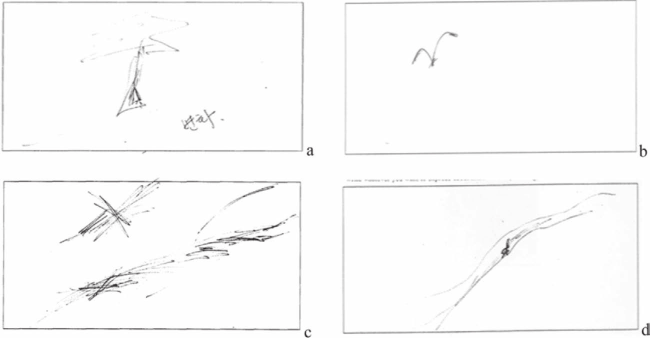
Figure 15.3a-d. Figures Drawn by Minjimoment. Minji then lightly hopped forward, with free childlike arm movements. Her arms moved up and down, a typical Korean arm movement of waving and flying. She opened both arms on a horizontal plane, advancing and spreading her chest forward as one would do upon reaching the summit of a mountain. This was the first time that Minji fully used her sagittal plane in her body posture. Minji shared her experiences with the scarf dancing by saying, “It was a great chance for me to understand myself better. The dance was not just about dance; it gave me more. I could see myself through dance. . . . When I am dancing I forget about everything. I am not thinking [of only bad things] and I can focus on myself.”
What follows is my LMA-based interpretation of Minji’s drawings (see Figure 15.3a-d). I used my own body movement as a tool to respond to each image and then described the movements that emerged according to LMA principles. I have also included my verbal therapeutic interpretation.
a. Float: A tree without roots represents the difficulty that she has had in becoming connected and finding nourishment in the United States. She reflected that perhaps it was time to adjust to a new environment in a new land, a step that requires “change” to survive.
b. Glide: The client drew a bird, symbolically representing her wish to fly away from her current situation on earth and take off to see her mother who had passed away. This drawing captures her loneliness, her longing to see her deceased mother, and a strong desire to move forward, because birds can only fly forward.
c. Slash: A boiling hot emotional container. This drawing made after Session 8 differs from all previous drawings: This drawing is abstract and expressed outward in rough way; it also uses much more space than the other drawings.
d. Press: Climbing a steep mountain alone. Unlike the drawings made in earlier reflections, this drawing expressed a mobilized quality, symbolically representing Minji’s strength in standing her challenging situation, depicted as a steep mountain.

