Dance/Movement Therapy in Japan and its Cultural Roots
Yukari Sakiyama
As dance movement therapists, we try to understand our clients. In this context, there is no difference between Western and Japanese DMT. The following sentence reflects our universal beliefs: “Every little movement has a meaning all its own, ever}' thought and feeling by some posture can be shown” (Hauerback, 1910). DMT also reflects each culture, especially through their dances and attitude toward the body. I have had numerous and varied experiences of DMT within different cultures. When I attend annual conferences of the American Dance Therapy Association (ADTA), I learn many things from my DMT colleagues from Western countries and other Asian countries as well. I appreciate both the wonderful diversity of DMT and the similarities we share, although our history and cultures are quite varied. The differences are hard to clearly explain, but this chapter will attempt to do so through a description of Japanese DMT history and our DMT features that reflect our body culture.
GENERAL HISTORY OF DANCE/MOVEMENT
THERAPY IN JAPAN
Japan has a background of various types of dance, just as every country does. Our distinctive and traditional dances are Kagura (sacred Shinto dance with music) and Shimai (Noh dance). Some trials using dance/movement for therapeutic approaches with psychiatric patients were reported in a research journal of the Japanese Society of Psychopathology of Expression & Art Therapy. They made use of such traditional dances such as Shimai, (Nogawa & Murai, 1979), Kagura, Oni kenbu, and Shika odori (Ban, 1981). Shimai is rather grounded and has steady steps with sliding feet.1 They tried to apply the slow and steady steps for clients in a psychiatric hospital, and it enabled them to concentrate on the movement. Shimai is a solo dance, and a good example of introspective movement. Kagura, Oni kenbu2 and Shika odori2, are rhythmic and extroverted group dances. They include jumping and sometimes spreading energy in order to bless all the gods and goddesses. Ban utilized these local dances for groups, particularly for the use of symmetrical movements. Members of the group had to be aware of each other in order to follow the same choreography. The leaders were not dmts, but a psychiatrist and a clinical psychologist who tried to apply Japanese traditional dance forms. However, these trials did not continue, unfortunately.
Butoh, a specific type of dance created by' Tatsumi Hijikata, is now being used by' professional Butoh dancers working as dmts. Their DMT has been established gradually through their work with clients within psychiatric hospitals. Officially' they aren’t trained in DMT, but one has been working with a psychiatrist and nurse, and the other is a psychology professor. Other types of dance are traditional dance forms for rituals or related ritual community' performances like Bon dance. Historically, Japanese DMT pioneers often utilized dance forms with people who were not used to physical expression and without dance experience. By' comparison, Western DMT was started by' modern dancers, and modern dance emphasizes creativity for free expression. There was one research paper using modern dancein a Japanese psychiatric hospital (Sakata & Shimoyama, 1970), but the practice was not discussed.
In the 1980s, Machida (1999) tried to gather all possible information about dance therapy in Japan by personal communications, attending conferences and meetings, or searching research papers and worked toward creating a large network for DMT all over Japan. In 1984, an American dance therapist, Sharon Chaiklin, was invited to a Japanese psychiatric hospital and gave some sessions for the staff there (Momonoi & Matsubara, 1985). Beginning in 1988, Amy B. Wapner was invited to another psychiatric hospital in Tokyo and taught DMT to clinical psychologists and nurses (Ogiwara et al., 1993). Finally, the Japan Dance Therapy Association (JADTA) was established in 1992. In the 1990s, some Japanese who had studied DMT in the United States or the United Kingdom came back to Japan as registered dmts and started working in different regions, such as Okayama and Gunma.
An interesting difference to note is that when compared with Western countries, males (9) were almost the same number as females (8) actively working in 1970s and 1980s in the aforementioned research papers (Nogawa & Murai, 1979; Ban, 1981; Sakata & Shimoyama, 1970; Momonoi & Matsubara, 1985). They were DMT practitioners and clinical psychologists (Shimoyama) or psychiatrists (Murai). Additionally, the first Japanese registered dance therapist (DTR) by ADTA, Motohide Miyahara, is male.
One reason there may have been more men in the field may be related to applied dance forms of DMT used in clinical settings. Many dance forms were performed by men who are closely connected to Shinto or Buddhism. Not only religious ceremonies but also other traditional art forms such as Noh and Kabuki are performed by men. Also. Butoh is a unique Japanese dance form that in its beginnings was performed only by men.
Several features of Japanese DMT outlined by previous JADTA president Machida (2012) are as follows:
- • It reflectsjapanese culture.
- • Group sessions are more popular.
- • Massage is often included.
- • Verbalization is not often required.
The following sections will discuss these features.
TRADITIONS OF THE BODY
Dmts recognize the importance of the integration of body and mind. Which body parts do you point to when you say “mind”? Japanese take it for granted that our body and mind are not separable. Western people have different ideas about this, so they point to the head when they say mind. Many Japanese put their hands on their hearts, despite knowing the brain controls the body. In our cultural context, the body includes a spiritual aspect and that cannot be separated. (Sakiyama, 2000)
Bathing Culture
The Japanese Onsen (natural hot springs and public bath)1 is frequented by families and by unrelated people who bathe together. All who bathe in the Onsen together, whether related or not, are equally touched by the waters that comfort and soothe, creating a collective body
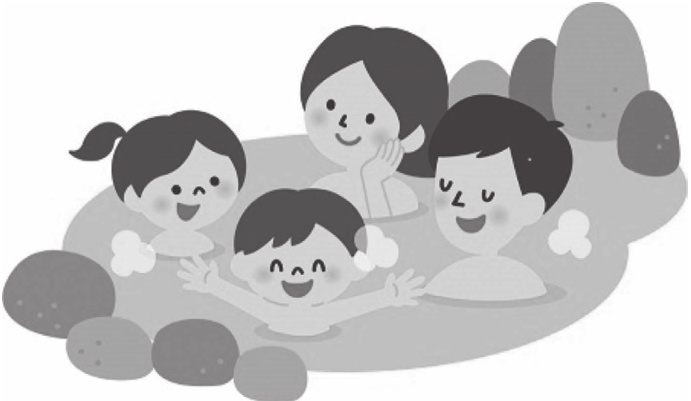
Figure 16.1 Family Enjoying Onsai
sense (see Figure 16.1). In addition, the act of bathing with others at the Onsen provides children with a venue in which to learn how to negotiate personal space and to support the development of the body sense within the public context. (Sakiyama & Koch, 2003). Dmts use the image of Onsen, since we have a pleasant association with it. It is “more than a bath”. Kitajima (2012) gave her session participants an image of soaking themselves in Onsen together by using a giant stretch band. She used a Japanese onomatopoeia, hokkori, which means warm and fluff}'. Hirai and Sakiyama (2016) also used the image of Onsen at a workshop at the International Association for Analytic Psychology to introduce Japanese body culture.
Broderick and Moore (2010) state that this bath is not only for cleaning but for relaxing and getting rid of the day’s worries. Merry (2013) explains Japanese bathing culture as follows:
Japanese bathing culture is a phenomenon remarkably different from most traditions in the modern Western world. To many, the concept of stripping off one’s clothes and bathing communally is foreign. However, in Japan, this accepted and loved convention permeates society, transcending generational, social, economic, and geographic barriers. The sheer number of hot springs and baths in Japan attests to their cultural significance and importance. Due to the great degree of variance in the types of baths and the rituals surrounding them, an understanding of their distinctions is critical to interpreting their individual societal functions and implications.
(P-1)
The Image of bathing may be part of dreams and may be used as a therapeutic image. (Ohnuma, 2012) Mostly, we shower and take a bath alone. However, we still keep the experience of taking a bath together in our memories of our daily' life or of leisure with family or friends or even unknown people when visiting Onsen. Sharing the same hot water in the tub at the same time is a good opportunity for communication, as it is a shared experience.
Use of Touch and Massage
The Japanese are accustomed to “indirect” touch through sharing the same tub to bathe as mentioned earlier but we don’t hug much in salutation. However, in child-parent relationships, we have experiences of direct touch through playing (see Figure 16.2). As an example, there is a traditional nursery song when children give shoulder-tapping massage (Kata Tataki) to their mothers.
The translated English lyrics are:
Mommy, shall I tap your shoulders and ease your stiffness? Tap, tap, tap, tap, tap, tap, tap Mommy, you have some gray hairs, did you know? Tap, tap, tap, tap, tap, tap, tap
Our veranda gets plenty of sunshine Tap, tap, tap, tap, tap, tap, tap
Bright red poppies are smiling at you Tap, tap, tap, tap, tap, tap, tap
Mommy, are you feeling so much better now? Tap, tap, tap, tap, tap, tap, tap
( Original lyrics by Saijo Yaso Music by Nakayama Shinpei, English Translation by Yamagishi Katsuei ©)’
Japanese children who are Westernized still know Kata Tataki. This suggests that massage is not done only by specialists. Sakiyama and Hirai (1997) showed how to use touch in psychiatric settings during relaxation and mentioned the importance of rhythmical touch that includes an image of progressiveness and moving forward. Through rhythmic active stimulation, as the massage goes on, clients can feel the tension in the muscles being released. The lyric, tap, tap, tap, tap, tap, tap, tap easily gives us the image of rhythmical shoulder tapping. When doing this massage, we sing along with the original lyrics. It is tan ton tan ton tan ton
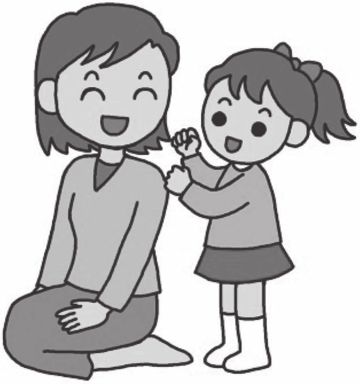
Figure 16.2 Kata Tataki
ton, an onomatopoeia which means “light touch with tapping” and promotes an intimate contact. Touch exists within the daily lives of families and friends just like Kata Tataki (see Figure 16.3).
Included with these kinds of rhythmical touch, we often use the word, “Karada Hogucht’. Karada means body, and Hogushi is a noun meaning disentangle, straighten out, and relax the tension. The concept of Hogushi is not active but rather being passive in order to allow the body to be just the way it is naturally. The concept of Karada Hogushi is officially adopted in physical education.
Kata Tataki is not done by facing your partner. Every child stands behind their mother, father, or grandparents. They all face the same direction. The back is left defenseless because they trust their children and grandchildren and there is affection between them. Japanese body culture embraces this defenseless back. Here is a vignette:
K (male, 25, mentally handicapped, epilepsy) initially could not participate in group DMT sessions. At first, he disliked entering the room. When the session started, he would run away and each time I would run after him. It became a game to him, and the “game” seemed to be a way of starting a relationship with me. It was then that I noticed he always stood with his back toward me. It seemed completely defenseless to me. I also stood with my back toward him. This appears to be a common body position among Japanese.
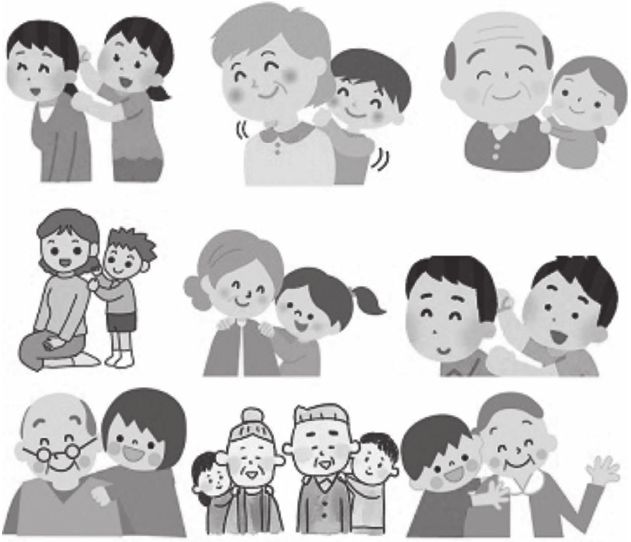
Figure 16.3 Examples of Google Illustration Search of Kata Tataki
K and I have since developed a good relationship due to, in part, the “defenseless back” position. Perhaps a lack of eye contact helps most Japanese feel comfortable. Possibly, most Japanese unconsciously develop relationships through their “defenseless backs” that are open to the world. These ways of communication give us some information which is useful for DMT in Japan (Sakiyama & Hirai, 1991).
American dmts who had several experiences providing sessions in Japan understand our body culture. Appel (2005) introduced the Japanese concept of the body through personal communications with Chaiklin and Koch as follows:
Japan is open to the use of the body through such things as martial arts and an understanding of the body through meditation and other Buddhist influences. There are many rituals and ways of doing things and no one wants to be embarrassed in having [to] “lose face,” but these are choices that people make. In Japan, the body has not been repressed. . . . The Japanese did not have the perspective that we inherited from the Puritans about the body being a source of sin. It is rather a source of pleasure and accomplishment, i.e., martial arts, noh, kabuki.
(personal communication, 1999)
The body is not sinful but respected. Therefore, we can share spaces with others even while naked in Onsen. It is a great advantage and historical treasure.
In Japan, as is true of Eastern thought, the mind and body are seen as one. This idea, distinc tly different from what has been perceived as a split in the West, gives the Japanese a particular openness to using dance as therapy (personal communication, 1999).

