Shouting Silently
One of the early interview-conversations in London was with Takeshi, a collaborating professional dancer in the project whose father—Souji—lives with YOD in Japan, see Figure 11.7 for an early family photo taken by Takeshi’s mother, Kimika. Takeshi has spent time being his father’s carer, and as I listen to him speak about their relationship, I feel warmth and groundedness together with sparks of agitation. It is with these affective layers that I start to imagine into their current relationship. I reach for a deep breath when Takeshi tells me that he does contact work with his aligning father, “back-to-back, and then holding hands and leaning back and forwards. Sometimes turning together ”. Takeshi, invites his father, Souji, into a way of knowing in the world, and into the present moment through tactile-fan-aes-thetic conversation. Touch awakens deep-rooted somatic memories and in doing so, as Manning (2013) describes, it animates the politics of an event. This fan-aesthetic conversation was not something that father and son engaged with before dementia, and Takeshi notices that taking his father’s weight (in all senses) agitates the father-son balance of power:
Father always wants to be ‘father’ rather than be taken care of. Also, I think it’s my tendency to become like a teacher and I think my dad doesn’t like that. I see it with his facial expression ... and he also says ‘no, I don’t want to do this!’
A different father-son kinship seems to manifest through confronting the boundaries of touch. It seems that this exchange trembles as Manning has it, “between touch-as-tact and touch as the activity through which new constellations for bodying are created” (2013,
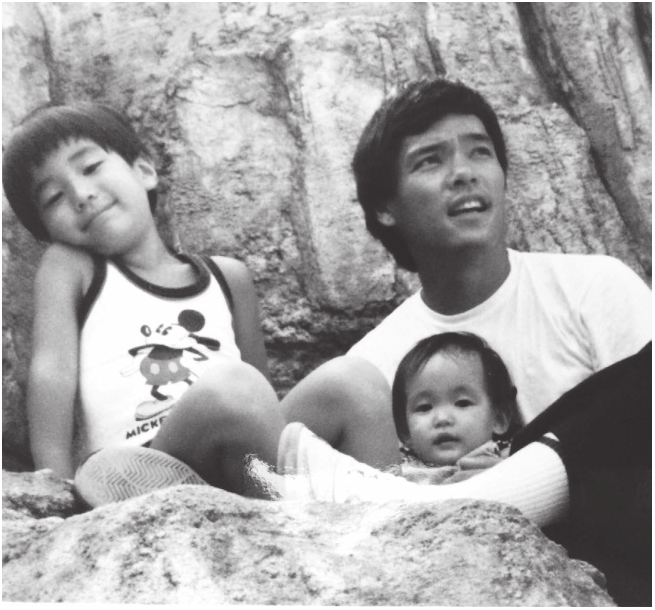
Figure 11.7 Takeshi, Souji and Asami Matsumoto
Photo: Kimika Matsumoto.
p. 125). Souji s clear boundary', his ‘no’, poignantly resounds with Takeshi’s description: his father is a man who was diagnosed with dementia at the age of 56, with a working life, a family and, who in the early stages of diagnosis, developed hallucinations and now, is restless with insomnia, expressing his resistance as he shuffles his way through the family home at night barefoot, speaking quietly into the silence of the night. I sense a man confronted by his own finitude, laying bare some of our most fundamental notions about what it means to be human. Dominant discourses of aging and dementia describe not only a threat to some part of the anatomy, but to a person’s mind, their autonomy, their capacity to speak and ‘voice’ themselves in the world, or even their humanity—thus revealing deeply held, if seldom articulated misconceptions about the nature of selves and bodies, which in turn has consequences for how we assess the very humanity of the elderly. By way of antidote, I am moved when Takeshi considers his father’s humanity and potential:
I’ve never really looked at him until he gets dementia. So, it’s like, ‘ok I hear your voice now.’ He never complained before. It’s hard, because that’s dominating at the moment, but at the same time I see him as a whole, and I think it’s OK to have these moments, because he’s never been like that. I positively try to take dementia as a kind of ‘possibility’ to do something different to what he never experienced before.
Takeshi challenges the limits of humanism with his inclination towards ‘taking dementia positively’, allowing for potential to meet the possibility. Preceding PheMateriahsm, Japanese anthropological research conceptualizes the self as relational and a process of achieving a social and psychological reciprocity and integration into the wider collective (Traphagan, 2000). From this vantage point, historical Japanese representations of dementia tend to eschew tropes of obliteration and erasure that figure so prominently in Anglo-American narratives and biomedical accounts and are instead attuned to the materiality of memory and its role in making us who we are (Post, 2000). This dwelling in the present allows Souji and many other people living with dementia, for dancers, therapists, to embrace the flux and persistence of somatic habits with/in the dynamic specificity of everyday life (Barad, 2007).
Summer 2017, London-Tokyo
I am working in the studio with four dancers preparing Takeshi and Souji’s bespoke performance for other families to witness. I am aware that Souji is both present in this creative process and yet geographically ‘absent’ as he lives in Japan and is the only participant living with YOD that is not physically present with us in London. This realization becomes paradoxical, it highlights the ontological presence-absence that often characterizes the person living with dementia and, also Derrida’s notion of the person ‘lost’ as inescapably ‘in’ us (2001).
In an attempt to maintain a response to some of this complex and ambiguous bodily knowing, I support the dancers to work improvisationally with Takeshi’s refrain, ‘I hear your voice now’. In doing so, I am also aware, from Takeshi’s current updates at the time of writing, that his father’s capacity to speak words is diminished, leaving him with a permanently open mouth. As I witness Takeshi, I am drawn to the cool, shiny, grey dance linoleum floor as he takes gradual and steady forward steps repeatedly opening his mouth and reaching with both hands, arms extended in front of his body, see Figure 11.8. I sense my own steady
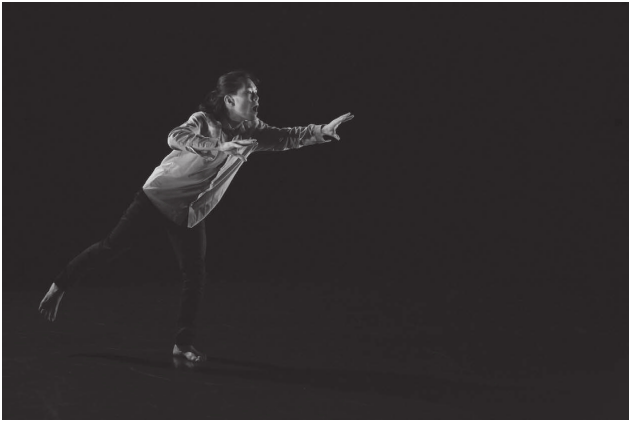
Figure 11.8 Takeshi, Public Performance at Michaelis Theatrebreathing rhythm and my gut tells me he is not reaching in the singular, his father reaches with him, I am reaching with them both, and the environment reaches. Takeshi, repeatedly opening his mouth as if to shout, remains silent. In this moment, the impact of Souji’s voice is kaleidoscopic, across time, space and place, between Tokyo and our London studio. Souji’s voice is ‘post-verbal’ (Quinn & Blandon, 2017, p. 587) extending beyond his individual body and as it does so, the material begins to compose us. For Takeshi, hearing his father’s ‘voice’ in the creative process has articulated the ineffable. Ten months later, Takeshi speaks about this material in his interview:
I’m shouting towards the void, or loss. Shouting Silently. And someone is assisting me shout. I think more so now, I start to feel anger towards dementia—finally, I just want to shout and express this anger.
We are not defined solely by our intellect. Railing against hypercognitivity and in stark contrast to biomedical prognosis of silence, language impairment and individualism, Takeshi’s silent shouts have an acoustic presence that draw attention to the articulacy and agency of this bodying act. Becoming a choreographic refrain, shouting silently is not less than human, it does not render those living with dementia as ‘disposable’ (Braidotti, 2013, p. 15), shouting silently is a worlding, as Manning (2013) has it, of equity, solidarity between father, son, dementia, bodies and choreographing the political—all at once a reconfigured fen-aesthetic assembling of otherness and reciprocity. This fleshy act of resistance summons a constructive politics of illness, silence, anger, loss and of relating with fathers.
Winter 2017, Florence-London
The politics of shouting silently evokes a parallel process that churns in my gut. I too want to shout from a primal, rage-filled place as I remember shifting uncomfortably between sitting and standing in the intensive care unit of Florence’s university hospital, the hospital where I was born. I am dimly aware of the bright January sun filtering through the vertically slatted blind. This suggestion of light from the natural world is something I crave but is in stark contrast to witnessing my dying father in a coma, silenced, no longer speaking for himself. And yet, as I pay close protective attention to his micro-movements, his heart rate changes, mechanically captured by the clicking and beeping of the monitor, my dad has become-with-machine (Braidotti, 2013), it will do the telling. I carefully breath-with his fluctuating rhythms, the rise and fall of his chest, a chest I have rested my head against all my life, and I do so one more time, again and again, because I know that soon I will no longer be able to do this. Reaching for his body I squeeze his feet, gently hold his head, grip his hand, a conflicting intimacy both treasured and resisted. In his near-death state, I am summoned to speak for my father, I want to release my breath from a deep place and to shout out his suffering and mine. I cannot. As we both confront death’s “final silence” (Lorde, 2017, p. 3) this moment wrenches, it viscerally marks my understanding of kinship as an entangled materiality and Barad reminds me that “the other is not just in one’s skin, but in one’s bones, in one’s belly, in one’s heart, in one’s nucleus, in one’s past and future” (2007, p. 393). This silent shouting becomes a Zranscorporeal inheritance where affective intensities, vital organs, life support technology, father-daughter bonds, an Italian January assemble for the first and last time.
Destabilizing the linearity of past, present and future (Barad, 2007), I do not yet know how this material will dispossess me. Braidotti (2013) tells me that it will be part of my ‘future-present’ and I begin to see how it is part of the wider creative process of living. As the
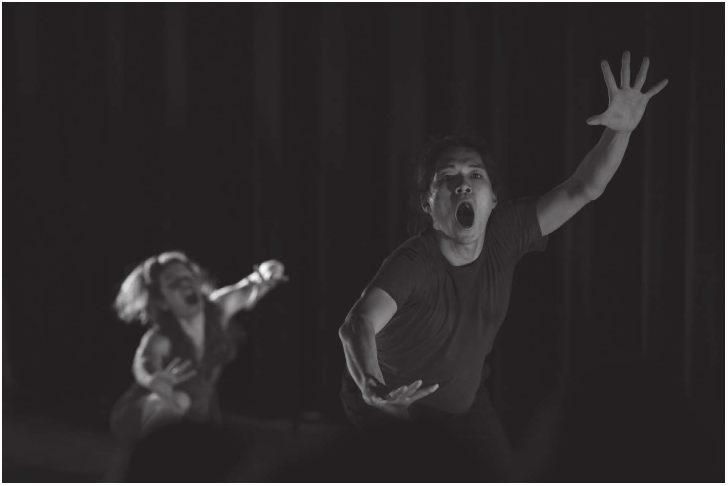
Figure 11.9 Maria, and Takeshi, Public Performance at Michaelis Theatre
Photo'. Thomas Lines.
co-compositional process takes hold, I invite Sabrina to stand behind Takeshi and, rooted to the spot she gradually begins to find a deep resonating shout from her belly, see Figure 11.9. I witness the intersecting body politics of this moment and am caught off guard: Sabrina’s small-boned, muscular body shape-shifts, she becomes-animal (Braidotti, 2013) emitting a deep howl that seems to propel Takeshi forward. Sabrina becomes with Takeshi, Souji and dementia:
Takeshi starts in front of me very close, we are gathering our breath from the previous scene. I can see his back swaying. Slowly, I start to breathe, my exhalation will be the engine for him to move. As I breathe a force from the ground reaches my lungs and my throat—my voice is out.
I can see his back breathing and expanding, I’m talking with his back, my voice now is powerful and through it he can reach further. He wants to scream but he can do so just through me, we are connected. He is me and I’m him, he talks because of me and I walk because of him.
Sabrina’s somatic ‘force from the ground’ summons Braidotti’s words on art as “cosmic in its resonance and hence posthuman by structure, as it carries us to . . . the limits of life itself and thus confronts us with the horizon of death” (2013, p. 107). Sabrina’s becoming-with is an affirmative endurance of rage, loss, dementia, since it articulates how, as Manning has it, that “movement is not of a body. It cuts across, co-composing with different velocities of moment-moving. It bodies” (2013, p. 14). In a similar vein, Kate Swaffer (2016), diagnosed with dementia at the age of 49, proposes a dementia carer as a ‘back up brain’, an extension of ‘self-other’ binary. Sabrina, Takeshi and Souji, voice, breath, dementia—are also pros-thetically entwined (Manning, 2007). This /ran.icorporcal moment of shouting silently offers an extension of a capacity for relating, beyond the imagined stability of individualism, beyondidentity, a posthuman shouting, highlighting material-discursive flows, incompleteness, indeterminacy and continual reconstruction.
Winter 2018, London
In a continued web of relating, the un/voiced rolls across the studio and through eleven public and international performances of I’ve Lost You Only To Discover That I Have Gone Missing. As it does so, the shouting silently material sensorially widens in a way that Luke describes as a “disruption”:
I remember first working with this material from Takeshi and his father . . I always work with clenched fists, disturbing the space. As I was doing it, it felt really emotional and I felt really affected by it.. ., the tension. And then, the more times I’ve done it [t] he material has emptied out in relationship to Takeshi, but in relation to my role with Sabrina, it’s loaded up. So, yes, just feeling and seeing the different content that comes and goes emotionally with the material and knowing when to let go. Every time I perform that piece, it couldn’t have been about Takeshi’s father, otherwise I would have looked at him on stage and burst into tears (see Figure 11.10).
The material is infra-activated and transformed through Luke’s performative acts where voice is distributed and becomes part of an agentic assemblage. Luke’s response somatically unsettles relating with the material, and his deliberate provocation demonstrates how his movement has created space and time (Manning, 2007). In doing so, shouting silently gathers affective momentum, interfering with hegemonic expressions of anger and voice residing in
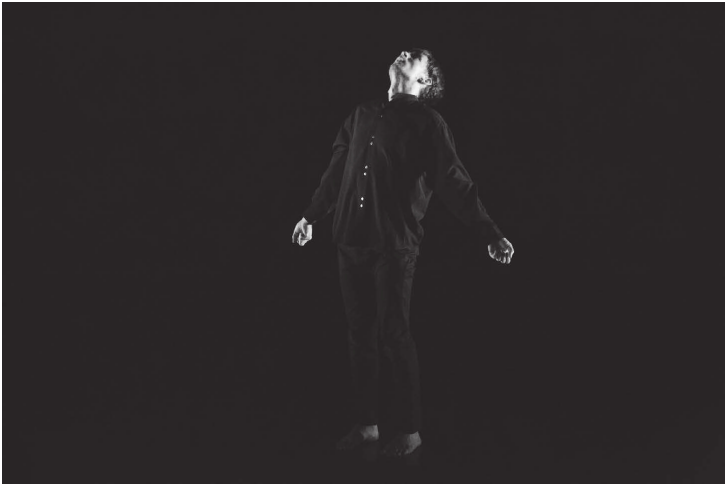
Figure 11.10 Luke, Public Performance at Michaelis Théâtreindividual bodies. Instead, moving affects constitute this event that in turn becomes bodying multiplicity (Manning, 2013).
The bodying multiplicity of shouting silently points towards clinical and/or artistic material being self-evidently in flux, and as Luke clearly demonstrates, a distributive process. All these affectively affirmative layers—father, son, daughter, vocal chords, acoustic resonance, geographical locations, movement across oceans and time zones, technology, becoming-animal, studio floor—have assembled and are nonsemantic companions in birthing Ain-aesthetic clusters of resistance. This is our dancing activism.

