TRADITIONS OF IMAGERY FROM FOUR SEASONS
Other cultural images are closely related to climate and the school year. Japanese culture is full of traditional seasonal events related to nature. They are cherry blossoms in spring, Bon dance in summer, red leaves in autumn, and Kotatsu, a Japanese foot warmer with a quilt over it in winter. Figures 16.4-16.7 show us these typical images of each season.
The Japanese school year begins in April. Families celebrate the entrance to schools for children. The timing is just the same as with beautiful cherry blossoms, Sakura. In spring, images of cherry blossoms are sometimes utilized in psychiatric hospitals. I gave my sessions at a psychiatric hospital for the first time more than 30 years ago. It was located in a rural place in Nara prefecture, close to Mt. Yoshino," famous for beautiful cherry blossoms and registered as a world heritage site in 2004. At that time, inpatients had the opportunity to go out and enjoy the beautiful cherry blossoms on an excursion (see Figure 16.4).
Many Japanese people enjoy Bon dance in summer. Bon (or Obon) is a Japanese Buddhist custom to honor the spirits of their ancestors in mid-August. Bon dance (or Bon Odori) is a style of dancing performed during Bon period. Originally a Nenbutsu Odori is to welcome the spirits of the dead. The style of celebration varies in each region. It was established more than 800 years ago.
In summer, all the patients and staff danced Bon dance together in the courtyard at the hospital. I didn’t know the local Bon dance, so a patient who loved Bon dance taught me how to dance before the event. At the event, it didn’t matter if we were a psychiatrist, nurse, or patient. Sharing the same time and space and enjoying the same rhythm and choreography allowed all the participants to feel that they belonged to the same community (see Figure 16.5).
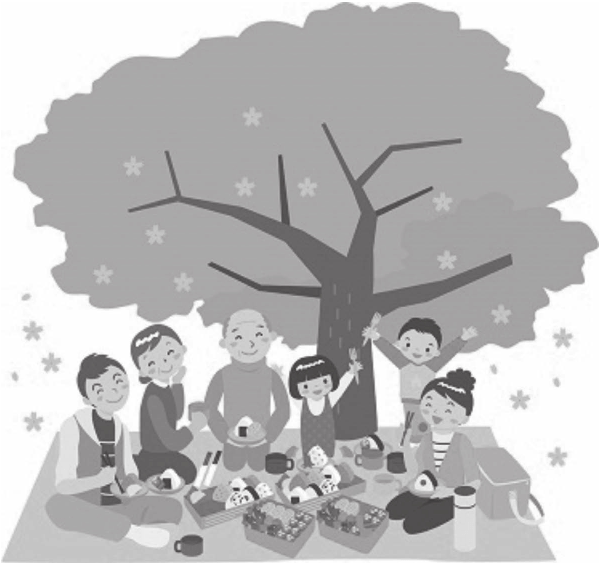
Figure 16.4 Family Enjoying Cherry Blossom Viewing Picnic in Spring

Figure 16.5 Family in Bon Dance in Summer
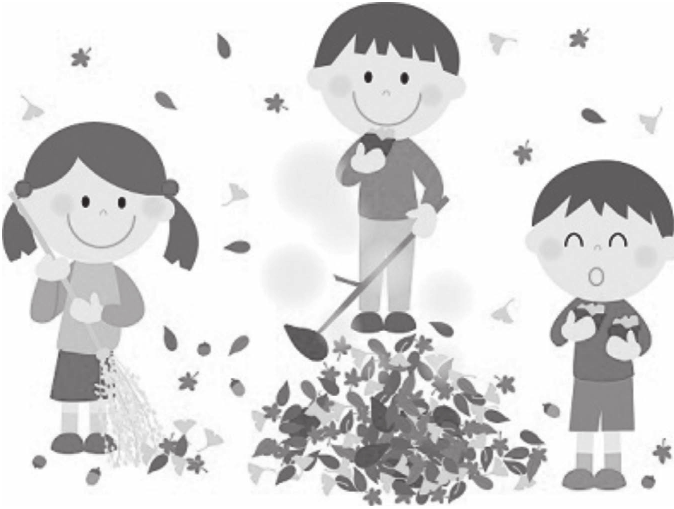
Figure 16.6 Children Baking Sweet Potatoes in Autumn
In autumn, Japanese people can enjoy beautiful red leaves just as they love cherry blossoms in spring. Children often play with red leaves. In kindergarten, occasionally many red leaves are gathered in order to bake sweet potatoes outside (see Figure 16.6).'
Japanese dmts apply these ideas in various ways in their sessions. These drawings of Japanese images are sometimes utilized for encouraging people to move. Here is an example of playing with red leaves presented by Yo Teruya in 1993 (Machida, 2012):
Teruya showed many red leaves which he picked up during an autumn morning. He asked participants to pick a favorite one and to examine it and then to feel it with eyes closed. After that he asked them to walk slowly with the leaf on one’s hand and then, to exchange it with someone else and put the new red leaf on another body part . . .
Teruya always gave suggestions to all the participants such as this, to facilitate their movement exploration. These intimate images are appropriate for many Japanese who do not feel comfortable with free expression. These seasonal images come from experiences in daily life. They are concrete and easy to reflect upon. Japanese collective cultural images support clients’ expressive movement and are a key to communicate with others in DMT sessions.
Kotatsu is a traditional heater in Japan. Each family shares this heater together and spends their own time as they choose. The heat from the bottom is quite comfortable so people often fall asleep (see Figure 16.7). When winter came, inpatients enjoyed the Kotatsu in the recreation room in the hospital. Some read books or newspapers, some enjoyed talking with friends, and others did nothing but just take a nap just as shown in the figure.
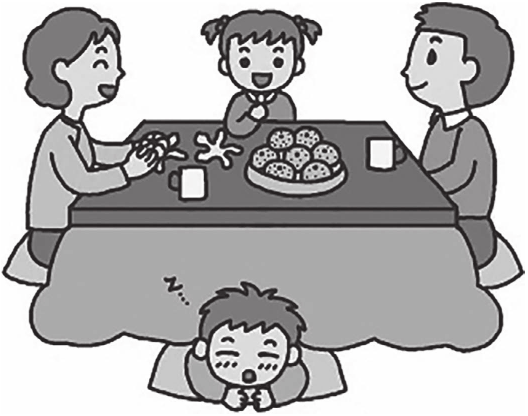
Figure 16.7 Family in Kotatsu in Winter
Many Japanese share the same images of the four seasons because these experiences exist in our daily life from childhood to adulthood. Such concrete images are easy to transfer to physical movement. People recall what they' did in their past with others. The concrete suggestions by dmts often work well for clients without confidence to explore movement.
INFLUENCES OF WESTERN DANCE/MOVEMENT THERAPY
Kayoko Arakawa and Kyoko Jingu are both pioneer dmts in Japan who graduated from an approved course in the United States. Their explanations about DMT illustrate the importance of approaching one’s inner world and the use of improvisation. Arakawa says that based on the idea that “the mind and the body are connected and interact with each other’’ through improvised movement, it is possible to reach deeper parts of the self, namely, through freely' associative movements and images, iconic languages, physical sensations, and so on.
Ogiwara et al. (1993) describe their group sessions at psychiatric settings in Hasegawa Hospital. At one session, a dmt tried to reflect one client’s fear through vocal sounds and then added movement related to fear. The other clients shared the same voice sound and movement. As the session progressed, angry feelings gradually came up. The therapist used imagery to help them verbalize and use movement to symbolize the feelings that arose and were thereby supported by' this process. This example is similar to the Western DMT approach. An American dmt, Wapner had visited Hasegawa Hospital many times and taught these approaches that were adapted to Japanese clients. In Ogiwara’s article, a dmt picked up an image from a client’s gesture/posture to activate his movements. She suggested appropriate words that clarified the movement for that person. These sessions focus on the importance of free expression or improvisation, and after that their reflection through verbal sharing.
AN INFLUENCE OF BUTOH IN JAPANESE DANCE/MOVEMENT THERAPY AND NOGUCHI TAISO
Butoh is a worldwide famous post-WWII Japanese original dance form originated by Tat-sumi Hijikata. (Jones, 1992)
With a number of collaborators, including Kazuo Ohno, Hijikata developed a style of choreographic extremism designed to startle the Japanese into recognizing unpalatable truths about their society. The name given to their movement was Ankoku Butoh, which can be translated as “dance of the dark soul.” Butoh has since evolved a more flexible aesthetic that makes room for lyricism and even humor alongside grotesquerie (p. 236).
Hijikata and Ohno are the most famous Butoh dancers. Fraleigh and Nakamura (2006) analyze these Butoh dancers’ ideas and spiritual darkness. In Ankoku Butoh, the dancer’s body is always shrinking and full of tension. It sometimes looks like spastic paralysis or cerebral palsy. It has no lightness in Effort, no gentleness in precursors of Effort. It looks grotesque, just as we view a human’s dark side (see Figures 16.8 and 16.9). Figures 16.8 and 16.9 show us these aspects.
Sometimes people confuse Butoh and Ankoku Butoh because of the historical background from Hijikata and Ohno. However, when we use Butoh in DMT in Japan, dmts don’t focus on the dark side of human nature as Ankoku Butoh which is full of shrinking shape flow and High Intensity of Tension Flow Attributes.9 Japanese dmts who use Butoh methods also don’t focus on clients’ inner worlds. Instead, they try to focus on the body itself for body awareness and relaxation.
Iwashita and Hashimoto (2004) named Iwashita’s sessions as Iwashita-Konan Method after 14 years of practice. Table 16.1 describes a workshop given by Iwashita (see Figures 16.10 and 16.11). We can see how the session was divided, and many parts had specific suggestions to move. This means the session progressed step-by—step with easy movements and clear instructions. The most important thing is to be free little by little.
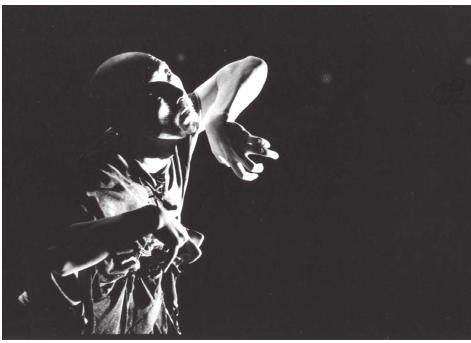
Figure 16.8 Performed by Itto Morita, Goo Say Ten Dancer
Photo'. Katsumi Takahashi, 1999.
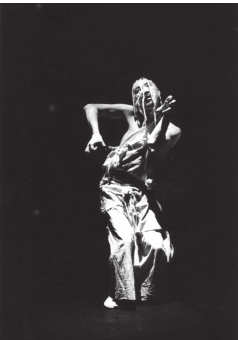
Figure 16.9 Performed by Itto Morita, Goo Say Ten Dancer
Table 16.1 Group Session Example of Iwashita-Konan Method
|
1 |
Salutation |
|
2 |
Lying on the floor to find comfortable state |
|
3 |
Turning over with a clap |
|
4 |
Waking the upper body with a clap and smoothly lying again |
|
5 |
Lying on the floor to find comfortable state again |
|
6 |
Standing slowly |
|
7 |
suwaisho from Tai Chi movement |
|
8 |
Lying on the floor to find comfortable state again |
|
9 |
Standing slowly again, walking around and making a various pose with a clap |
|
10 |
Making some relations with someone by movement |
|
11 |
Lying on the floor to find comfortable state |
|
12 |
Tea break with masala tea |
|
13 |
Karada Hogushi by oneself |
|
14 |
Pair massage |
|
15 |
Improvisation of pair posing |
|
16 |
Improvisation of group posing |
|
17 |
Interactive start-stop movement between two groups |
|
18 |
Corporative wall posing with all the members |
|
19 |
Lying on the floor to find comfortable state |
Translated by Sakiyama from Iwashita and Hashimoto (2004)
Kayo Mikami, who is a Butoh dancer and researcher, described the connection between Butoh and .Noguchi Taiso (1998). .Noguchi Taiso is an original gymnastic exercise created by Michizo Noguchi. Since the 1970s it has been the most well known of Japanese exercises for relaxation. It focuses on the body-mind connection, especially the importance of loosening rigidity and tension. Butoh dancer, psychologist, and researcher Toshiharu Kasai mentioned
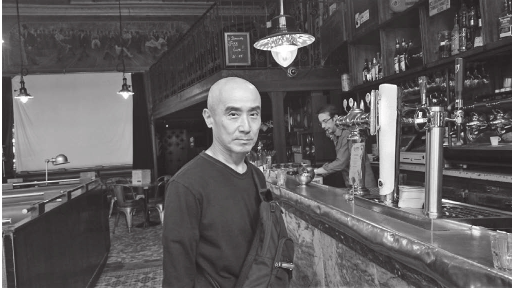
Figure 16.10 Toru Iwashita, San Kaijuku Dancer
Reiko Shiga, 2015.
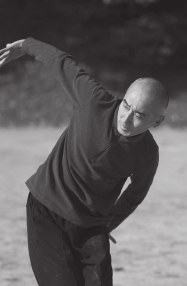
Figure 16.11 Toru Iwashita, San Kaijuku Dancer
Toshihiro Shimizu, 2012.
the connection of Butoh and Noguchi Taiso with Esposito (Esposito & Kasai, 2017) and also described the connection with Butoh as follows:
The following are central principles in Noguchi taiso: a) It is important to pay attention to passively induced movements; b) the muscles should be regarded as sensors rather than effectors when controlling the body; c) the heightened sensory awareness leads to movements performed with the minimum amount of energy. Noguchi taiso shares with butoh a concern for enhancing bodily sensitivity and responsiveness through a focus on gravity, inertia, the principle of an equal and opposite reaction for each action and the use of imagery.
(Esposito & Kasai, 2017)
Kasai has been working with psychiatric patients for a long time as a dint. He focuses on the importance of slow and small movements. Kasai (2015) wrote:
. . . small or slow movements are not always regarded as “non-expressive” but “significant” because most traditional indoor dances in Japan use delicate movements mainly because they tend to avoid rude movements and the resultant air turbulence and dusts in a small room with a tatami mat floor. The small and slow movements and peripheral vision exercise have been utilized for Japanese clients in dance movement therapy. They often induce a different and meditative mental state when they arc extremely slow, as described “painfully slow” in Butoh dance.
He concludes that their effect enabled change in thinking and creativity. He often describes it as body-oriented psychotherapy (Kasai, 1999). He introduces his work in video clips with his colleague, Butoh dancer, Mika Takeuchi. They demonstrate seven kinds of movements which you can observe.10 One of the famous movements is Nenyoro. It is body-waving movement for relaxation in pairs. One of the pair lies on his/her back. The other holds their partner’s ankles softly and shakes them side to side on the floor. If one can loosen tension, the body waves smoothly from the ankles to the head. Kasai pointed out his concept for body relaxation by referring to Nenyoro as follows:
A basic idea of Noguchi Taiso is that our body is not a skeleton with muscles and flesh on it, but a kind of water bag in which our bone and viscera are floating. He also places great emphasis on the significance of the weight of our body, saying “listen to the god of weight,” and appreciates most efficient movements with minimum muscle tension and instant tension release, (p. 309)
On the other hand, Ohnuma (2014) thought that restricted non-free movement is also good for her psychiatric patients as a challenge for new movement experiences. Butoh has various styles and movements created by each Butoh dancer. The idea of focusing within the body itself can be applied to DMT and other dmts often use some of the same concepts: The body has its own language and its movement describes how it feels.

