Shifting Focus
As the leader, my primary focus is external, paying attention to the group. However, I find my focus shifts very rapidly from external to internal. I find that my intuition kicks in as my attention shifts briefly and swiftly to my internal kinesthetic sense. In those moments, I am often guided by a brief discomfort, as it were. I check within to better discern what I am feeling, based on what I am seeing. It may be that I am observing an evenness to the energy' that lasts a bit too long. As my focus returns to the group, I may notice who is moving little and needs individual attention to express themselves more. I arise from my seat and approach
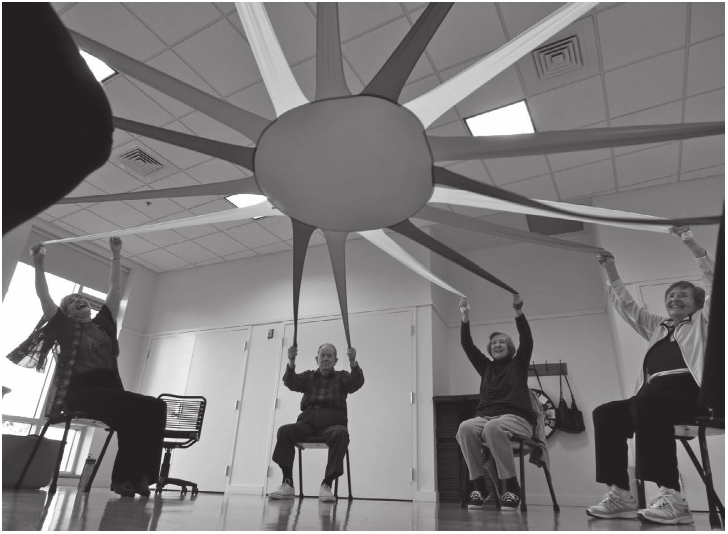
Figure 12.2 The Octaband“ affords us the opportunity for mutual play as we each give and receive energy
Source'. Charles Daniels Photography.
that person. I may use a gentle touch to get them to open their eyes or I may mirror their movements up close. I crisscross the circle, going from the person who is the least alert to the next least attentive, activating not only the individuals but also the energy' at the center of the circle. Again, I find an image helpful. It as though my perspective is a camera lens, shifting rapidly from whole to parts and back to the whole. This shifting between direct and multi-focused aspects of Laban’s Space Effort, along with my deep care and concern, is what I believe makes my groups as effective as they are.
Or I may respond to the evenness of the group by changing the pace, introducing suddenness either through what we’re doing or by changing the music. When I notice that they or I seem to need a bit of a break, I lower the energy, perhaps bringing our attention to the breath with our hands to our chests, or through sighing, and appreciating a moment of stillness.
Regarding my use of intuition, dance/movement therapist Alma Hawkins wrote:
When we are functioning at the highly conscious level, we arc concerned with the outer world of reality and action. At the deeply unconscious level, our interaction with the outer world is diminished, memory traces are deeply anchored, and there is less interest in action and more concern with self-experience. Between these polarities is believed to be another level of mental activity that has been identified as ‘prc-conscious’ (Kubie, 1942). This mode of thought makes possible the effortless bringing together of fragments and isolated elements of experience into new constellations. Drawing on affective states and sensory imagery, a spontaneous stream of thought results in clustering around a preconceived goal.
(Hawkins, 1991, p. 7; Kubie, 1942)
In a discussion with a DMT colleague, I once mentioned my use of intuition in leading groups. She advised me not to speak of intuition, that it makes it seem as though DMT has no foundation actually grounded tn theory. I am confident that not only is DMT grounded in theory, but intuition is part of that theory. It is also, in part, where our artistry lies.
Optimizing the Environment Through Props
Because difficulty initiating is one of the executive functions often affected by dementia, giving people stimuli to respond to reduces their need to initiate and changes their environment to one that is less stressful and more supportive of ongoing engagement with life (Coaten & Newman-Bluestein, 2013; Newman-Bluestein, 2017). In general, the greater the level of dementia, the more I use props, because they provide a structure, which people with dementia need. Props can help elicit a range of Effort qualities and provide motivation for a person to reach farther into their kinesphere, all of which contributes to a greater aesthetic experience.
In order to focus my attention entirely on them during the group, I create, in advance, a musical playlist beginning with music of their era which I find irresistible, that I think will appeal to them, is culturally sensitive, and that has lyrics they may remember. Using a high-quality sound system, I play music evocative of a range of dance styles. As we warm up our bodies, we begin expanding our physical range of movement.
Ribbon wands are plastic sticks with colorful ribbons attached and are usually the first prop I offer, providing group members with an opportunity to choose colors, to further elicit their rhythmic responses, and to expand the visual component of their movement (Newman-Bluestein, 2017; Newman-Bluestein & Hill, 2010). Regardless of diminishing cognitive abilities, most people have the ability and the desire to make choices, whether of colors or whether or not they want to participate. Honoring their choices reinforces their sense of agency. Observing, mirroring, and naming their movements, i.e., bouncing, swinging, or twirling, side to side, up and down, forward and back, effectively increases their responses (Newman-Bluestein & Hill, 2010).
The ribbon wands tend to boost the individual energy group members expend. As I observe their movement, I am looking to increase their range of movement, both physically and expressively, finding contrasts that make the dance more interesting, for me and for them. Maracas are another frequently used prop, appealing to their auditor}' engagement. And while balloons may seem to have little to do with dance, there is no other prop I have seen which prompts group members to move to the edges of their kinesphere or to move as spontaneously as the balloon. With the ribbon wands, balloons, and with scarves, I encourage a range of Efforts. All three of these props may be used with lightness. However, flexing the wrist with the ribbon wand with a sudden, whipping type of movement creates a snapping sound that wakes us up and usually generates laughter. Similarly, encouraging group members to hit the balloon with strength, directness, and quickness often results in great hilarity. While we often use scarves to waltz music for lyrical movement, by using a little tango music and changing direction on the count of 4, we begin to create some of the dramatic contrast I long for. With a cognitively higher-functioning population, using derby hats in the manner of choreographer Bob Fosse tends to foster their playfulness and observation of one another as well as to build upon memories they may have of Broadway and movie musicals. Finally, group props such as Octaband®s contribute to an increased level of group awareness and connection.
As Chaiklin (2016) stated, dance allows individuals to relate to their community while simultaneously being able to express their own impulses and needs within the group. The shared energy and strength that comes from being with others enables people to go beyond their personal limitations or concerns. Moving together brings joy, providing validation of our own worth as well as recognition of our personal struggles (p. 5).
Group Leader’s Movement Style
In 2010, as part of a gi ant-funded project, Certified Movement Analyst Jackie Hand analyzed video footage of my movement patterns while leading a DMT group with people with dementia to identify effective elements of my leadership style. Among her findings was considerable attention to Space with both Direct and Indirect focus, a flexible expressive range, and adapting my shape to each participant. She also noted an interesting spatial pathway: in the beginning of the group, I approached each person directly, shaking hands, exchanging names, and making eye contact. I then backed away toward the center of the circle before approaching the person beside them in the circle. I repeated that pattern with every person. I was unaware of that pattern until she reflected it back to me. I realized that my backing away was purposeful so that they would see my leave-taking as deliberate, rather than leaving them to be with someone else. That pattern also seems reminiscent of the Octaband® shape.
Salient Moments
It is in this atmosphere where openness and spontaneity are encouraged that some new movement usually happens, whether in moving with a prop, gesturing as they speak, sharing memories, interacting with others, or entrusting secrets. There is a depth and volume of synergy that emerges from this interdependence which is surprising, energizing all of us. Murmurs of appreciation can always be heard at the end of a group.
Because memories are stored in the body’s muscles and tissues, expressive movement often stimulates the release of memories. Within the safe context of a group, people will often share something important. It may be something that they repeat often, such as: “I was the only girl, with five older brothers.” It may be something that they say quietly and with great feeling, only to me: “Life is good. There is no slavery in my life since I was released from the concentration camp where my son died.” One woman, 100 years old, was in a group where two of us were swinging a jump rope across the circle. She asked for a second rope so that she could swing “double dutch”. As she swung the second rope, she said, “I wonder if Jane died. She used to be my partner.” Yet another woman with lifelong physical and cognitive challenges cried on remembering an uncle who used to carry her to school. They were tears of sadness and joy. Another Holocaust survivor found herself not wanting to talk about something that was bothering her, yet she continued to speak. She acknowledged, “I didn’t tell my children; I tried to protect them. I found out that my daughter knew when I was worried, even though I tried to not let her know. I lost a son.” Rather than feeling depressed at these memories, at the end of group she smiled and said, “You’re wonderful. You made me feel better.” She acknowledged that she felt better because she was accepted for what she was feeling and not pretending. When one woman forcefully threw a balloon to me, I asked her where her strength came from. She answered, “Wisconsin.” I asked, “Wisconsin?” She said, “Yes. I grew up on a farm.” There are many who cannot verbalize except to say, with great effort at the end of a group, “Thank you” as they look earnestly into my eyes, press my hand with theirs, or blow kisses.
Of course, there are also the stories of those who cannot speak with words. Theirs are the dances of prolonged handshakes prior to group—the physical jokester, who willingly dons a ridiculous hat; the person who doesn’t remember how to use a fork but whose spine lengthens elegantly when she hears a waltz; and the man who speaks gibberish but knows to toss the balloon gently to the frail elderly woman and smashes it to me.
Closing Ritual
To mark the end of the group, I close with the following ritual: three times, we slowly take a breath in, bringing our hands up in front of us only as high as our shoulders; we breathe out, bringing our hands down. After the third time, I say with accompanying gestures, “In a gesture that symbolizes what we’ve been doing, we give a little bit of ourselves to everyone here and we receive a little bit of everyone right back in.” We move our hands face up, from the heart, arms extending forward and then out to the sides and back to the heart. I follow that with, “We give with our words, our movements, our voices, our smiles, our presence.” Most of the group members, even those who didn’t join in the opening greeting ritual, usually do the ending ritual.

