FORMATION OF KOLKATA SANVED
In 1998, I developed a pilot project called Rangeen Sapnay (‘colorful dreams’) that combined movement and performance techniques from dance, music, physical theater, and miming. From 1999 to 2000, Rangeen Sapnay was supported by the government. During this time, it reached out to 120 children who were 6-14 years old and had been rescued from four red-light areas. The pilot project was a great success and marked the birth of Sanved—a platform for creative expression—in 2000. This started as a semi-autonomous program that advocated for children through performance, workshops, and regular sessions. It helped individuals identify their own potential as human beings rather than as victims. Since society tends to focus on class- and gender-based livelihood options, I attempted to break this barrier by thinking outside the box and taking risks. This led to the development of Sampoornata for women and children, who unfortunately, in most cases, do not receive the quality rehabilitation and reintegration sendees they need.
After formulating the rehabilitation methodology, I developed a model through which survivors can become healers and practice DMT in their communities. I trained ten survivors with no formal academic background to become DMT practitioners. DMT is not a field that is in high demand, so this was a challenge. However, I took these risks because my students agreed to start on a new journey with me and had the passion, body knowledge, and experience for the work. After a four-year rigorous training process, five of the original students and I founded Kolkata Sanved on April 29, 2004, with the mission of establishing DMT as a method for bringing about psychosocial rehabilitation and social change in South Asia.
SAMPOORNATA MODEL
Championing the arts and therapy as crucial aspects of social development is central to Kolkata Sanved’s work. In the wider field of social development (World Bank OED, 2005), art and therapy remain sadly under-recognized and under-utilized. In that sense, Kolkata
Sanved is a pioneer in the field of DMT in India and South Asia. Developed in response to the communities Sanved serves, Sampoornata recognizes and explores dance as an art form and an experiential therapeutic tool. It has become the dynamic force motivating our organization and furthering DMT in the region (Rajan & Bhogal, 2017).
DMT is a tool that helps survivors, and subsequent practitioners, to connect and contribute to the lives of people from various backgrounds, age groups, and socioeconomic strata.
It is a creative process that emerges from the body through improvisation. The individual expresses their experiences with movement and verbally reflects on the process at the end of the session. Everyone’s experience is different and unique. In the same group, DMT can make someone feel energized, another feel a sense of release and freedom, and yet another experience catharsis. Through DMT, we go on a journey through our body and learn from that experience in order to gain insights to implement in daily life (Bernstein, 1995). As a form of expressive arts therapy, DMT utilizes a natural skill: all you need is your body. It requires little to no investment in new infrastructure and thus can be utilized in almost all situations (Chakraborty, Mondol, Bhattacharya, & Chaudhuri, 2014).
THE PROCESS OF SAMPOORNATA
Sampoornata is a group process with two facilitators working with 20—40 participants at a time. The process is experienced mindfully in real time. It is a steady, consistent process that allows participants to take whatever risk they want within a safe space. What is beautiful about the process is that one learns from the journey of moving with peers while simultaneously going through the experience as an individual. In the group, participants often feel emotionally supported. They might break down because something deep is emerging, but they do not feel threatened while engaging with the group (Chakraborty, 2015, 2019).
The Sampoornata process comprises the following:
- 1. Needs assessment
- 2. Developing a plan of implementation
- 3. The DMT session (see Figure 14.1)
- 4. Documenting the process
- 5. Evaluation
What follows is the personal experience of a DMT practitioner who was once a program participant and who is now a senior facilitator in the organization:
What amazed me the most was that, at first, I was judging Sohini negatively. Sohini had not been talking much while facilitating. So, I thought this was not going to go well. Then, the space was transformed. On the first day, we did a warm-up with a piece of cloth. During this warm-up, there were individuals who were making use of the cloth. It was not the specific activity' that affected me to such an extent, but the way space was held by Sohini on that first day. It became a very non-judgmental and safe space from the get-go. Even before wc broke for lunch, the room had already been transformed. Later on, when I was reflecting, I understood that in reality, we all had co-creatcd the space through our own creative experience.
Across the five days, each day' there was a new discovery. On the first day, I felt that this was interesting. On the second day, there was a deeper reflection about myself through the process. I was able to partly share it with the group. Nobody judged. I took this back with me so
I could think and reflect about it. The main thing in the process was how the facilitator held her own being and how she held the space. Even without many conversations, teaching, or preaching, it was so deep. That was my memory of those five days. I was able to access deeper spaces within myself. I would not have done this before in a group, ever. The first five-day-long workshop pushed me to attend another one facilitated by Sohini.
Now, I have done many workshops with Sohini and am also a practitioner. Despite this, when I recently participated in a ten-day KS [Kolkata Sanved] workshop on a specific module, there was an activity that was particularly powerful to me. This activity was based on fear. Before the activity, everyone shared their stories through movement. It was like building blocks. I discovered that healing is a process. Prior to doing this exercise, I thought that I had healed. I thought that I had overcome it. I had spoken about it. .. . Yet, suddenly during that process, it all surfaced with great force. That day, I finally let it go. It was just gone.
After this activity, all of us shared our stories verbally. We did this with randomly chosen partners. I was able to share through movement such a deep thing that I had never thought I would share with somebody who I was not close to. This is one of my most powerful examples. There was also a balance activity that we did that was phenomenal for me. Different people shared different things. I was also taking on the role of the caregiver in the group, while also not taking space. I felt that that is how life is. People have to take and give. I felt and experienced it in that space. That balance to this date remains a very special memory. Each time that I do it now in the field I tell myself to not compare it with that time because my experience was very deep, and it is not necessary that in every group people would have the same experience.
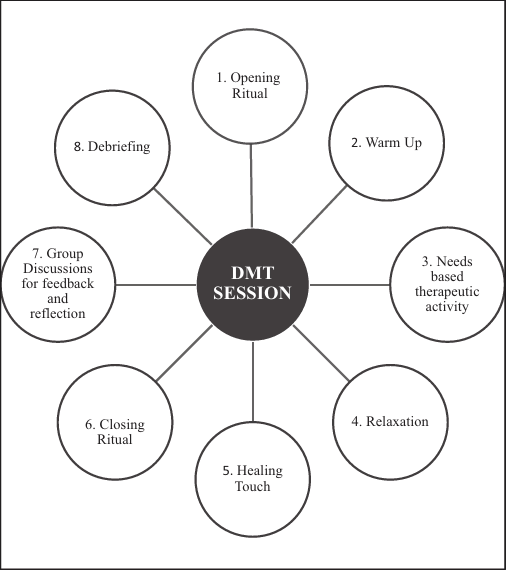
Figure 14.1 DMT Session Structure in the Sampoornala Process
DMT is a creative process, and the facilitators are like architects working with participants to design the process in real time. This is a step-by-step process wherein whatever emerges from the group’s experience informs the next level of therapy (Fargnoli, 2014). Step one in the Sampoornata repertoire is a ritual and a warm-up. Rituals are predictable so that people feel safe: participants know what to expect. The facilitators co-create the rituals with the participants so that everyone owns that space. It is not a matter of everyone following what the facilitator does. This is about participants building ownership from the first session.
After the ritual, the session moves into a warm-up that engages all body parts. It is not an exercise class where you focus on specific movements. The practitioners get the participants to warm up through metaphors or creative ideas. Step-by-step, the body is prepared, energized, and loosened. Then the facilitator asks the participants about their feelings each time. Through this, the facilitator creates awareness for them. If participants are aware of ever}' part of their bodies, then they can connect the center, ground, and body. That is the first building block.
After the warm-up, depending on what the objective for the session is, we take small steps towards that goal. For example, if the goal is to create focus, then we play with ideas such as ‘following the finger’ or using the image of the finger as a pencil. There are three stages: individual exploration, pair exploration, and group exploration. The facilitator first establishes a safe, therapeutic space through ritual. Then the facilitator does isolated body movements or uses a prop in a fun way to help the participants focus. After this, the main activity is introduced.
Without the conscious mind knowing, the subconscious comes out in the DMT process. Participants have a moment to reflect on the experience during the final stage of the process. Often, they realize that something that has been deep and suppressed for years has suddenly come out. Group DMT sessions use movement, props, music, and other means of creative experience to address challenges ranging from mental health problems to trauma. The Sampoornata model uses these creative tools as a means of learning to use one’s voice and form cohesive, empowered communities.
Healing touch is also an integral part of the Sampoornata process. This is a touch the facilitator gives at the end of the process or when they believes it is required for a participant. The touch is on top of the head, and the facilitator ensures that everyone is comfortable with it. Its effect is very powerful and almost magical. Of course, this only happens at the appropriate time and only if a safe space has been created (Fargnoli, 2014; Chakraborty, 2019).
Facilitator’s Role in the Process
The role of the facilitator is very important. If a safe environment has been established, there is a higher probability of participants opening up and sharing their feelings. Facilitators should be mindful of their body language, so that it is nonjudgmental, and they should aim to co-create a therapeutic space with the participants. If the facilitator feels burdened or negative, participants feel judged. This causes damage rather than leading to healing.
It is only once participants feel safe that they begin to experience the therapeutic process. Until this point, feelings are buried deep, but once a safe space is established, participants can bring their feelings out through movement. The process builds up step-by-step at each participant’s own pace. They do not need to force anything. The movement that comes out of the body is authentic.
Facilitators need to know how to respect participants, hold the space, and not judge any movement as ‘ugly’ or ‘beautiful.’ A facilitator must compassionately allow for what is happening and let it be. Afterwards, participants can decide whether or not they want to take this process out into their everyday lives.
Settings of Kolkata Sanved’s Work
The core of Kolkata Sanved’s work takes place in community settings. This consists of DMT sessions for survivors of human trafficking, survivors of sexual violence, people living with mental illness, and other marginalized communities. Sanved’s innovation—Sampoornata—not only makes DMT relevant to the Indian context but also makes it accessible to marginalized persons. Sampoornata has evolved from established DMT practice and has moved beyond the clinical structure to focus on the overall well-being of the participants. Though Kolkata Sanved’s work results in healing, its aim is not restricted to this, unlike in the clinical setting. It is focused on removing systemic barriers from participants’ lives that prevent attainment of optimal development.
As a result, the approach fits into a social development framework as contrasted with a clinical framework (Chakraborty; 2019; World Bank OED, 2005). This means that the model focuses less on treating an individual medically and more on the individual’s needs within society (Wiese, 2017). This social focus has made Sampoornata successful in integrating participants back into society and preparing them to become leaders and healers themselves (UNICEF, 2016).

