WE’RE DOING THIS TOGETHER
The wide open patio doors reveal a long garden dissected by a rose bush trellis. Seated in Jacquie and Tony’s kitchen for their interview-conversation, Tony has silently witnessed Jacquie and me talking for some time. He then puts on his Ray-Bans, moves out into the garden and stands under the roses in full bloom. Jacquie explains Tony’s previously professional legal life which relied on his outstanding communication skills and that now, at this stage of his dementia, “he knows his limitations and recognises his inability to find the, right words”. I feel a pang of guilt as I hear this, being able to summon words at my own volition and witnessing Tony’s vulnerability in this conversation, in the safety of his own home, and yet demonstrating his resistance by maintaining contact from a distance. Jacquie hands me a tiny piece of paper and on it are the words that Tony wrote to his future self, ten years pre-diagnosis, “he lapsed back into that contented solitude of an only child going his own way in silence, without reference to anyone at all”.
Any life-changing illness causes ruptures in everyday life and can divulge values, ideals and mental habits that would have otherwise remained implicit and unrecognized—perhaps challenging notions of responding in socially prescribed ways. And yet Jacquie quotes her son, “it took dementia to reveal dad”, and I hear Takeshi’s words chiming with his experience of his own father, far from ‘loss of self’ another layer of Tony has been revealed, changed, become apparent because of dementia. Is this the struggle of that ‘all too human’ striving for survival to which Braidotti (2013) alludes?
The Dance Studio
When I bring Jacquie and Tony’s stories into the studio, I am compelled to set a task that mobilizes the vulnerability I sensed from my visit to the family home. My invitation to ‘do your dance of courage’ produces a stunning assembly of bodies evoking vulnerability as a form of activism (Butler, 2015, p. 123). Here, in this private dance studio, we open a space for small acts of activism, not yet a ‘public’ performance (for families or for theatre); instead, an unknown creative process. What emerges is materialJor and with life. Luke, like Tony, is an only child, and in response to my suggested task, he begins an internal dialogue where speaks to his five-year-old self, “You’ll be OK, you can jump, you’re deserving’’; he then proceeds to run blindly—t-shirt covering his head—towards the stretchy cloth boundary held by Takeshi and Sabrina. Aneta tells us how, as a child she was “mummy to my younger sister” and begins to ceremoniously pick up every dancer, one by one and carry them from the edges of the room into the centre. I am struck by what I witness as the simultaneous expression of her vulnerability in evoking her younger self and her current physical strength as she lifts Luke and Takeshi, see Figure 11.11. The dancer’s guided movement responses become
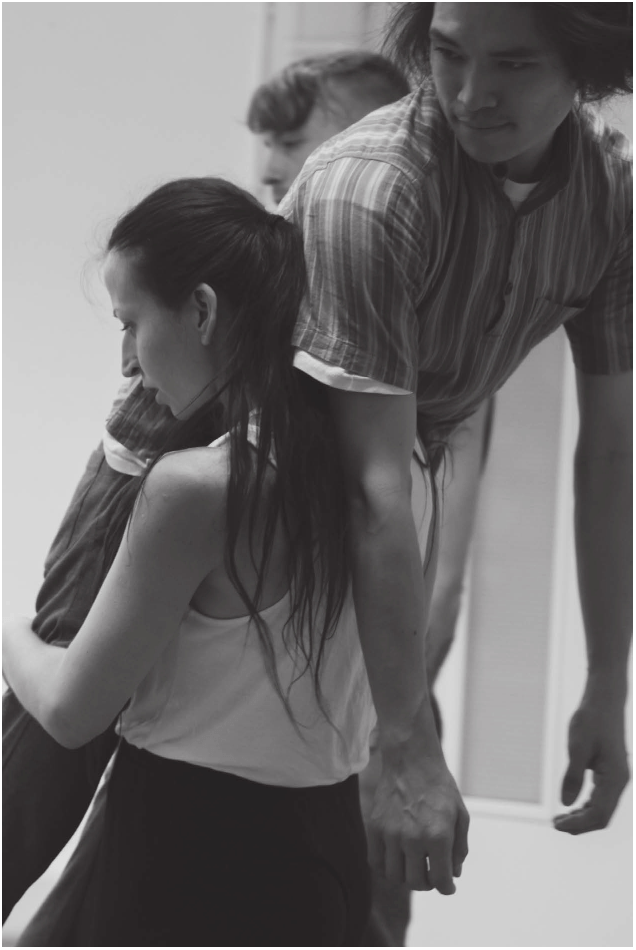
Figure 11.11 Aneta and Takeshi, Making the Material in the Studio
Photo'. Julia Testa.
interstitial connections between the family home and the dance studio. In this creative process, mobilizing vulnerability shows how it is not a gendered characteristic. By co-composing this material, it is possible to glimpse how vulnerability and resistance coexist and pave the way for dancing collective recognition.
Ties That Bind
Tony and I are walking side by side, through the South London public library and into the art gallery that we have transformed into our participatory ecology. As we reach the door, Tony stops, a small act of resistance, perhaps. It is as if he anticipates the affective potential inside this room. We are at a threshold, between a public space and a smaller, more intimate one. I look through the door and gesture towards the pianist, Frankie, motioning him to play something welcoming. It seems to work and Tony moves, slowly, through the door, where the dancers await in the gallery room heated by the summer sun.
Within seconds of Tony and Jacquie s bespoke performance starting, Jacquie cries tears of recognition. As the four dancers scatter paper, there is an immediate reminder of the mess tangled with the ‘thing power’ of this paper Jackson & Mazzei, 2016, p. 98; Bennett, 2010), see Figure 11.12. With/in this paper is the ethics and decision making that Tony was faced with, signaled by the moment when Jacquie entered Tony’s office and witnessed his legal documents in complete disarray covered with nonsensical writing. Later Jacquie comments on the immediacy of witnessing the performance, “It’s quite shocking how quickly we felt things”.
Minutes later, Sabrina and Takeshi are enacting a tug of war with a cloth-covered stretchy elastic cord. Takeshi has his back to Sabrina and Sabrina is pulling Takeshi backwards, towards her, see Figure 11.13. This moment becomes a trigger: Tony, suddenly stands bold upright from his chair, ready to intervene. Offering a barely audible commentary, it is striking that Tony may be trying to make sense of his losses in the same way we all are in
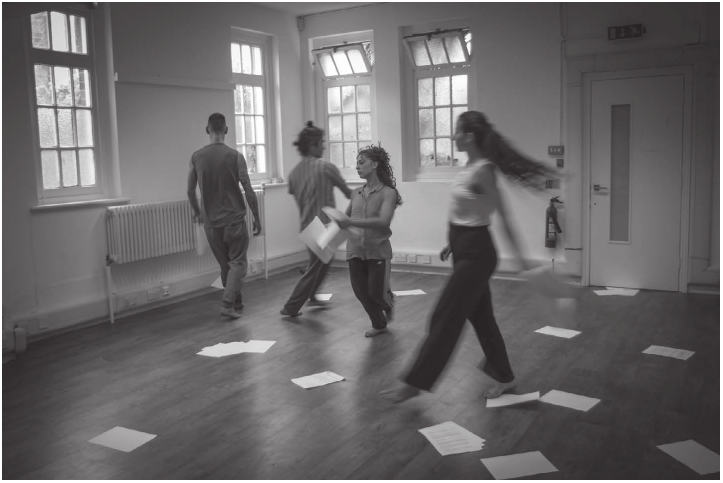
Figure 11.12 Luke, Takeshi, Sabrina, Aneta, Bespoke Performance for Tony and Jacquie Photo: Julia Testa.
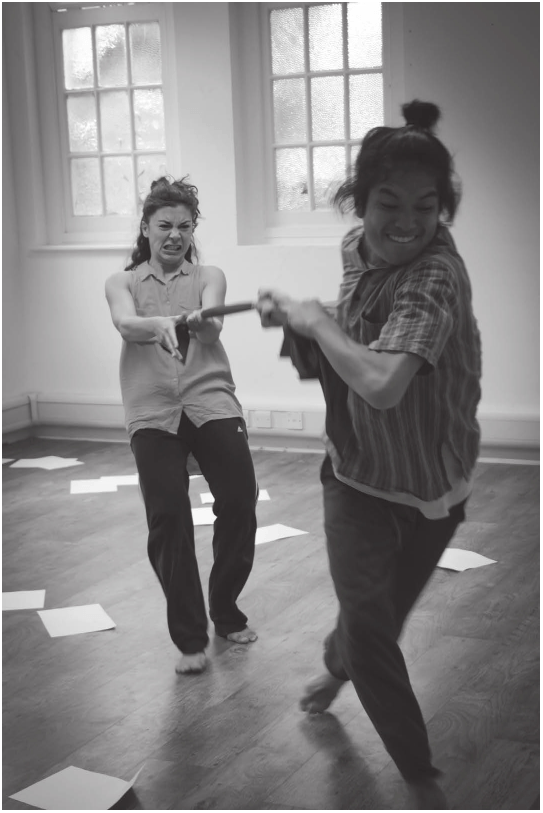
Figure 11.13 Sabrina and Takeshi, Bespoke Performance for Tony and Jacquie
Photo'. Julia Testa.
this room today. Jacquie remains sitting, gaze fixed ahead whilst also reaching out for Tony’s hand as if to steady him. What are we all facing in this moment? Perhaps we are becom-ing-with the material in a stretching, grasping, pulling, tussle. This performance becomes more than the sum of its parts, and the ‘umbilical’ cord has agentic force, and it becomes a means of survival.
During this moment, I strain to hold the tension and am concerned how long everyone can endure. Bodying the ubiquitous ties that bind has taken us all to our edges: those processes that bring up information that is difficult for us to accept. I am faced with the ethics of acknowledging “the ties that bind us to the multiple ‘others’” (Braidotti, 2013, p. 100): wearc not in charge of these irrepressible flows, affects, movements, and we are tangled. Tears sting my eyes and once again I turn to Frankie, imbuing him as acoustic leveler and ask him to play something soothing. Sabrina tears down the fourth wall, looking directly at Tony, and Tony looks back at her, still standing, gaze scrutinizing as he is ‘infolded’ into performance (Manning, 2016). Sabrina then looks at Jacquie and later comments on this tangling of human and no-human agents:
I felt for the first time that I’m carrying this, and I’m showing to him, to her, it must be difficult, especially when we were with the elastic-cord. I kind of wanted to protect her. I decided to look at her, and kind of like: ‘we are with you, don’t worry, we’re doing this together’. And she was aware of this, we exchanged a smile.
In a striking resonance, after the performance, Jacquie recounted, “What surprised me about the dance was how painful and how raw it was to watch”; she is feeling with the dance and this process is neuro-affectively unmediated, since when the feeling evokes a response there is a physiological marker on a visceral level (Damasio, 2000). Like the PheMaterial mobius, bodying is an unmediated process. Tony, too, has grasped the affective content of this performance and Jacquie later comments “how he was drawn to intervene”. The ‘loss’ of his cognitive and linguistic function does not endanger the status of his ‘self’. Tony’s visceral response affirms his presence: he experienced an aspect of himself. It becomes clear that affect and memories, far from being unique and personal, can be reconstructed through dance movement relating.
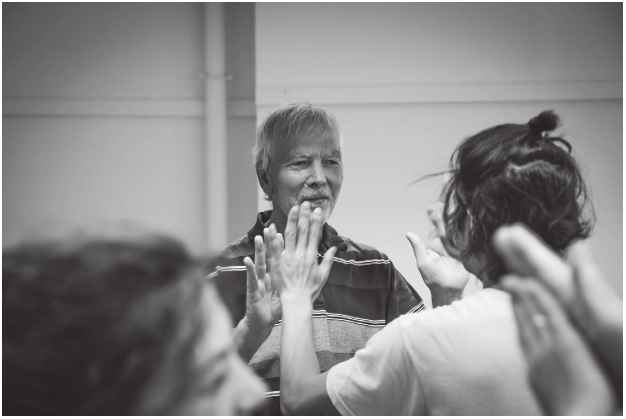
Later still, when we invite Jacquie and Tony to join the improvisation, Tony allows himself to be with us in another way, see Figure 11.14. In contrast to his solitude, Sabrina comments on how Tony is present, not only in his witnessing, but also by participating:
It was really powerful when Tony [was] in the middle of the room, stretching. Because I thought..., he’s a solitary man and yet, we were all around him.
Our dance with and for Tony and Jacquie becomes political; it is a 'collective assembly’ (Butler, 2015) where we open a space for making physically and spatially visceral, otherwise hidden vulnerabilities and social arrangements. The evocative and recursive impact of witnessing, being witnessed and participating in improvised movement responses, expands beyond anthropocentric intersubjective relating (Ammaniti & Gallese, 2014) and towards entanglement: we are all becoming with this moment of vulnerability. In this dance, dementia leaks beyond the confines of diagnosis; instead, human relating and agency is distributed across the bodies of dancers, families, through the choreographic material, with objects and into everyday life. We become-with our vulnerabilities and become more-than-dementia.
MOVING WITH THE TROUBLE
In this global time of sociopolitical and environmental crisis, we are faced with multiple forms of social exclusion and economic inequality that challenge core values of equality and respect for human and animal rights. Securing peace and prosperity for future generations in the face of such challenges requires a reinstating a bodying activism, a generative change with innovative solutions that address social inequalities, reconcile conflict and have lasting impact, in short, a more-than-human revolution in relating.
My intent in this chapter has been to demonstrate how the ability to affect and be affected is in constant motion. The affecting process is more than anthropocentrically intersubjective—it is /ran.icorporeal and has the potential to Ain-aesthetically reshape the micro-politics of relating. How we make (the) material and the multiple colliding subjectivities and in/ra-action of these events (in clinical or artistic contexts) will help us to pay attention to how change and transformation occur, in turn changing our relating in micro and macro ways. This work goes some way towards rethinking the relations through which the human is made possible, specifically with and through an assembling of choreography, DMP and dementia. To this end, choreography and performance as potent artistic processes—within or without the therapeutic process—allow for neurodiverse, transversal ways of relating. Choreography is not a luxury but an ethical imperative yielding constantly renewable Ain-aesthetic insights into ways of relating for people living with YOD, their family carers as well as for broader healthcare and medical practitioners. In this way, dementia (and any other ‘diagnosis’) becomes an ecological process distributed in the environment rather than a pathological manifestation of a human subject.
When stories of crisis and othering become part of us, as they do ubiquitously in therapy, art and everyday life, we must cultivate the capacity for “response-ability” (Harraway, 2016, p. 2). The dancing activism discussed in this chapter is an artistic contribution to nourishing equitable citizenship and counterhegemonic narratives of aging, agency, illness, vulnerability, living and dying. Dancing activism is, to paraphrase Harraway (2016), a moving with the trouble. In a time where a hypercognitive view holds currency in the global North and where neo-liberalist ideals permeate education, health and arts policies and cultivate a culture of anthropocentric individualism, dancing activism is a Ain-aesthetic antidote, a response to moving with the complexity of the more-than-human in everyday life. Danc-ing-with human and more-than-human others enacts subtle and incremental changes and makes space for our unimagined hopes.
NOTES
- 1. The UK name for the profession.
- 2. The project, is funded by Arts Council England (2016- 2021), with commissions from Bergen International Festival and in partnership with Dementia Pathfinders, Merton Arts Space, Dementia Action Alliance UK, Public Health (Merton), University of Bergen, Alexandra Palace.
- 3. Beatrice Allegranti Dance Theatre comprises artistic director and choreographer Beatrice Allegranti; producer Nancy May Roberts; professional dancers Luke Birch, Sabrina Gargano, Takeshi Matsumoto, Maria Palliani, -Aneta Zwicrzynska; composer Jill Halstead, and musicians Robert Howat and Frankie Burrows.
- 4. At the time of writing, 12 (audio-recorded and transcribed) interview-conversations have taken place with a cumulative total of 30 family members. Ethical clearance is from the University of Rochampton, London.
- 5. At the time of writing, five studio practice discussions were audio-recorded and a further five individual interviews conducted with the company dancers.
REFERENCES
Alaimo, S., & Heckman, S. (Eds.). (2008). Materialfeminisms. Indiana: Indiana University Press.
Allegranti, B. (2011). Embodied performances: Sexuality, gender, bodies. London: Palgrave Macmillan.
Allegranti, B. (2014). Corporeal kinship: Dancing the entanglements of love and loss. In J. Wyatt, & T. E. Adams (Eds.), On (writing) families: Autoethnographies of presence and absence, love and loss. Rotterdam: Sense Publications.
Allegranti, B. (2019). Moving Kinship: Between choreography, performance and the more-than-human. In S. Prickett & I I. Thomas (Eds.), 7he Routledge dance handbook. London: Routledge.
Ammaniti, M., & Gallese, V (2014). The birth of intersubjectivity: Psychodynamics, neurobiology and the self. London/ New York: W.W. Norton & Company Ltd.
Barad, K. (2007). Meeting the universe haljway: Quantum physics and the entanglement of matter and meaning. Durham/ London: Duke University Press.
Bennett, J. (2010;. Vibrant matter: A political economy of things. Durham: Duke University Press.
Braidotti, R. (2013). The posthuman. Cambridge: Polity Press.
Butler, J. (2015). Notes toward a pe formative theory of assembly. Cambridge, MA: Harvard University Press.
Burton Jones, J. (2015). Approaching an unthinkablefuture: Understanding the support needs of people living withyoung onset dementia. Dementia Pathfinders Resource Publication. Retrieved from www.youngdcmentiauk.org/sites/ default/files/approaching_an_unthinkable_future_lr.pdf [accessed 2017 05 20].
Calvo-Merino, B., Grezes, J., Glaser, D. E., Passingham, R. E., & Haggard, P. (2006). Seeing or doing? Influence of visual and motor familiarity in action observation. Current Biology, 16, 1905 1910.
Damasio, A. (2000). The feeling of what happens: Body and emotion in the making of consciousness. London: Vintage Books.
Derrida, ]. (2001). The work of mourning (PA. Brault & M. Naas, Eds.). London/Chicago: University of Chicago Press.
Harraway, D. (2016). Staying with the trouble: Making Kin in the Chthulucene. Durham: Duke University Press.
Jackson, A., & Mazzei, L. (2016). Thinking with an agentic assemblage in posthuman inquiry. In C. A. Taylor & C. Hughes (Eds.), Posthuman research practices in education. London: Palgrave Macmillan.
Lorde, A. (2017). Your silence will not protect you. London: Silver Press.
Manning, E. (2007). Politics of touch: Sense, movement, sovereignly. Minneapolis: University of Minnesota Press.
Manning, E. (2013). Always more than one: Individuation's dance. Durham: Duke University Press.
Manning, E. (2016). The minor gesture. Durham: Duke University Press.
Post, S. G. (2000). The concept of Alzheimer’s disease in a hypercognitive society. In P. J. Whitehouse, K. Maurer, &J. F. Ballenger (Eds.), Concepts of Alzheimer disease. Baltimore & London: John Hopkins University Press.
Quinn,J., & Blandon, C. (2017). The potential for lifelong learning in dementia: A post-humanist exploration. International Journal of Lifelong Education, 36(5), 578 594.
Ringrose, J., Katie, W., & Zarabadi, S. (2019). Feminist posthumanisms and new materialisms in education. London and New York: Routledge.
Swafler, K. (2016). И the hell happened to my brain?: Living beyond Dementia. London: Jessica Kingsley Publishers.
Taguchi, H. L. (2013). Images of thinking in feminist materialisms: Ontological divergences and the production of researcher subjectivities. International Journal of Qualitative Studies in Education, 26(6), 706 716.
Traphagan, J. W. (2000). Laming Oblivion: Aging bodies and the fear of senility in Japan. Albany: SUNY Press.
Winnicott, D. (1971). Playing and reality. London: Tavistock.

