Supporting Quadric Method (SQM)
Precise Statement of the FFR Problem
First we will complete the precise formulation of the far-held rehector problem which we began to discuss at the beginning of the introduction in Chapter 7. We will also continue to refer to Figure 7.1.
For the light ray of direction m from the source О incident on rehector R at point r(m) with normal u=u(m) the reflected direction у is determined by the law of reflection as

where (m,u) is the dot product of m and и in R3. Thus, the surface R dehnes a map y: m -*■ v which maps the input aperture Dc S2 onto some set T a S2; see Figure 7.1, where for convenience the input aperture D and the set of reflected directions T (the “output aperture” in the “far-held”) are shown on the same sphere S2. According to the reflection law of geometric optics (Born & Wolf, 1999) in inhnitesimal form, the irradiance produced by light rehected in direction y=y(m) is given by
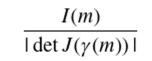
where J(y) denotes the matrix of the Jacobian of the map у and det is the determinant (assuming that det J(y) * 0).
Suppose now that the sets D and T on S2 are given as well as nonnegative and integrable functions I(m) on D and L(y) on T. The FFR problem is to hnd a reflecting surface (“rehector”) R such that for the map у dehned by R the following conditions are satished:

Because the functions L and / are assumed to be nonnegative, Condition (8.3) implies that it is assumed that det./(y)(m)) > 0. Conditions (8.2), (8.3) can be transformed into PDEs in terms of the radial (=sag) function p(m), m e D, giving the distance from the origin О to the rehector R along the ray in direction m as shown in Figure
7.1 (cf. Schneider, 2014, p. 57). We refer the reader to our papers (Newman & Oliker, 1994; Oliker & Newman. 1993; Oliker & Waltman, 1987) for the detailed calculations leading to the formulas presented below.
The domain DcS2 is described by a vector function m(u', и2) in some local coordinates и1 and u2 on the sphere S2. Usually, и'=в, и2=ф are the spherical coordinates but in some situations other coordinates may be more convenient. The formulas below are given in arbitrary coordinates u1 and w2 on S2. The input radiance I(m)=/(«', u2) of the point source О is specified as a function of the source ray direction m e D. The position vector of the reflector R to be determined by (8.2)-(8.3) is sought as a vector function r(m)=p(m)m, m e D. Thus, the goal is to determine the function p(m), m e D.
We now transform the general Expressions (8.2) and (8.3) into expressions in terms of the function p. For that it is convenient to use some terminology from vector calculus and differential geometry. The unit length normal vector и(т) on the surface R at the point r(m) = p(m)m is given by

where

with [еЦ being the inverse of the matrix etj = ;(m)] of the first fundamental form (= metric) ds2 = У е»du'duJ of the unit sphere S2,
* J l. j=l
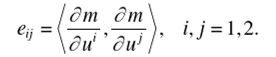
Here and elsewhere, when no confusion may arise, in order to simplify the formulas we omit m when it is used as an argument of a function. The unit vector у in direction of the ray reflected off R for the incidence direction m can be expressed in terms of p and its derivatives upon substitution of Equation (8.4) into Equation (8.1). Then

The determinant of the Jacobian of the map у is given by
 where

and Г* denote the Christoffel symbols of the second kind constructed from e,t (see any elementary book on differential geometry). The expressions Vnp are usually referred to as second covariant derivatives of the function p.
Now the FFR problem can be stated as follows. Find a function p e C2 (D) П C1 (D) (that is, p is one time continuously differentiable in D and twice continuously differentiable in D) such that the map у defined by Equation (8.5) satisfies Equations (8.2) and (8.3), where det J(y) is defined by (8.6).
The expression in Equation (8.6) involves second derivatives of the unknown function p under the determinant. Due to this special feature, Equation (8.3) and other equations of this type are referred to as PDEs of the Monge-Ampere type. The strong nonlinearities in Equations (8.5) and (8.6) (and consequently in Equations (8.2)—(8.3)) make a complete mathematically rigorous analysis of such equations very difficult. At the same time, most of the prescribed irradiance problems arising in optics and other fields require theoretical and numerical analysis of equations of the Monge-Ampere type.
Heuristic ad hoc (usually iterative) numerical approaches to specific problems of this kind have been used, often with only a posteriori graphic justification; see, for example, Kinber (1962); Kinber (1984); Galindo-Israel et al. (1979); Galindo-Israel et al. (1987); Galindo-Israel et al. (1991b); Westcott (1983); Westcott and Norris (1975); Ries and Muschaweck (2002); Brenner (2010); and Wu et al. (2013).
The FFR problem in various formulations has been studied in optics, mathematics, and numerical analysis (Keller, 1958; Kinber, 1962; Kinber, 1984; Galindo-Israel et al., 1979; Galindo-Israel et al., 1987; Galindo-Israel et al.. 1991; Galindo-Israel et al., 1991; Westcott, 1983; Westcott & Norris, 1975; Caffarelli & Oliker, 2008; Caffarelli et al., 1999; Xu-Jia Wang, 1996; Guan & Wang, 1998; Caffarelli et al., 2008; Loeper, 2011; Fournier, 2010; Fournier et al., 2009; Oliker, 2002; Oliker, 2008; Glimm & Oliker, 2003; Merigot & Oudset, 2016; de Castro et al., 2016; Wang, 2004; Romijn et al., 2019). Under a priori assumptions that the data and the solution are rotation- ally symmetric, the FFR problem was studied in Schruben (1974); Malyak (1992); Burkhard and Shealy (1987); and Oliker and Waltman (1987); see also Oliker (1987) and Oliker (1996). Geometric properties of reflectors have been studied in Newman and Oliker (1994); Hasanis and Koutroufiotis (1985); and Oliker, (2008a).
Relaxed Formulation, SQM, and Freeform Surfaces
It turns out that if, in the formulation of the FFR problem, the requirement that p eC2(Z))ПС'ф) is relaxed and Equations (8.2)—(8.3) are replaced by more general but still physically meaningful relations, then a mathematically rigorous theory for solving an appropriately modified version of the FFR problem can be developed and a reliable solution in the class of weak solutions (explained in Section 8.6) can be obtained. This was done in the case of the two-reflector problem for the first time in Oliker and Prussner (1994) and an application of this result has been discussed already in Oliker et al. (1994). For single reflectors this was first done in Caffarelli and Oliker (2008). It is important to note that if there exists ape С:(0)ПС'(0) satisfying Equations (8.2)—(8.3) (in this case p is called a strong solution) then such p is also a weak solution. Thus, the class of weak solutions includes strong solutions of the FFR problem.
The concept of weak solutions was introduced in a geometric framework which allows a rigorous formulation of and solution to the FFR problem (Caffarelli and
Oliker, 2008; Caffarelli et al., 1999) and many other optical design problems (Oliker, 2006a; Kochengin and Oliker, 1998; Glimm and Oliker, 2003; Glimm and Oliker, 2004). In this framework any reflector solving the FFR problem is defined as an envelope of a family of paraboloids each of which is touching (“supporting”) the reflector so that optical properties of paraboloids can be transferred to that reflector. This particular feature plays a crucial role in our considerations. In other optical problems the required optical surfaces are constructed as envelopes of families of “supporting” ellipsoids (Kochengin and Oliker, 1998; Kochengin and Oliker. 1997), hyperboloids (Oliker, 2017; Oliker, 2011; Oliker et al., 2015), or Cartesian ovals (Michaelis et al., 2011). This fact motivated our choice of the name for this framework as the supporting quadric method (SQM). Of course, Cartesian ovals are not quadrics but the method of design in this case remains the same. The reader will see that this framework is highly versatile as, in combination with the concept of weak solutions, it can be used to formulate, analyze, and solve a large variety of optical design problems concerned with the redirecting and redistribution of light.
Moreover, the solutions obtained with the SQM are freeform surfaces, that is, surfaces determined by the goals and constraints of the design without any a priori assumptions on their shape. In particular, freeform surfaces are not required to have any special symmetry, such as rotational or rectangular.
Reflectors and Radial Functions
We begin by redefining a reflector in purely geometric terms. For each у e T we denote by P(y) a paraboloid of revolution with focus at the origin O, axis of direction у—directed toward the opening of P(y)—and polar radius

where p(y) >0 is the focal parameter of P(y). For a given paraboloid p(y) = const = ps’(m') when m' 1 y. If p(y) = 0 the paraboloid P(y) is considered to be a limit of co-axial paraboloids with focal parameters tending to zero. Obviously, this limit is a half line originating at O.
Definition 8.3.1 Suppose f c S2 and contains more than one point. Let {P(y)} f be an arbitrary family of paraboloids with p(y) > 0 for all y. For each у eT let B(y) be the infinite convex solid bounded by P(y). The surface R defined as

is called a reflector defined by the family (P(y)} f with the light source at the (common) focus O. See Figure 8.1 for an illustration in a plane. The set of all reflectors with the source О is denoted by Ft. An important special case is when 7 = {У|,_У2,---,у*} Д > 2. In this case we say that R is defined by paraboloids P(yi),i = ,2,-,k.

FIGURE 8.1 T = {.Уь)’2,Уз>>’4}. Reflector R consists of the arcs AB. BC, and CA which are
pieces of parabolas P(y(), /= 1, 2, 4; parabola P(y}) is not touching R. The set D and S2 are not shown.
Let Re'R and T. p, be as they are in the above definition. Since f has more than one point, R is bounded. The solid B(y) is convex for each у ef and because the intersection of convex sets is convex, the set В is convex. Since p(y) > 0 for all у e f, the point О is in the interior of B. Thus, R is a bounded, closed (that is, dR = 0) convex surface, star-shaped relative to O. It projects 1-1 onto S2 by rays from O. Equivalently, if R e 'R is defined by paraboloids jP(v)}cf. then

and the inf vsf in (8.9) is attained at least for one у eT. Thus, p(m) is a specialization to reflectors in 1Z of the notion of a radial function used in Section 8.1. Because any R e 'R is closed and convex, its radial function is well defined on the entire S2 and R is the graph of p over S2.
It may happen that some of the paraboloids in the family {P(y)}>sr have no common points with R (as in the case of P(y}) in Figure 8.1). We want to exclude from consideration such paraboloids. More generally, in order to identify all paraboloids P(y), у e S2, “touching R from outside,” we introduce the following
Definition 8.3.2 Let R e'R, and let p be the radial function of R. Let у e S2 and let P(y) be a paraboloid of revolution with focus O, axis of direction y, and radial function p. If

then we say that P(y) is supporting to R at the point r(m) = p(m) m e R.
Note that P(y) is not required to be in the family (Р(у)} f defining R.
In Figure 8.1 the parabolas P()), P(y2) and P(y4) are supporting R at each point of the arcs AB, BC and CA, respectively, while P()) is not supporting to R. It follows from Equation (8.7) that by decreasing the focal parameter p(yf) of P(y3) to a suitable value р'(уз) a new parabola P'(y3) supporting to R is obtained. This property is applicable in much more general circumstances and it will play an important role in the construction of a reflector solving the FFR problem.

