Weak Solutions to the FFR Problem and Its Semi-Discrete Version
In this section it is shown that existence of weak solutions to the FFR problem can be established rigorously under very general conditions (Caffarelli & Oliker, 2008). Put

Theorem 8.7.1 Let / and L be nonnegative integrable functions on S2 and
 Then the FFR problem in weak formulation admits a solution ReR such that

If infc2 / > 0 then this solution is unique up to homothety relative to O.
Remark 8.7.2 The measure F in Equation (8.20) is defined by a nonnegative integrable function L. This and Condition (8.21) imply that F is a positive Borel measure. In fact, Theorem 8.7.1 is valid for Borel measures not necessarily generated by nonnegative integrable functions. It suffices to assume that F is a positive Borel measure not concentrated at one point. On the other hand we note that if F is concentrated at one point, say у, then any paraboloid with axis of direction у is obviously a solution to the FFR problem.
The requirement that F is not concentrated at one point is important as it allows us to conclude that the set of reflectors 'R in which the solution is found can be defined so that it is not empty and the radial and focal functions of all reflectors in R satisfy the inequalities

where the constants c„ c2 depend only on I and F; see Caffarelli and Oliker (2008).
The proof of Theorem 8.7.1 is sketched below and follows the proof in Caffarelli and Oliker (2008). It is important to sketch it here because it is based on an approximation scheme that can also be used for solving the problem numerically (this aspect is discussed later). In addition, the proof clearly illustrates the ideas behind the SQM. Theorem 8.7.1 is proved in two main steps. On the first step, the measure F is approximated by a sum of Dirac masses

concentrated at a finite number of points yf.....yf on S2. For each Fk the reflector
problem is solved by a reflector determined by к paraboloids of revolution with a common focus at O. The corresponding FFR problem is called semi-discrete. On the second step, we let к -*■ oo and use weak convergence of measures Fk to G to obtain a weak solution to Equation (8.22). For the convenience of the reader we recall now the notion of weak convergence used in this work.
Let G and Fk, k= 1,2,... be completely additive and nonnegative measures defined on Borel subsets of S2. If

for any continuous function/on S2 then it is said that the sequence {Fk} converges weakly to G (Lieb & Loss, 1997; Taylor, 2006). The integrals on the left and on the right are taken with respect to measures Fk and G respectively.
We outline now the proof of Theorem 8.7.1.
Derivation of the Semi-Discrete FFR Problem
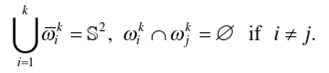
At this stage, for each к e M, к > 2 we subdivide S2 into к measurable subsets cof,...,cof, such that for each i = ,...,k the diameters cof < Ъл / к and
Pick points yf e of, i = l,2,...,k, and put

and assume that yf are chosen so that F,k > 0 for at least two points. For a measurable set со a S2 we define
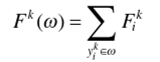
Since the “balance” Equation (8.21) holds, the equation
 is also satisfied.
Fix some к as above. We want to find a reflector Rk e TZ defined by paraboloids P(yf], i = l,...,k, with focal parameters pf >0,i = l,...,k, such that

The problem of constructing the reflector Rk e'R, satisfying Equation (8.25) with given yf,Fk, i = 1 function /as above, and Fk, i = 1 satisfying Equation (8.24), is the explicit form of the semi-discrete FFR problem. We claim that the semi-discrete problem can be solved and the proof of existence of the required reflector is based on the following arguments.
Solution to Equation (8.25)
First, we note that any к paraboloids P(yf j, i = l,...,k, of revolution with axes of direction yf, foci at О and focal parameters pf > 0 for each i form a family of paraboloids defining a reflector Rk s'R (as described in Section 8.2). For any such reflector we have

Second, the functions G^Rk,yf 1 are invariant relative to homotheties of Rk w'ith respect to the origin O. Therefore, we can pick any such reflector and rescale it so that the focal parameter pf = 1 for the paraboloid P^vf j. Fix one such reflector and denote it by Pf. Relabeling the points уf if necessary, we can index the points yt....,yl so that Fi >0. Next, observe that for / > 1 the function G^Pf,yf)->0 when pf —> -boo. Therefore, the focal parameters p >(),...,pf >0 of paraboloids forming R can be chosen so large, and a number/ > 0 so small, that

At the same time, at least for one i > 1, the inequality G(Rf,yf)> 0 holds; see Remark 7.2.
Consider now the paraboloid P(y2). If G |Rf, y* j < fk we decrease p2 w hile keeping the pi for / Ф 2 fixed. As p -» 0 the function G (Pf, y2 j is continuously increasing to a value as close to E as one w'ishes. Therefore, there exists a value p2 such that c(P!,y2) = P>*, wliere Pi denotes the reflector with paraboloid Ply?) with focal parameter p2 replacing the original P(y2 j. During the process of decreasing p2 the G(Pf, y; j are nonincreasing for all i Ф 2. The same step is repeated for Pf and p and then for all remaining paraboloids in the family, except for P(yf j. This process produces monotone sequences of pf, i = 2,...,k bounded away from zero and infinity. It is shown in Caffarelli and Oliker (2008) that the corresponding sequence of reflectors converges to a reflector in 71 for which equalities are achieved in Equation (8.25) for all i. This completes the proof of existence of solutions in the semi-discrete case.
To obtain the solution to the FFR problem in the general case, a sequence of subdivisions of S2 into subsets with diameters of cok -> 0 as к -> oo for all i = l,...,к is considered. These subdivisions are constructed as in the beginning of the proof. Consequently, we obtain an infinite sequence of reflectors Rk,k = 2,..., with radial functions |pk,...,pk, к > 2. and focal parameters jpf,...,pkj. к > 2. The estimate (8.23) allows us to conclude that there exists a subsequence of reflectors with radial functions denoted again by pk, к > 2, converging in C°(S2) to a reflector Re 'R with radial function p(m) = mk^„pk(m) for all m e S2.
Next, it is shown that the measures G (/?*,•)> k> 2 converge weakly to G(/?. ), that is,

for any function h e C(S2). On the other hand, the desired irradiance is

and F',...,Fk are produced by discretization of F. Therefore,

Combining Equation (8.25) with Equations (8.26) and (8.27), we obtain

for any contunuous h on S2. This implies Equation (8.17) and, therefore, R is the required weak solution. Again, further details can be found in Caffarelli and Oliker (2008).
In practical applications the FFR problem needs to be solved when the input and output apertures D and T do not coincide with S2. The construction of the weak solutions described above can be easily adapted to this formulation. Namely, for D,f c S2 we extend the functions I and L to the entire S2 as before, by setting them equal to zero on S2 D and S2 f, respectively. Since the balance Equation (8.21) is satisfied with D and T, it will also be satisfied with the functions I and L extended to the entire S2. Then Theorem 8.7.1 can be applied. Next, we delete from the resulting closed reflector all of the supporting paraboloids with axes of directions in S2 T. The part of reflector over S2 D can also be deleted, as the radiance of the source over that part is = 0. This determines a reflector R' with a boundary whose radial projection on S2 is the set D and y(D) = T. Evidently,

that is, R' is the required reflector. The uniqueness of the solution in Theorem 8.7.1 was proved in Caffarelli and Oliker (2008) for reflectors defined by a finite number of paraboloids; the general case was treated in Guan and Wang (1998). For related results on intersection of paraboloids see de Castro et al. (2016).
Numerics and SQM
The first provably convergent computational algorithm for solving the FFR problem was based on the SQM approach described in Section 8.7 for proving existence of weak solutions to Equation (8.17); see Caffarelli et al. (1999).
A w'eak solution is obtained as a limit of a sequence of convex reflectors Rk e 1Z, к = 2,3,..., solving the corresponding semi-discrete Problems (8.25). Thus, for numerics, the first task is to determine numerical solutions of such semi-discrete problems.
For each k, a reflector Rk solving a semi-discrete FFR Problem (8.25) is defined by к supporting paraboloids with given axes y{,..., yf each of which produces irradi- ances Fik,...,Fkk in corresponding directions. According to the procedure described in Section 8.7, the к supporting paraboloids with axes yf,...,y* are determined iteratively with guaranteed convergence. This iterative scheme was implemented in Caffarelli et al. (1999) in a numerical algorithm for solving Equation (8.25) and concrete numerical examples were presented there. We will not repeat here the details of this algorithm and make only several general comments. In order to make the reference to this algorithm easier and emphasize the fact that it is a special case of the SQM, we will call it the supporting paraboloid (SP) algorithm.
The results in Caffarelli et al. (1999) and Kochengin and Oliker (2003) imply that for a fixed к the SP algorithm finds a reflector Rk approximating the solution of the semi-discrete FFR problem with accuracy up to ek or, more precisely, the determined reflector Rk satisfies

where ek is the required error bound. Equation (8.28) is used as a normalized measure of error.
The SP algorithm can be initialized with any reflector Rk elZ. In our implementation the algorithm automatically determines from the data some values of
Рг,...,р1 for which it is guaranteed that Rk, generated with paraboloids with focal parameters (pf,p2, . ,Pk), is in 1Z. Once the algorithm is initialized it produces iteratively a sequence of reflectors Rkt, s = 0,1,2,..., such that (a) each member of this sequence belongs to R, (b) the sequence monotonically converges to a solution of Equation (8.25), and (c) there exists some finite N for which /?£ satisfies (8.28). This N can be estimated in terms of the given data. More details on the proof of convergence, including an estimate of convergence rate, are in Caffarelli et al. (1999). In general, because of strong nonlinearity of the problem the convergence of the SP algorithm may be slow for large values of k. A rigorous analysis of the SP algorithm in Caffarelli et al. (1999) shows that it generates a sequence of reflectors converging at least linearly. See also de Castro et al. (2016) for related results.

