BIG DATA ANALYTICS
The spread of mobile devices, social media, and platforms, including YouTube, has contributed to reaching an impressive volume of information (i.e., in 2012, Facebook users posted 700 status updates per second worldwide).
In 2011, about 4 billion mobile-phone users were identified worldwide; about 12% of them using Smartphones shaving the capability of turning themselves into data-streams. Meanwhile, the video platform, YouTube, received 24 h of video every 60s [2].
-Radio-frequency identification (RFID) uses electromagnetic fields to automatically identify and track tags attached to objects, people, or animals to relay identifying information to an electronic reader by means of radio waves [1].
The literature identifies ‘big data’ as the next management revolution and that ‘big data’ is bringing a big revolution in science and technology. So, the ‘big data’ call for a radical change to business competition. This phenomenon is capable of unlocking an organization’s business value and facilitating films to tackle key of their business challenges [2].
The term big data describes unstructured data that need sophisticated methods and technologies for data analytics. An International Data Corporation (IDC) report forecasts that big data analytics incomes will be more than S203 billion in 2020, as mentioned in Figure 5.1.
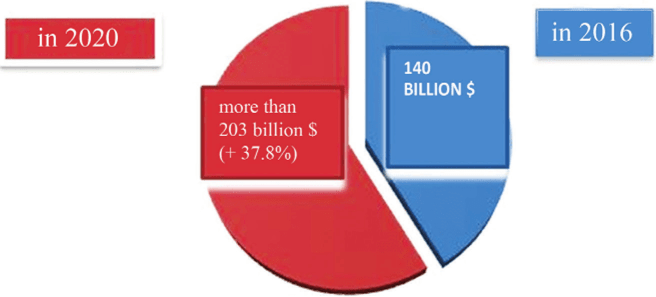
FIGURE 5.1 Global big data market.
Source: Double-digit growth forecast for the worldwide big data and business analytics market through 2020 led by banking and manufacturing investments, according to IDC. Available at: https://www.businesswire.com/news/home/20161003005030/en/Double-Digit-Growth- Forecast-for-the-Worldwide-Big-Data-and-Business-Analytics-Market-Through-2020-Led- by-Banking-and-Manufacturing-Investments-According-to-IDC [3] (Significantly modified).
Big data present the opportunity to change business models, government, human resources, and science. Many industries have tried to develop their ability to benefit from the data [4]: [1]
• For companies such as Linked In and Facebook, data itself is their primary product. These companies are derived from the data they gather their intrinsic value.
The features of big data can be characterized by 5V’s; Volume, high Velocity, high Variety, low Veracity, and high Value [5]:
- • Volume: A large amount of data that need big storage (Exabyte, Zettabyte).
- • Velocity: Frequency or speed of data generation.
- • Variety: Refers to the different types of data from different sources.
- • Veracity: Big data analysis can give us a reliable prediction.
- • Value: The benefits through extraction and transformation of big data.
In general, ‘big data’ is defined as a new approach to manage data and analyze 5V’s to create an actionable vision for developing performance and establishing sustainable competitive advantages [2].
- [1] By processing billions of transactions, Credit card companies canidentify fraudulent purchases with a high degree of accuracy. • Mobile phone companies analyze subscribers’ calling patterns todetermine, for example, whether a caller’s frequent contacts are on arival network.

