Investigation, Probable Cause, and Search Warrants
Investigation
If a report of suspected cruelty is submitted by a witness who chooses to leave contact information, the officer should first speak with that witness. Obtaining as much information as possible can sometimes help determine the best initial course of action. But once again, discretion should be used when communicating with a complainant in order to remain objective. It is common for an HLE officer to speak with a complainant who is willing to provide their name and phone number but refuses to testify in court. Officers need to communicate to the complainant that often the only thing that will bring justice is an eyewitness account. When those who file reports understand that animal cruelty can be difficult to prosecute, that the cases are typically not given much validity in courtrooms, and that judges or juries demand irrefutable proof before enforcing penalties, they can sometimes be persuaded that their testimony is vital.
Filtering nuisance complaints is a prevalent task among those investigating animal maltreatment. It is imperative in a field where hundreds of reports are received daily. Officers frequently find that a call about animal cruelty stems from spousal conflicts of a vindictive nature, neighbors frustrated by a continually barking dog, or landlords or tenants irritated by an unresolved argument. In some instances, an officer who speaks directly with the person reporting suspected abuse will find that there were other circumstances that prompted the call. Neighbor disputes are frequently the cause of falsified or inflated reports, and in certain circumstances, by the time the officer is able to contact the complainant, they will have had time to “cool off.” If the report seems baseless, an officer can

Figure 3.3 Actual scene photograph of dilapidated stables—an example of inadequate shelter.
often flush out the true reason for it by asking the right questions. HLE policing is often rewarded by using excellent communication skills (Arluke, 2004).
HLE officers are responsible for determining which reports are investigated as cruelty and which are unfounded. They use their personal judgment and experience to decide whether actual laws have been broken or whether a report of cruelty is merely a moral or ethical offense. They must interpret the law themselves due to its nebulous and arbitrary nature. In many states the statutes do not define terms such as "cruelty" or “torture,” and they do not elaborate on their meaning, leaving plenty of room for misinterpretation or for clarification as an officer sees fit. Anticruelty statutes are often explained and applied on a case-by-case basis due to how loosely they are detailed. The phrase “proper food, water, and shelter” can be defined in many ways; is proper shelter a leaky, wooden structure with broken slats and a partial roof; is it a large, heavy plastic drum turned on its side? Is proper water considered fresh at all times, or is water that may have dirt or insects or a thin film of algae or that has not been changed in many days sufficient? Officers often must make recommendations to respondents based on opinions or a veterinarian’s suggestions rather than hard facts. One person’s definition of "beating” or “overworking” may be completely different than someone else’s. It is this very ambiguity that both frustrates officers and allows them a bit of flexibility when enforcing the laws (Figure 3.3).
Flexibility can also take the form of making decisions on which cases officers will pursue as criminal based in part on the age or condition of the respondents, coupled with the nature of the violation. Infractions of a nonviolent or non-malicious nature could be handled with coaching, instruction, or aid versus criminal penalties. Cases involving elderly or mentally handicapped respondents can be treated as educational pursuits or opportunities to compromise. This is common with repeat hoarding offenders who have the ability to recognize their problem and frequently call officers who had been understanding with them in the past. To most officers it is more important to help both the people and the animals than to pursue an 82 year old through the court system for possessing more animals than the law allows. It also builds stronger community relationships and gives people safe options. In these cases, the officers’ help could come in the form of an agreement not to press charges if the respondent voluntarily surrenders some of the animals, or in the form of free veterinary treatment if needed.
Visiting the location where a cruelty incident is said to have occurred is often where the most information will be obtained (Arluke, 2004). Often, an officer may have little to go on before

Figure 3.4 Investigative photograph—a property where it was reported that animals were abandoned inside a home.
conducting an inspection of the property. An HLE officer’s judgments can start forming the moment they receive an address; experience and knowledge of the location can tell them something of the ethnicity, economic level, and common law infractions or crimes, if any, generally encountered there. Certain areas may be prone to certain types of crime; for instance, in Philadelphia, Pennsylvania, dogfighting is often encountered in the southern sections of the city. Cockfighting is often associated with certain ethnic groups, as is ritualistic or religious animal crime. An awareness of locale is important not only to prepare an officer for what may be occurring there but also to inform them of possible safety threats. A seasoned officer knows the territory and which areas are the most dangerous and prone to crime or violence. But since reports of animal cruelty can come from anywhere, all calls must be investigated with caution. It is never a given what might happen when an officer knocks on a door. HLE officers may work with local police to investigate residents’ backgrounds or past crimes at a particular property, either before visiting the location or after the initial visit or contact. If it is found that a resident of that property has had prior arrests, the humane officer may request police accompaniment (Figure 3.4).
If no one is at home or if no one answers the door when the officer knocks, they may do a brief property inspection to determine if anything can be seen or heard. An officer may be walking a fine line when doing this, as they must be aware of trespassing laws and privacy rights. But if an animal can be seen and briefly visually inspected from a safe distance it can inform the officer of the necessary next steps. Humane officers become trained to use all their senses when investigating, noting sounds of dogs or cats crying, the smell of urine or feces, or the sight of an overturned bucket and a heavy chain. All of this is important to their case.
If no one answers their initial knock, the officer may leave their business card or a written notice which is taped to the door and photographed as evidence, giving the property owner a certain amount of time to respond (frequently 24-48 hours). If no one responds within that given time period and a violation of the animal cruelty law exists or is thought to exist, the officer may choose to obtain a search warrant. This is characteristic of abandonment cases (Figure 3.5).
Communicating with respondents directly is always the goal; however, speaking with respondents can be tricky. Officers must approach every situation with a critical, and in some cases, cynical outlook because of the unpredictable nature of the investigations. Officers must anticipate the possibility of not only an undesirable response from the respondents themselves, but they must also
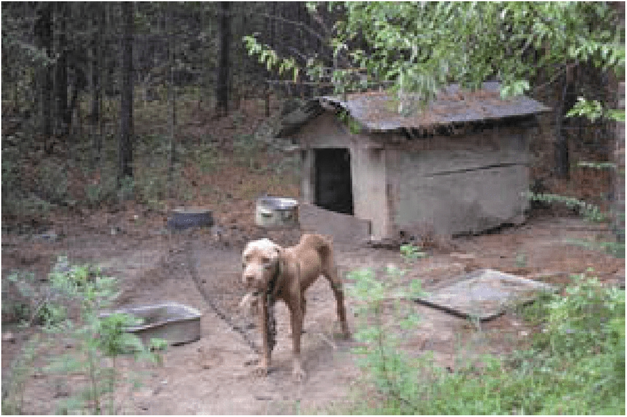
Figure 3.5 Photograph obtained during an investigation without entering the property; photo taken from an alleyway behind the property.
assume that the animal or animals they’ve been dispatched to check on could attack them. Danger presents itself from every angle. Experienced officers have learned to “read” animal behavior, and sometimes can make a determination of whether the animal is in serious pain or suffering, although this is preferably determined by a veterinarian. Veterinary accompaniment to scenes of potential animal crime when possible is extremely helpful.
Respondents can react differently in each situation. They may be receptive and cooperative, but in many instances they can become hostile and belligerent. Seeing someone in uniform approach their door can cause immediate suspicion and defensiveness. The respondent may have had unfavorable dealings with police in the past and may not take the time to notice an officer’s badge identifying them as HLE. Even after becoming aware of an HLE officer’s professional association, a respondent may still exhibit hostility due to feeling threatened or cornered. They may be afraid of the officer seizing their animals, even if the officer has only come to do a brief investigation. It is common for HLE officers to encounter respondents who react in an adverse manner when told that a witness reported an incident on their property—respondents commonly demand to know who reported the problem and often become so agitated that they don’t focus on the problem needing to be addressed. It is imperative that an HLE officer retain control of the situation. This may be accomplished by redirecting the heated conversation back to the matter at hand or by calmly listening and diffusing the situation by compromise. Much of an officer’s job is education—respondents often have little knowledge of the law, leaving the officer to try to communicate it to the best of their ability. Because the laws themselves are vague, the officers can make recommendations knowing full well that the law doesn’t require specifics. This is a commonly frustrating aspect of the profession, as officers can find themselves faced with what they know is inadequate care for the animal, but since no law has been broken, all they can do is try to communicate what is proper and hope for the best. If calm explanations and suggestions do not achieve results, officers may then escalate to warnings or threats of legal action. But this tactic too could have mixed outcomes. It may cause the respondent to become even more combative. They may refuse to let the officer inside, slam the door in the officer’s face, or hurl obscenities. They may threaten the officer in some way. A refusal to cooperate may require an officer to obtain a search warrant to further the investigation.

