Anatomical Terms
Standardized anatomical terms allow for easier descriptions of trauma, pathology, or other variation between practitioners and other experts. Figures 11.5 through 11.7 demonstrate these terms.
Cranial: Toward the head
Caudal: Toward the tail
Rostral: Toward the nose when referencing the skull
Ventral: Toward the belly or the ground; down; it is not used when referencing the limbs
Dorsal: Toward the back or the sky; up; can be used to reference the superior surface of the fore and hind paws or feet
Medial: Toward the midline
Lateral: Away from the midline
Proximal: Nearer the trunk or axial skeleton or main mass, primarily used for limbs and tail
Distal: Farther from the trunk or axial skeleton or main mass, primarily used for limbs and tail
Palmar: Inferior surface of the fore paw or foot
Plantar: Inferior surface of hind paw or foot
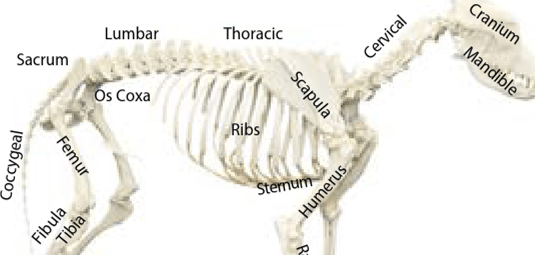
Axial: Skeleton of the head, vertebra, and ribs
Appendicular: Skeleton of appendages; arms, legs, and their sockets
Dental Terms
Mesial: Toward the midline, or central incisors
Distal: Away from the midline, or toward the molars
Lingual: Toward the tongue
Labial: Toward the lips, typically referring to the anterior teeth or incisors
Buccal: Toward the cheeks, typically referring to the posterior teeth or molars
Interproximal: Between two teeth
Occlusal: Chewing surface, called incisal surface on incisors

Figure 11.5 Direction terms indicated on Cam's skeleton.
Anatomical Terms

Figure 11.6 Axial versus appendicular skeleton indicated on Canis skeleton.
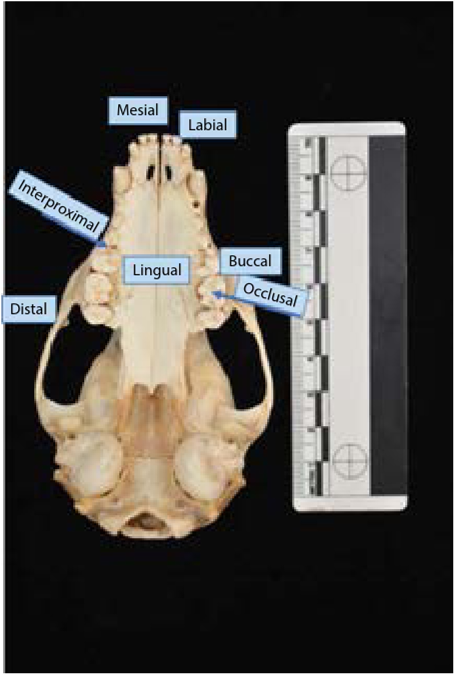
Figure 11.7 Dental direction terms indicated on inferior view of raccoon skull.
Skeletal Elements
A detailed discussion of the skeletal elements is beyond the scope of this chapter. Therefore, a brief overview of the elements is provided (Figure 11.8). When examining various mammals, one will notice that form follows function; in the skull, vision, scent, and diet are the particularly influential functions, while in the distal limbs, locomotion is the primary influential function. Some elements are more diagnostic of species than other, with the skull being the most diagnostic, therefore it will be discussed in a little more detail to highlight some of the features that are examined.
Cranium
The cranium encompasses four of the five senses: sight, sound, smell, and taste (diet). The shape of the cranium and mandible can provide a great deal of information about the importance of these senses to the animal which can help quickly narrow the range of species under consideration.
Sight
The eye orbits are made up of a number of bones and are delineated by the zygomatic processes, also called the postorbital process, on the lateral aspect of the orbit. The size, orientation, and bony completeness of the orbits and the process can provide insight into an animal’s reliance on vision for hunting/survival. The large and semi-complete orbits of felines (Figure 11.9) attest to their visual acuity in hunting. Similarly, owls have very large and well protected orbits to allow for nocturnal vision. In both species, anterior orbits create visual field overlap and stereoscopic vision or depth perception. Rodents have smaller, less protected orbits and less reliance on vision. Likewise, the armadillo (Figure 11.10) has minimal orbital protection; they rely on other senses to navigate the world or to protect themselves from predators. Ungulates, such as horses, deer, and cow, have large and laterally placed orbits which allow them to see nearly 360°, essential for watching for predators, but they see the world through monocular vision and they have no depth perception; as prey they need to know where their predators are, but not necessarily how close (Figure 11.11).
'Metatarsals o-.
T I *
Tarsals 3
©>
„Phalanges Carpa|s .
*
Metacarpals
Phalanges

Figure 11.9 Anterior view of common house cat skull.
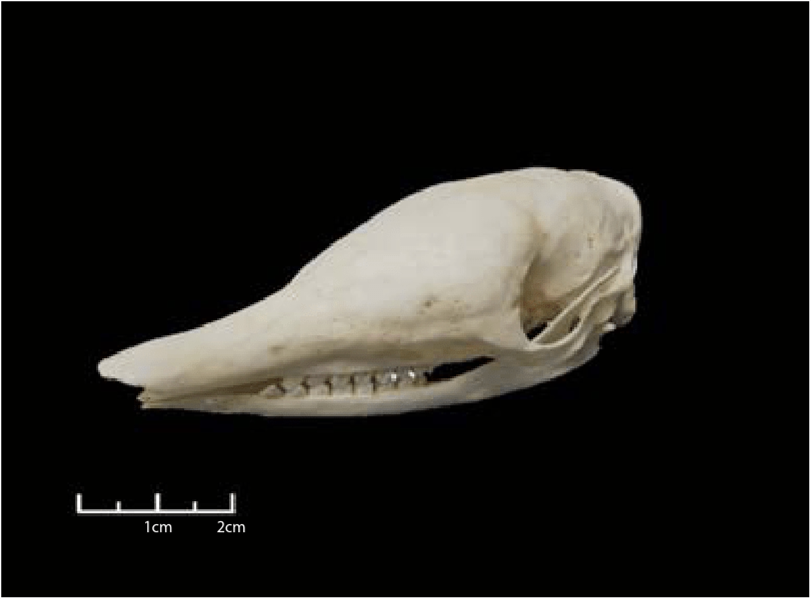
Figure 11.10 Lateral view of armadillo skull.
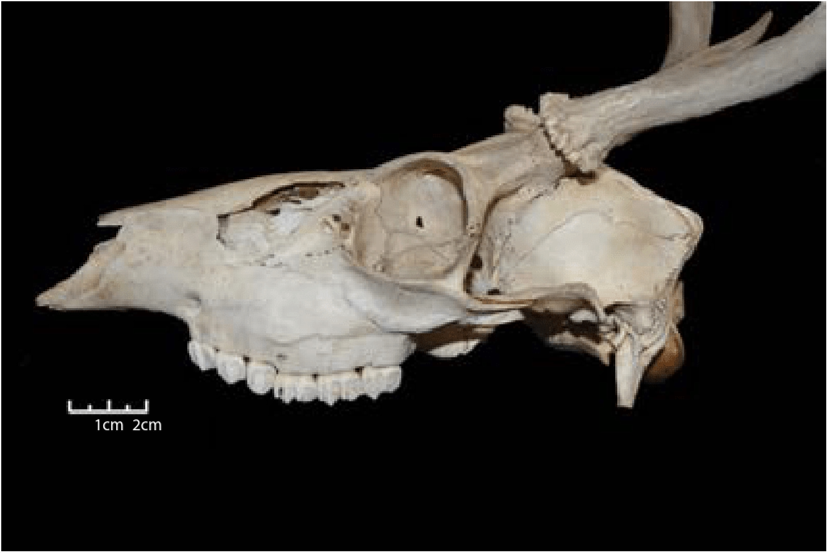
Figure 11.11 Lateral view of whitetail deer skull.
Sound
The temporal bones, on the sides of the skull, house the auditory structures, the auditory bulla and in some mammals the external auditory meatus, or ear hole. The auditory bulla is an inflated, thinwalled structure located just inferior to the external auditory meatus. It is enlarged in canids and felines, is moderate in deer, and is smaller in bears, opossum, and cattle. Again, this is based on the functional significance of hearing to each species in hunting and survival (Figures 11.12 and 11.13).
Smell
The nose is defined by the maxilla and the nasal bones. Within the nose are the nasal conchae, which are snail-like in their appearance, and act as turbines in the sense of smell. The nasal conchae are larger and more complicated in animals that rely more heavily on their sense of smell (Figure 11.14). The overall length of an animal’s nose also reflects its reliance on smell for hunting/survival. The armadillo, which is heavily reliant on smell, has a very long nasal region and no orbital protection, while primates have reduced nasal regions and significant orbital protection (Figure 11.15).
Taste
Dietary habits dictate the size and shape of the maxilla and mandible and the articulation of the mandible with the skull via the temporomandibular joint, found on the temporal bone. Looser articulations with the cranium allow for more lateral movement of the mandible in grazing animals, while tighter articulations allow for exact tooth alignment and shearing of meat from carcasses. Also, the height of the mandibular condyle, the part that attaches to the cranium near the ear, in relation to the tooth row can inform diet. A condyle in line with the tooth row allows the teeth to meet more effectively, which is better for slicing, shearing, and grinding food or meat (carnivores and omnivores; e.g., the bobcat), while a condyle that is well above the tooth row is better for rolling food or milling vegetation (herbivores; e.g., the horse).
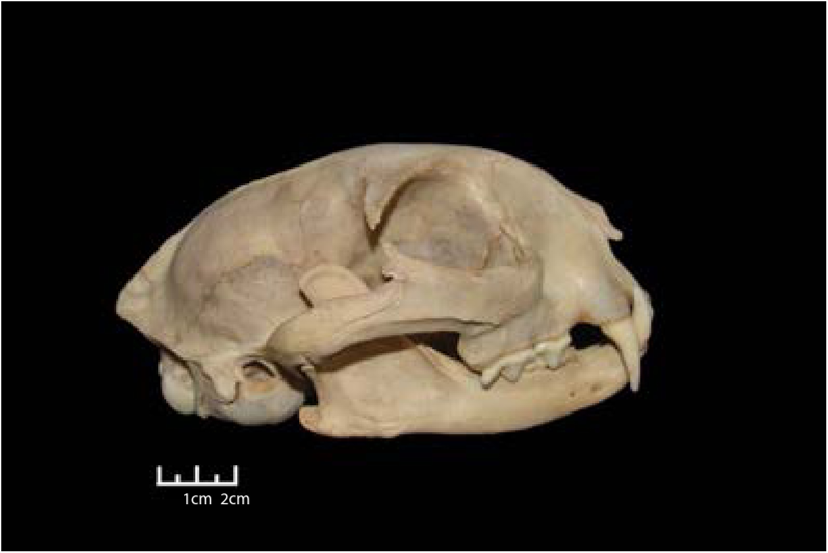
Figure 11.12 Lateral view of bobcat skull.
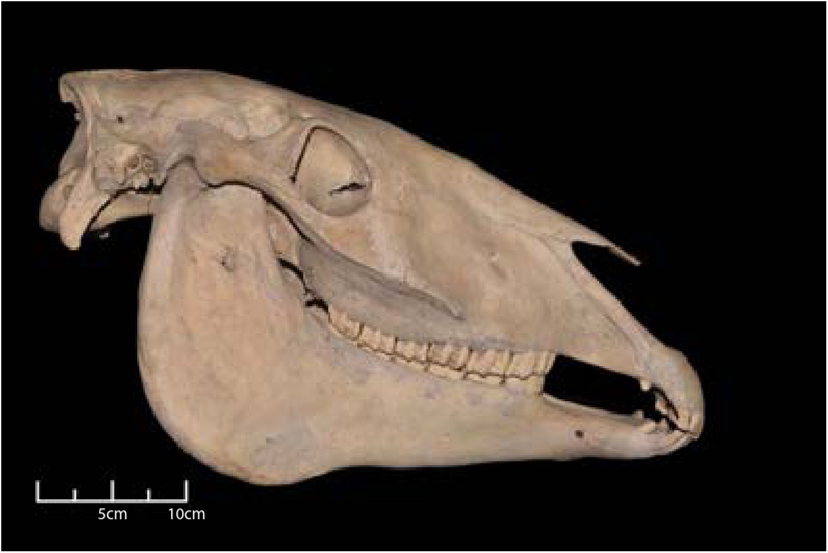
Figure 11.13 Lateral view of horse skull.
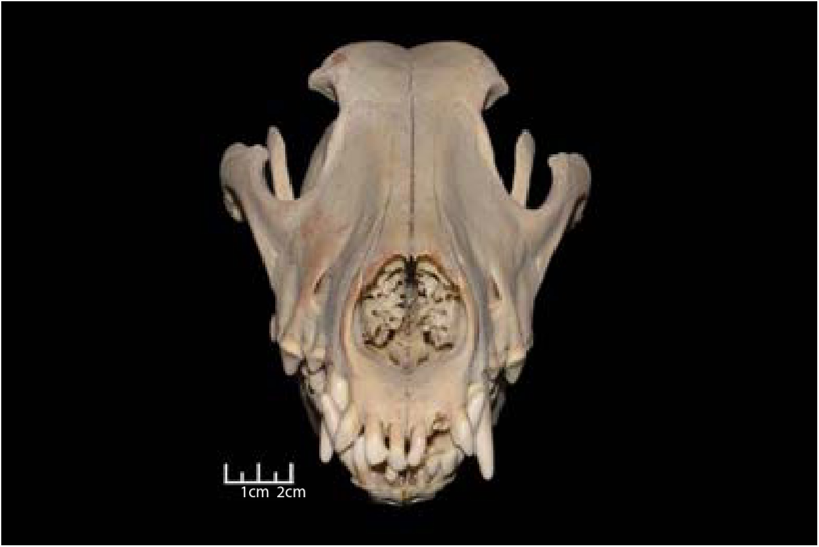
Figure 11.14 Rostral view of dog.
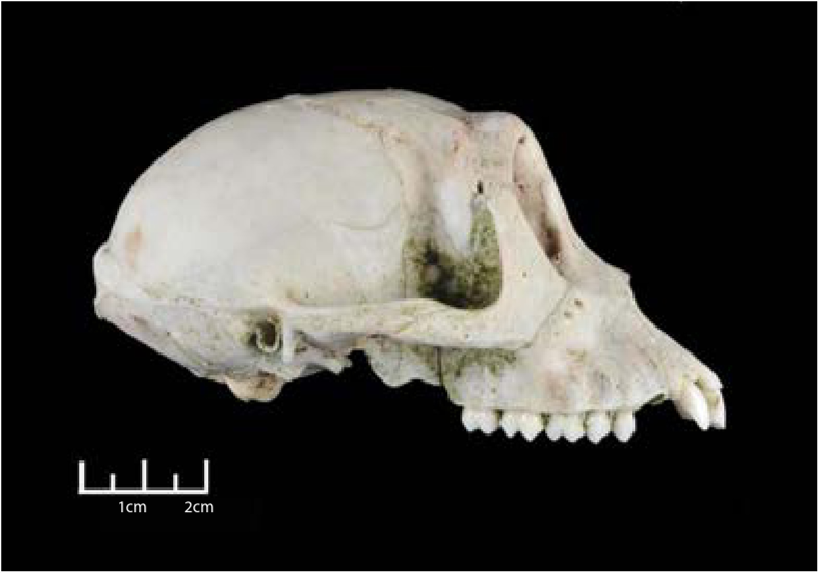
Figure 11.15 Lateral view of Old World monkey skull.
There are many other features found on the skull that can assist in distinguishing species, too many to detail in this chapter. Hopefully, this discussion of the senses has helped lay the foundation of what types of features are examined to evaluate class, genus, and species.

