Examination of the Suspected Animal Sexual Abuse Victim
All animals can potentially be victims of ASA. It is imperative that veterinarians recognize conditions or behaviors that may signal animal abuse and include them on their list of differentials. Animal sexual abuse victims may be identified by law enforcement or others upon presentation to a veterinarian for examination or because of witness accounts. Any reported history of ASA must be approached with gravity and an open clinical mind.
When a veterinarian is reporting ASA to law enforcement, it is important to be thorough in communications. The veterinarian is the animal expert but may not be as familiar with legal proceedings in sexual abuse cases as medical doctors may be. Law enforcement officers may need to be reminded that the veterinarian requires guidance or input.
The nature of an ASA incident may range from contact without physical harm to death as a sequela of penetration, strangulation, other accompanying trauma, or overdose of an administered sedative agent. After the physical exam with trace collection and lesion documentation, baseline blood work, urine for urinalysis, and fecal sample should be collected and submitted to a reference laboratory.
If sedative agents are suspected to have been used in a drug-facilitated animal sexual assault, sufficient samples should be collected to provide for toxin screens before any sedatives are given for the purposes of the veterinary exam. The first voided urine sample of a female dog should be handled very carefully to preserve any spermatozoa that may be present.
Veterinarians in private, shelter, and emergency practices are the front line in the response to animal cruelty cases. The manner in which the initial examination and treatment of a patient is handled can directly impact the ability of law enforcement and forensic professionals to collect and document critical evidence needed for a successful prosecution. This is especially true in cases of sexual assault.
Conditions That Can Mimic Animal Sexual Abuse
When examining a patient with suspicious conditions, veterinarians must consider the question: Is this in fact an ASA case?
Animal sexual abuse should be an included differential in any form of abnormal urogenital or perineal presentation. However, differentials for abnormal genitals may include neoplastic, inflammatory, or hormonal causes. Abrasions, swellings, or other abnormalities in these areas may require further diagnostics to differentiate from acquired or natural conditions using laboratory tests, biopsy, or ultrasound.
When ASA is suspected, adequate examination and testing should rule out natural or acquired conditions that mimic ASA. The examining veterinarian must exhibit scientific impartiality when examining an animal alleged to have been the victim of ASA. Conditions that can mimic injury to the anus, vulva, and perineum must be considered and ruled in or out when appropriate. The presence of a disease condition does not exclude ASA as a possibility, but this raises the bar for finding trace evidence to corroborate allegations. Sexual abuse should be a differential in any case of genital or anorectal injury or trauma.
The Anus and Perineum
The anus is normally thick and prominent in intact males due to testosterone-dependent hypertrophy of the apocrine glands. This secondary sex characteristic does not cause the abrasions or broken hairs that can be seen with anal penetration.
Dogs may self-traumatize or have ulcerations on or near the anus due to anal sac impaction or gastrointestinal parasites. Animals may traumatize their own perineum due to irritation from
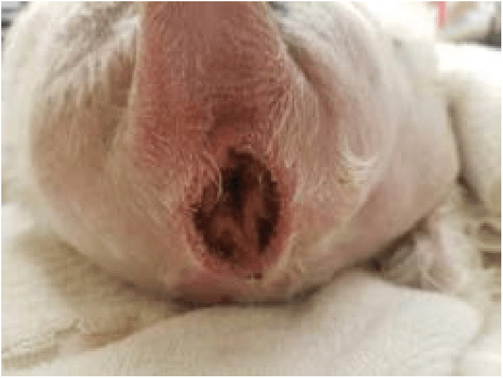
Figure 6.3 Pseudocoprastasis trauma post-removal of a fecal dam in a 6-year-old spayed female Bichon Frisé. (Author's photograph.)
allergies. Perianal fistulas and fissures are an immune mediated lesion of the anus and perianal region of dogs. Perineal hernias are seen in intact older male dogs with prostate gland enlargement and obstipation. Rectal prolapse may occur secondary to tenesmus or excessive postpartum straining.
A long-haired dog or cat that has experienced pseudocoprostasis (a hair mat with feces entanglement obstructing the anal opening, also known as a fecal dam) may have a dilated anus and a rim of reddened swollen tissue ringing the anus after the mat is removed (Figure 6.3).
The Vulva and Vagina
Swelling of the vulva is normal during estrus. Excessive or persistent swelling is abnormal but occurs commonly in dogs. This can happen with hyperestrogenism of ovarian tumors or with exposure to estrogenic substances. The vaginal mucosa swells with edema and this tissue can protrude through the vulva exposing the mucosa.
Vaginal hyperplasia, hypertrophy, and/or prolapse of bitches are common conditions seen during proestrus of the first few estrus periods of young dogs, and this is seen more often in brachiocephalic breeds. It is thought that there is an increased sensitivity to estrogen and there is excessive edema of the submucosal tissues of the vagina. Severe swelling can cause protruding vaginal tissue that can become excoriated and ulcerated. This condition will spontaneously regress during diestrus or after spaying.
Vaginal polyps occur in most species and they are particularly common in dogs. They may protrude through the vaginal opening and ulcerate. Stricture or stenosis of the vagina or vestibule may occur as a congenital anomaly or following traumatic injury at parturition. Mycotoxins can cause hyperestrogenism and subsequent vaginal hypertrophy in some species, especially pigs.
The most common neoplasm of the vagina and vulva is a squamous cell neoplasm. They occur in all species but are most common in the cow, ewe, and mare. These are more common with exposure to sunlight on less pigmented tissue. Canine transmissible venereal tumors may be present in dogs of both sexes. Female dogs may develop leiomas of the vaginal wall.
Most species have a species-specific herpes virus which can cause genital lesions. Genital herpes can cause multifocal epithelial necrosis, apoptosis, and erosion. In some species the ulcers will coalesce to form large ulcers up to several centimeters in diameter. These lesions may leave depigmented marks after healing.
Post-parturient vulvitis and vaginitis occur when they are lacerated during dystocia and become infected. Granular vulvitis is the descriptive term for the appearance of the vulva and vagina in inflammatory diseases and can be the result of hyperplasia of lymphoid follicles.
The Penis, Scrotum, and Testes
Diseases of, or accidental trauma to the scrotum and testes (orchitis or epididymitis) can cause swelling and discoloration; torsion of the testicle and scrotal hernias can cause spontaneous acute swelling and discoloration. Hematogenous or ascending spread of Escherichia coli or other gramnegative bacteria can cause orchitis with marked swelling and ulceration of the scrotum. Intact dogs may experience scrotal burns from sitting on caustic substances such as kennel disinfectants that have been inadequately rinsed from the primary enclosure. Dogs may lick and chew at the affected scrotum and cause a fistula to the scrotal contents.
Male horses may have habronemiasis, which is aberrant migration of fly larvae deposited on the penis or prepuce. Equine sarcoids may also present with ulcerated, proliferative lesions on the penis and prepuce.
Many of the above-listed conditions require histologic evaluation to properly diagnose them. Biopsies may help to support the absence of a disease condition and confirm a diagnosis of ASA. A fecal analysis for gastrointestinal parasites and a careful and documented exam of the anal glands can help to discern whether any perineal trauma is likely related to those conditions.
As a veterinarian, depending on your jurisdiction, you may be a mandatory reporter. If an injury does not fit with the history given, it is your duty to question it and report it. Veterinarians are advocates not only for their animal patient, but for societal health and safety as well.

