Is Animal Sexual Abuse A Psychopathy in Humans?
Findings from inmate research suggests that bestiality may represent a risk factor for future interpersonal violence (Holoyda, 2016), and zoophilia has been cited as an early marker for psychosis (Lesandric et al., 2017). Animal sexual abuse, particularly when experienced as a child, has been shown to be the single largest risk factor and strongest predictor of increased risk for committing child sexual abuse (Abel, 2008). Thirty-five percent of arrests for bestiality also involve child sexual abuse or exploitation. In addition, nearly 40% of offenders have prior criminal records for bestiality, child sexual abuse, domestic violence, battery, adult rape, substance abuse, trespass, public indecency, and even murder (Edwards, 2018).
Motivations for sexual abuse may include opportunistic (experimental), fixated, or domineering sadistic traits. Opportunists are individuals who seek out animals because they are accessible, vulnerable, and nonthreatening. Fixation involves the type of abuser who has a sexual preference for or attraction to animals. The domineering (sadistic) abuser may derive gratification from forcing a vulnerable individual, like a child, into having sex with an animal to humiliate, dominate, control, or exploit their human animal victims. This type of person derives sexual gratification from the pain and suffering inflicted while sexually abusing others, including animals. This type of abuser is likely to injure or kill an animal in the course of their abuse (Sinclair et al., 2006).
In the 1970s, the belief was that bestiality behaviors were transitory, occurring when there is no other sexual outlet available. More recent studies report that most self-identified zoophiles do not have sex with animals because there is no other sexual outlet but do so because it is their sexual preference. The most common reasons for engaging in zoophilic relationships were attraction to animals out of a desire for affection, and a sexual attraction toward and/or a love for animals (Holoyda and Newman, 2016).
Until the advent of the internet, most scientific or clinical reports on ASA were case reports of individuals who sought treatment for their sexual predilection. Since the advent of the internet, there are dozens of social websites for zoophiles. Beast Forum is the largest online zoophile community in the world with over a million users and approximately ten thousand members online at a given time. The increasing availability of animal pornographic imagery and supportive communities may contribute to a growing incidence of ASA.
Sexual assault on animals is not limited to domesticated species or any particular animal size. Any animal species can be an animal victim. However, sexual activity has been found to be prevalent in dogs and horses (Williams & Weinberg, 2003). Dogs and horses were also the most common victims according to a 2002 survey of 93 zoophiles by Dr. Hani Miletski (Miletski, 2005a,b) For females, the main stated reasons for having sex with animals was because they were sexually attracted to the animal (100%), claimed love and affection for the animal (67%), and/or because they said the animal wanted sex with them (67%). Only 12% of her sample said they engaged in sex with animals because there were no human partners available, and only 7% said it was because they were too shy to have sex with humans. Most of Miletski’s sample preferred sex with dogs (87% males; 100% females) and/or horses (81% males; 73% females).
Animal Sexual Abuse Incidence
Drs. Helen Munro and Michael Thrusfeld’s foundational study “Battered Pets: Sexual Abuse” was published in 2001 and was the outcome of a survey of nonaccidental injury in small animals in the UK, based on responses from a random sample of small animal practitioners (Munro and Thrusfield, 2001). Of the 448 reported cases, 6% were identified as being sexual in nature. Of the sexual abuse cases, 21 cases occurred in dogs, 5 in cats, and 2 in unspecified species. Reasons for veterinarians suspecting sexual abuse included the type of injury, behavior of the owner, statements from witnesses, and admission by the perpetrator. Types of injury included vaginal and anorectal penetrative (penile and non-penile) injury, perianal damage, and trauma to the genitals. Some injuries (such as castration) were extreme, and some were fatal. In contrast, other cases revealed no obvious damage. The type and severity of injuries were similar to those described in texts on child abuse and human forensic pathology.
The incidence of ASA is higher among child sexual abusers. English et al. (2003) studied 180 adults who committed sex offenses against children. Although case records indicated that only 4.4% had engaged in animal sexual assault, when polygraphed, 36.1% admitted such activities.
Because of the variation of legality and definition in ASA and the limitations with law enforcement data collection, there is not a clear picture of how much ASA occurs. In the FBI’s release of 2016 National Incident-Based Reporting System (NIBRS) data, the first year ASA data was collected as a discrete data point, just 9 incidents were reported of 1126 total reported incident of animal cruelty. That represents less than 1% of the total cases reported (Figure 6.2 and Table 6.1).
Charging a defendant with ASA requires prosecutorial courage; some cases will instead be charged as indecency crimes, breach of the peace, or other lesser charges. Offenders may negotiate the opportunity to plead guilty to lesser charges or to charges which obscure the sexual nature of the offense. These defense tactics may cloud statistics related to prosecutorial outcomes, but they should not obscure incident reporting.
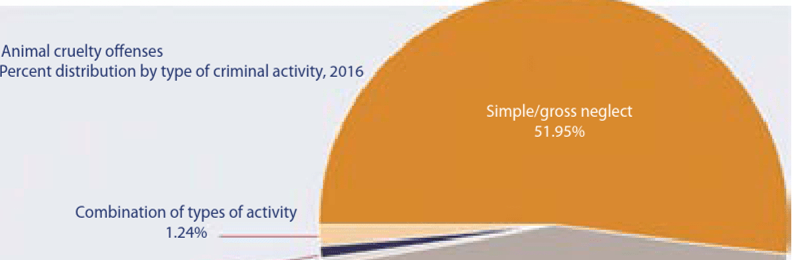
Intentional abuse and torture 45.29%
Animal sexual abuse 0.80%

Organized abuse (dogfighting and cockfighting) 0.71%
Figure 6.2 Animal cruelty offenses: percent distribution by type of criminal activity.
Table 6.1 Open data repositories that were quality checked by scientific data
|
Animal Cruelty Offenses: Distribution by Type of Criminal Activity, 2016* |
|||||
|
State |
Total Offenses |
Simple/Gross Neglect |
Intentional Abuse and Torture |
Organized Abuse |
Animal Sexual Abuse |
|
TOTAL |
1126 |
599 |
523 |
12 |
9 |
|
Colorado |
8 |
7 |
1 |
0 |
0 |
|
Delaware |
494 |
214 |
289 |
3 |
0 |
|
Massachusetts |
2 |
1 |
1 |
0 |
0 |
|
Michigan |
130 |
91 |
38 |
1 |
1 |
|
Minnesota |
1 |
0 |
1 |
0 |
0 |
|
Missouri |
15 |
8 |
6 |
1 |
0 |
|
North Dakota |
7 |
5 |
3 |
0 |
0 |
|
Oregon |
105 |
45 |
58 |
1 |
1 |
|
South Dakota |
10 |
5 |
5 |
0 |
0 |
|
Tennessee |
219 |
143 |
69 |
4 |
5 |
|
Washington |
85 |
50 |
34 |
0 |
2 |
|
West Virginia |
13 |
8 |
4 |
1 |
0 |
|
Wisconsin |
37 |
22 |
14 |
1 |
0 |
* Agencies can submit up to three types of criminal activity per offense. See the data declaration for more information.
CASE 1
History: This case was brought to the attention of law enforcement via routine screening of digital photograph submissions for development. Multiple photos of a person inserting a mallet handle into the vagina of what appeared to be a dog and additional photographs of human male genitalia penetrating the vulva/vaginal area of what appeared to be a dog.
Physical Exam: A search warrant was obtained to seize two female Labrador Retrievers approximately 3-5 years of age from the home of the suspect. Both dogs exhibited evidence of sustained vaginal trauma. Both had 360° linear lesions to a depth of over 10 cm into the vagina.
Outcome: Law enforcement was able to show in court that the dogs’ owner was the individual in the photographs. Testimony hinged on the amount of “perceived torture,” pain, and suffering the dogs endured, not the actual sexual abuse. Due to the diligence of a dedicated prosecutor, a felony conviction was eventually obtained. In addition, there was a motion to have the suspect listed as a registered sex offender; however, this never came to fruition.
Note: This case occurred in a state prior to implementing a bestiality statute. There were existing animal cruelty laws, but prosecution was made more complex due to vagueness of the existing animal cruelty statutes.

