Range Determination
As the firing distance moves from the contact to varying distances away from the animal, the deposition of soot or gunpowder residue will alter. Accurate interpretation of these differences requires additional diagnostics with a scanning electron microscope or spectrometer. Morphology of skin defects, margins, or abrasions may remain the same. A ballistic expert will evaluate the appearance of an entry wound, considering the weapon and type of ammunition, and may also need to test fire a specific weapon and ammunition to determine the distance the weapon was fired (DiMaio, 1999; Bradley-Siemens & Brower, 2016).
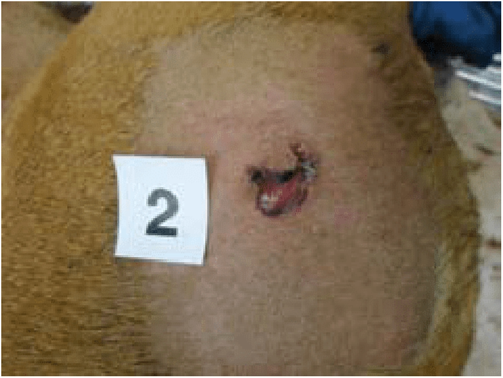
Figure 9.9 Exit wound; notice outward protruding of the tissue flap.
Contact
A contact wound is caused by placing the end of the gun barrel in direct contact with the animal’s skin when the weapon is fired. There are hard-, loose-, angled-, or incomplete-contact wounds (DiMaio, 1999; Bradley-Siemens & Brower, 2016). In a hard-contact wound, the muzzle of the firearm is pushed against the skin, causing the skin to rise up around the barrel periphery (pushing outward). The borders of the wound are seared by the hot gasses exiting the muzzle. This type of wound is caused by soot and gas being forced into the skin (DiMaio, 1999; Bradley-Siemens & Brower, 2016). In skin regions elevated by bone, the skin may separate from the subcutis, causing a “soot cavity." A loose-contact wound occurs when the barrel of the gun is held lightly against the animal’s skin. Any gas exiting prior to the projectile pushes the skin inward, causing a gap between the skin and the end of the muzzle, allowing the gas to exit. Soot is discharged in a zone surrounding the entrance wound (DiMaio, 1999; Bradley-Siemens & Brower, 2016). Angled contact wounds result when a gun barrel is at an acute angle to the animal’s skin; the circumference of the end of the muzzle is not in total contact with the skin. The gas and soot emanate outward from the end of the barrel where contact was not complete. An eccentric pattern of soot with two zones will develop. The inner zone, most evident, is a blackened seared area of skin or fur with a pear, circular, or oval shape. The larger outer zone is shaped like a fan of light gray soot. The majority of the inside zone will be on the opposite side of the wound from the muzzle, signifying the direction the gun was fired (DiMaio, 1999; Bradley-Siemens & Brower, 2016). Incomplete-contact wounds resemble angle-contact wounds. The barrel of the gun is in contact with the animal’s skin, but the body surface may not be completely flat, resulting in a space between the end of the barrel and the skin. Soot and gas escape from the space, causing an area of seared skin or fur (DiMaio, 1999; Bradley-Siemens & Brower, 2016).
Near (Close) Contact
This type of wound is created when a weapon is not in contact with the animal’s skin but held a short distance away. The distance is so small many of the particles exiting cannot disperse and mark the skin. In close-contact wounds, the entry wound is surrounded by a zone of powder soot over seared and blackened skin or fur. This zone of searing is larger than loose-contact wounds. The soot is buried in the skin and seared zone (DiMaio, 1999; Bradley-Siemens & Brower, 2016). In close-contact angled wounds, soot will radiate outward from the end of the muzzle, causing two zones like an angled-contact wound. However, the majority of the blackened seared zone is on the same side of the muzzle pointing toward the firearm. The actual direction of fire is in the opposite direction (DiMaio, 1999; Bradley-Siemens & Brower, 2016).
Intermediate Distance
These wounds occur when the end of the barrel is held at a distance away from the animal’s body when fired yet close enough for powder grains discharged with the bullet to cause "powder tattooing” of the skin. This involves embedding of gun powder particles in the skin and resulting hemorrhage. This hemorrhage is caused by the tattooing and appears as reddish-brown to orange-red punctate lesions around an entry wound. The dissemination around the wound may be symmetrical or eccentric dependent on the angle the gun was fired. Powder tattooing is an antemortem event and its presence indicates the animal was alive when it was shot (DiMaio, 1999; Bradley-Siemens & Brower, 2016).
The distance for intermediate wounds may be over 1.0 M dependent on the weapon fired; however, an intermediate range from a handgun is generally 10.0 mm (DiMaio, 1999; Bradley-Siemens & Brower, 2016). In addition, these wounds can help determine direction of fire based on tissue beveling and the angle of an abrasion ring or soot marks (Bradley-Siemens & Brower, 2016).
Indeterminate Distance
Beyond intermediate ranges, soot or powder tattooing is not evident near an entrance wound. The only marks may be those produced by the projectile perforating the animal’s skin. At greater distances abrasion rings may not be present (DiMaio, 1999; Bradley-Siemens & Brower, 2016).
Shotgun Wounds
As the muzzle-to-animal distance increases, the diameter of the shotgun shell pellet pattern will increase and the margins of the entrance wound will be more indented. As distance increases, pellets disperse, creating single injuries or striking surrounding objects (Figure 9.10a-c). If the shotgun is fired at an angle perpendicular to the animal’s body, the pellet pattern will usually be circular. An angled discharge will cause an eccentric pattern. In both situations, the diameter of the pattern is range dependent. A projectile pattern spread will vary based on shot size and velocity. The wad from a shotgun shell may often present as a secondary projectile at close range. It may look like a second shot with bruising (sometimes in a petal formation) with or without penetration (DiMaio, 1999; Haag & Haag, 2011; Bradley-Siemens & Brower, 2016) (Figure 9.11).

