Methodology
There are several ways that DNA can be extracted. One of the more common methods involves using a kit that contains a column. The sample is placed into a small tube and kit reagents are added to the sample, as per manufacturer’s protocols. The reagents are designed to stop any protein activity, lyse open the cells, and release the DNA into the solution. The reagents have compounds in them to maintain the DNA so it does not oxidize or degrade rapidly. The solution is introduced to a column. The column has a disc which acts as a physical barrier to capture cell particles and has a static charge which allows the DNA to stick to the surface when the pH is correct. After washing the DNA to remove debris, a buffer with a different pH is introduced to the column which has the effect of altering the static charge, allowing the DNA to wash off the column. In the end, only clean, genomic DNA (mtDNA and nDNA) is in the tube with the buffer (Figure 4.5).
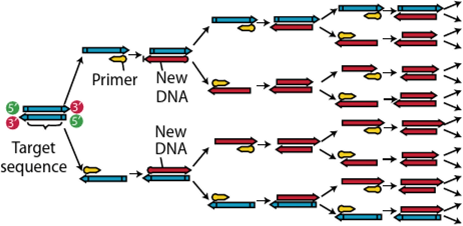
After the DNA extraction has been quantified, PCR is conducted to target a specific area of the genome, depending on the question asked. PCR is a way of chemically replicating a locus millions of times so that the product of the PCR is visible with special instrumentation (Figure 4.6). If the question is species, then a portion of the mtDNA is targeted, amplified, and sequenced. In this case, the actual order of the nucleotides is what is important. That sequence is then queried in GenBank or another database to determine the species. If the question is who and/or does the evidence match an individual, then multiple areas of the nDNA will be targeted by the PCR, amplified, and visualized on the same instrument. In this case the size of the PCR products for each allele at each locus is the important information that is used. The order of the nucleotides is unimportant (Figure 4.4).
The reliability of the results is a direct consequence of the database that the information is being compared to. Databases applied to animal forensic applications were originally extensions of databases designed for population and conservation genetic studies. Once a species was identified as a species, samples were collected to answer the question of what constitutes a population for
- 1. Sub-sample is removed from the evidence and placed in a tube
- 2. Reagents are added to lyse the cells and release the DNA
- 3. The lysed solution is introduced to a column to bind the DNA
- 4. The bound DNA is washed to remove impurities
- 5. The DNA is eluted into a fresh tube

nple
Lyse
Bind DNA
Wash
Elute
e DNA
»
Ready-to-U’
Figure 4.5 DNA extraction using a column-based kit. (From: Qiagen Dneasy Blood and Tissue Kit.)
this specific species. Samples were collected to determine the relationships of individuals within a population and between populations. The ability to identify a species is based on databases that have enough samples in them to take into account variability within species. Since every individual cannot be sampled, whether or not an individual belongs to a specific group is based on statistical analyses. If enough individuals have been sampled to establish a trend, then it is possible to say with confidence what group (species or population) an unknown sample belongs to.
This is an important aspect of a “good” database. People v Axell, 1991 (235 Cal.App.3d 836, 866-867) demonstrated how important it is for a database to take into account variability within and between populations. In this case, the statistics used against the defendant were called into question. Axell was Hispanic, and the defense asked if the potential for sub-structuring based on ethnicity had been taken into account. The ensuing legal wrangling generated a paper published in Science (Cohen et al., 1991; Devlin et al., 1993) which called into question all databases used for
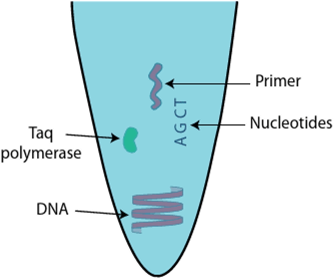
Figure 4.6 The process of polymerase chain reaction (PCR) involves adding all the necessary reagents and DNA to a small tube. The tube is subjected to rigidly defined heating and cooling cycles to make copies of the target DNA so that enough target is produced to visualize, ([a] From: https://www.biologyexams4u.com/2014/04/ per-polymerase-cha in-reaction. html#.XVRtd-NKjcs. [b] https://www.slideshare.net/biotechvictor1950/ technique-of-polymerase-chain-reaction-pcr-experimental-biotechnology.)
PCR-DNA synthesis cycle
Methodology forensic purposes. Was the database properly built to capture variability, and were there enough samples, enough data, in the database for reliable statistical analyses?
A database that has been created to answer population structure questions is a good starting point. Samples are initially collected to represent the individual populations and/or across a geographic distribution. To make a population database more applicable to a forensic question, sufficient samples need to be collected and added to capture within and between variability within populations, and samples collected across a geographic range need to be added in to make the database less biased to a specific area or population. This applies to databases that are used to address species identification as well as individual identification.
For example, a tissue sample submitted for species identification will have the DNA extracted, be PCR amplified, the PCR product cleaned, and sequenced. Once the technician has reviewed the data from the sequencer and determined it is good, the exported text of that sequence will be compared to databases to determine the source species. The sequence can be submitted to GenBank for a BLAST search and it may be found to belong to one of the species of sea turtles. GenBank may not have a very large bank of sea turtle sequences, maybe several hundred from several specific studies. However, if that sequence is now compared to an internal database consisting of many thousands of sequences of all species of sea turtles and it is found to belong to the group of Kemps Ridleys, the technician can be statistically certain that the sample is from that particular species. In addition, the beach of origin can generally be identified because sea turtles have natal homing and return to nest on the same beach their nest was.
GenBank results should be viewed with caution. Care is taken to identify and verify all sequences that are submitted to GenBank but it is not foolproof, and errors are present. It is a good place to start, as with the sea turtle example. There are enough sea turtle sequences present to make the technician confident that it is indeed a sea turtle. Further investigation will confirm the species of sea turtle. However, if the technician is looking for the genus and species of an insect that has been found associated with remains, it can be problematic. GenBank has very few sequences of certain insects. There is limited representation of within species variability, and there may be many genera and species present but only one or two representatives of each in the database. Ideally, an extensive internal database for each species a laboratory deals with should be designed and maintained; however, this is not always feasible, so GenBank remains a good place to start.
Databases for genetic profiles, nDNA, are quite different. These databases must be species specific and should be as unbiased as possible. There is not a repository of species-specific genetic profiles. These are databases that are built in-house by the laboratories assaying the specific species. Human profiles are generated using kits that have the same loci, so all human profiles can, in theory, be compared anywhere in the country or the world. Genetic profiles for nonhuman species, with a few exceptions, are not available as kits. There are some kits for horses, cattle, and dogs, but the kits among the different manufacturers do not have the same loci represented so there is no continuity. In general, species-specific loci are either developed in the laboratory using them or they are pulled from the literature. A laboratory using 10 loci for dog identification may not be, and probably is not, using the same loci as another laboratory, so there cannot be shared databases. The statistics generated from these databases are only as good as the size of the database and the representation of individuals within the database. For instance, a database of dogs should have about 50% “mutts” and 50% purebreds. The mix of mutts and purebreds should represent not only the local dogs, but dogs across a geographic range to show that there is no substructure or other event that skews the data. Databases for nonhuman assays are expensive and take a long time to populate.
Databases need to be large enough and properly representative to be able to generate reliable and consistent statistics. If too small or too biased, the statistics may not be able to support the DNA evidence in a case and the evidence may be thrown out and not considered. A well-designed database with many loci will generate a statistic that can be safely used in testimony and will be acceptable to the judge and jury.
Conclusion
DNA data is vital to criminal investigations whether for humans or animals. It may be the only way of linking individuals to crime scenes. DNA is used to identify species that have been involved in or used in various criminal activities. It is used to identify species of forensically important insects during early development when they are indistinguishable from one another.
DNA is used to identify individual dogs, deer, or other species. It is used to link the meat in a freezer with the blood in the back of a truck or on someone’s clothing and the tissue of a dead deer taken out of season.
The evidence is collected with all the same precautions and requirements as human evidence collection. It is processed using many of the same protocols and kits. Unlike human forensics, the species is often not known and must be determined before individual identification can be done. Individual identification is based on databases that have been designed and built for the species involved. Courtrooms around the world are recognizing that DNA evidence from animals needs to be treated in essentially the same way as human DNA evidence. Animal DNA used for forensic investigations is becoming the gold standard and is more and more often looked for in a court of law. It is a very exciting time for animal forensic DNA evidence.
References
Becker, F and French, L 2004. Making the links: Child abuse, animal cruelty and domestic violence. Child Abuse Review 13 (6):399-414.
Cohen, JE., Lynch, M, Taylor, CE, Green, P, Lander, ES, Devlin, B, Risch, N, and Roeder, K 1991. Forensic DNA Tests and Hardy-Weinberg Equilibrium. Science. 253:1037-1041.
Comstock, KE et al. 2003. Amplifying nuclear and mitochondrial DNA from African elephant ivory: A tool for monitoring the ivory trade. Conservation Biology 17 (6): 1840—1843.
Devlin, B, Risch, N, and Roeder, K 1993. Statistical Evaluation of DNA Fingerprinting: A Critique of the NCR's Report. Science. 259:748-749.
Gullone, E and Robertson, N 2008. The relationship between bullying and animal abuse behaviors in adolescents: The importance of witnessing animal abuse. Journal of Applied Developmental Psychology 29 (5):371-379.
Johnson CP 2000. Crime Mapping and Analysis Using GIS. Geomatics 2000: Conference on Geomatics in Electronic Governance. Paper 4.
Lockwood, R and Hodge, GR 1986. Tangled Web of Animal Abuse; The Links Between Cruelty to Animals and Human Violence. Humane Society News (Summer). http://www.ncjrs.gov/App/ publications/abstract.aspx?ID=155688
People v Axell 1991. 235 Cal.App.3d 836, 866-867. https://caselaw.findlaw.com/ca-court-of-
appeal/1769953.html

