Determining Quality and Quantity of Feed
If the animals are utilizing vegetation as part of their ration, the nutritional value is dependent on the plant species present, maturity of the plants, and growing conditions. Poorer quality feed must be fed in higher quantities to provide sufficient nutrients. It is possible to have rations so poor in nutrient content that it is impossible for the animals to consume sufficient quantity to meet their protein/energy requirement.
There are several places nationally that can analyze forage (see Resources). Members of the National Forage Testing Association can gain Certified Laboratory status by demonstrating proficiency. Use of a certified laboratory increases the chances of repeatability and decreases the likelihood of challenge in court. Contact the laboratory for their recommendations for best practices regarding sampling and shipment for your specific situation. In general, observe the plants the animals are consuming and collect 25-30 handfuls from each area of the pasture that has different varieties of grazed plants (ditches, under trees, along fence rows). Collect the plants at the level likely to be consumed by that species; cattle the top one-third of the plant, pigs and poultry the entire plant, and small ruminants, camelids, and horses within an inch of the soil. Sample packages should have identical labels on the inside and the outside of the container (case number, agency, location, time, date, contents, collector, and a unique sample number). Place the samples in a plastic bag, squeeze out the excess air, and label with the appropriate information after sealing with frangible tape. Freeze to prevent fermentation and ship overnight on ice via a courier service to maintain chain of custody.
Animals generally will not graze near manure piles or around water troughs or weed-filled areas unless there is no other forage available. These areas should be deducted from calculations


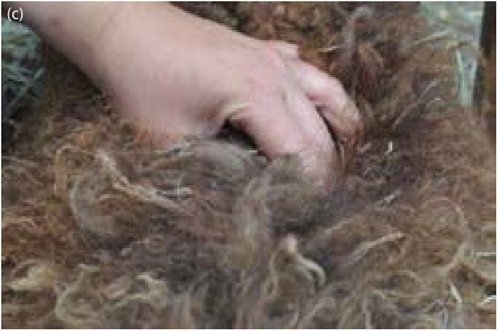
Figure 17.3 Documenting BCS in a fleeced animal, (a) Restrain the animal (a milking stand works well if the animal will tolerate it), (b) Part the fleece to expose the skin over the loin at the midpoint, (c) Bend malleable wire over the contour, (d) Trace the inside of the curved wire. Inclusion of the reference scale in the medical record facilitates clear communication during legal proceedings.

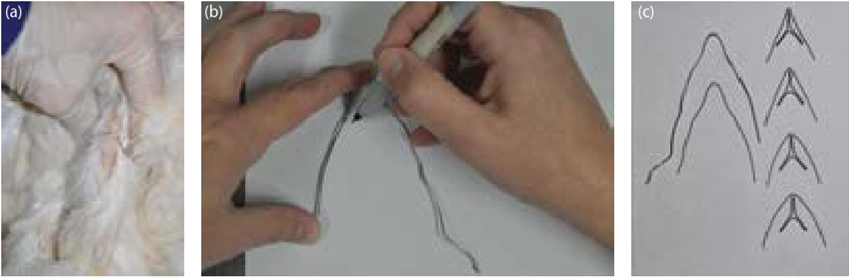
Figure 17.4 Documenting BCS of avian species using malleable wire, (a) Wire is pressed over the keel midway along the length, (b) Trace the inside contour of the bent wire, (c) Photograph the wire and the tracing with the individual's unique identification. The column of illustrations on the right represent BCS 0-3 (Gregory & Robbins, 1998).
Husbandry causes:
■ Insufficient/inappropriate feedstuff for environmental conditions, species, or production stage (lactating animals require more calories to maintain condition; heat-stressed animals will not eat; more calories required in cold weather)
■ Poor quality feed
■ Insufficient bunk space
■ Insufficient time to consume rations (social starvation or limited time in feeding area)
■ Inability to prehend, masticate, swallow, or digest ration (dental or other maxillofacial disease; halter too tight)
■ Exposure to environmental extremes (heat, humidity, cold)
■ Toxins
Animal causes:
■ Inability to access feed (lameness, weakness, feed barriers)
■ Heavy internal or external parasite burden
■ Acute or chronic disease (Johnes disease, neoplasia, heart disease, ovine progressive pneumonia, chronic pulmonary disease)
■ Geriatric conditions
■ Poor milk production of dam prior to utilization of solid food
Figure 17.5 Causes of poor body conditions.
of grazeable area. If a dirt lot has uneaten weeds and no other available forage, then the weeds should be collected or photographed, and the species identified. Nutritionists, toxicologists, and/ or botanists can determine if the plants are toxic or have any nutritional value for the species present. Sparse pastures may be the result of chronic overgrazing or a reflection of a single incident of overstocking, because pastures overgrazed in the fall will take longer to regrow and produce fewer nutrients in the spring. Similar in appearance, the former situation would provide better nutrition than the latter. As a general rule, well-managed pastures are rotated when 50% of the useable forage has been consumed (Undersander et al., 2002; Sprinkle & Bailey, 2004; Bartlett, 2005). Remember that the nutrition provided by pasture forage is dependent on the plants present, growing conditions, maturity of the plant, and the portions consumed of leaves, stems, and flowers (Undersander et al., 2002; Bartlett, 2005; USDA Natural Resource Conservation Service, 2003).
Hay should be free from mold and excessive dust and be stored in a dry, well-ventilated area. In general, the greener and leafier the hay, the more nutrients are available. The subsequent harvests from a hay field have a lower yield per acre, but the hay is more nutrient dense. For example, the second cutting (harvest) from an alfalfa field has greener, more nutrient-dense plants than the first cutting (Balliette & Torell, 1998). Round bales that are stored outside on the ground will mold on the outside. Livestock species will strip away the outside layers to access the edible inner portion. Hay samples should be collected with a coring device or representative flakes should be placed in paper, a label inside and outside on the container, marked as evidence, and shipped to a laboratory for nutrient analysis via a courier service.
Document the weight of all types of concentrates and supplements. Collect labels from mineral blocks, grain bags, and additives to determine if a balanced ration was available. If the grain is custom mixed by a local feed mill, it should be analyzed for content. The mill is required to supply the list of ingredients and proportions for each batch of prepared custom mix feed. If the list of ingredients is not included on the invoice, a phone call or visit to the feed store will provide the necessary information.
In addition to the qualitative analysis, the amount of grain purchased (documented with invoices, check stubs, or farm account at the feed store), divided by the time interval (in days) and the number of animals fed will give a pound/head/day amount for an individual. For example:
Table 17.2 Minimum feeder space for meal fed animals
|
Species |
Bunk Space Required/Head |
|
Beef calves |
18-22 inches |
|
Finishing cattle >600 lbs |
20-26 inches |
|
Bred dairy cows |
24-30 inches |
|
Lactating cows |
30 inches |
|
Dairy calves 2-4 months old |
18 inches |
|
Dairy calves 5 months until breeding |
20-24 inches |
|
Pigs |
1.1 times the shoulder width |
|
Sheep |
16-20 inches |
|
Lambs |
9-12 inches |
|
Goats |
16 inches |
|
Laying hens and broilers |
5 inches |
|
Broiler chicks up to 4 weeks |
1 inch |
|
Broiler chicks 4-8 weeks |
2 inches |
|
Broiler chicks 8-16 weeks |
3 inches |
One ton of grain is purchased every 2 weeks for 50 head of cattle.
2000 lb grain -r 14 days = 142.86 Ib/day fed to 50 cattle 142.86 Ib/day 50 cattle = 2.86 Ib/head/day
The amount of hay, silage, haylage, or other forage can be similarly calculated if the weights are known. Square hay bales can be weighed. Round bale weight can be estimated based on the diameter of the bale and the moisture content. Alternatively, a few representative bales can be loaded on a flatbed and the trailer weighed with and without cargo at a certified scale. Certified scales can be found at truck stops, grain elevators, and bulk landscape supply stores.
Forage purchases coupled with concentrate purchases are used to calculate the number of calories and nutrients provided to the animal(s). The National Research Council (NRC) series on nutrient requirements for the various species can be used as a minimum standard for adequate nutrition (https://www.nap.edu/collection/63/nutrient-requirements-of-animals).
If feed is being provided in adequate amounts but there is inadequate room at the feeders, then social starvation can occur when dominant herd members prevent the smaller, weaker animals from accessing the feed. Recommended space allowances are available from the state cooperative extension offices. If all animals are feeding simultaneously, minimum bunk space is required to accommodate all the individuals with extra space for the less aggressive feeders. Animals fed ad lib need less bunk space. Note if the feeders are appropriate for the species in size and configuration. Table 17.2 lists recommended feeder space.

