Preparing the Case
It is imperative that an officer be extremely meticulous when gathering information and solidifying the case. All animals seized during the course of an investigation must be evaluated by a veterinarian, preferably one with some (however meager) forensic experience, and who is willing to testify in court. Veterinarians can be considered expert witnesses based on their training and experience, and are often the only ones who can not only provide important information as to the extent of injury or neglect but whose testimony regarding their observations can be the difference between a petty offense, misdemeanor, or felony charge (Sinclair et al., 2006).
While an HLE officer may have little or no veterinary training, they must ensure that all possible testing and evaluation has been completed for the animal(s) in question. Working closely with the veterinarian will ensure that nothing is missed. The officer should review the veterinarian’s notes and reports along with any photographic or radiographic evidence that has been collected so that proper charges are filed. The HLE officer can provide their own expertise when the veterinarian examines the animal by communicating to the treating vet the case background and conditions the animal was removed from, along with possible evidence to look for. Might there be clues such as fiber or botanical traces in the animal’s fur? Are the animal’s nails worn down or broken, or are they severely overgrown? Did the owner say the animal '‘fell” on its left side, but the radiographs show trauma to its right side as well? When an embedded collar is removed, can measurements of the deepness of the wound be made? An officer can also provide assistance during a necropsy (should one be needed) by photographing or scribing (taking notes). It is very difficult and impractical for a vet to stop in the middle of a necropsy to take pictures, but pictures lend credibility, and in a
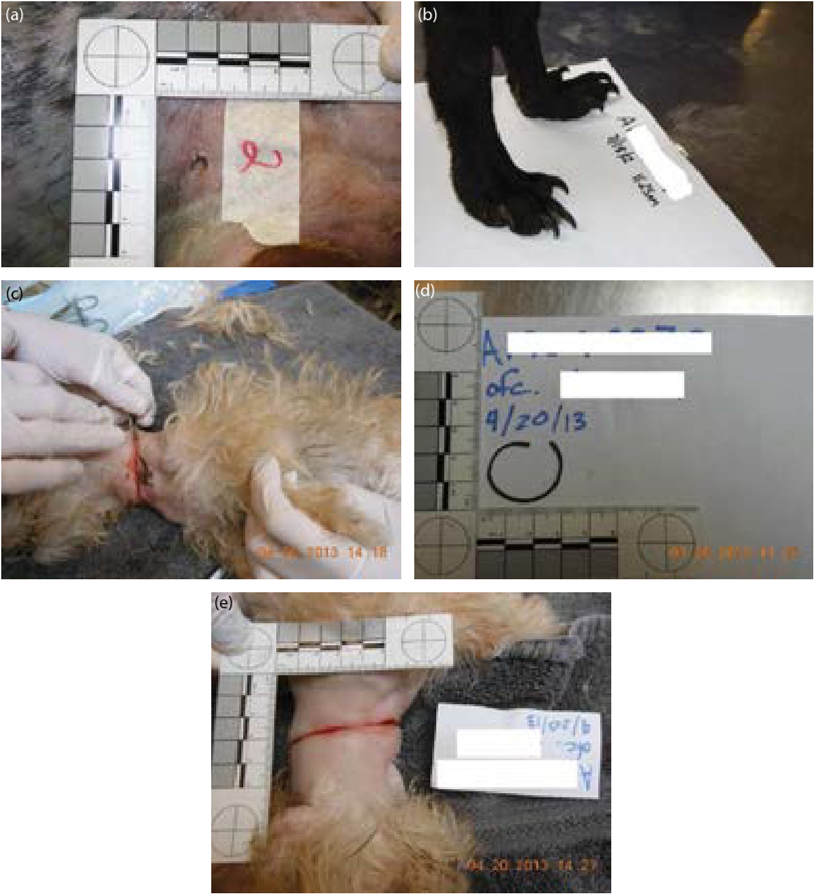
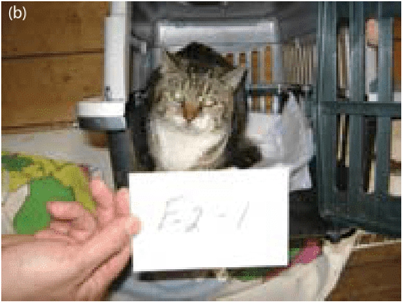
Figure 3.7 (a) Example of a close-up necropsy photo of a bullet wound with scale, (b) Example of a live examination photo with identifier card, (c) Photo of embedded rubber band at the time of removal, (d) Photo of rubber band after removal with proper identifier, (e) Photo of wound from rubber band after removal.
court of law when trying to explain complicated subjects to lay people, photos can speak volumes. Pictures of the animal should be taken before examination, at each stage of the examination, whenever a significant discovery or piece of evidence is found, and at each stage of the necropsy. Close-up, mid-range, and overview shots should be taken, both with and without a scale or ruler and including some type of identifier card listing date, officer, animal number, case number, and agency (Figure 3.7a-e).
Whenever possible, a veterinarian should accompany an officer to the scene of the incident in order to assess the conditions firsthand and from a medical perspective. A veterinarian will be able to identify medications that may be onsite and that are used to treat animal conditions; these may be missed by an officer unfamiliar with them (Sinclair et al., 2006). In the case of animal
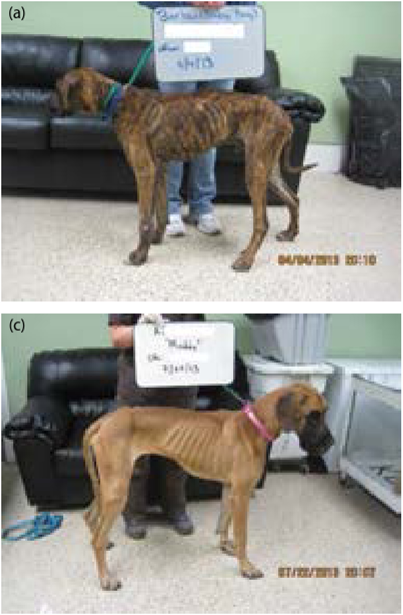
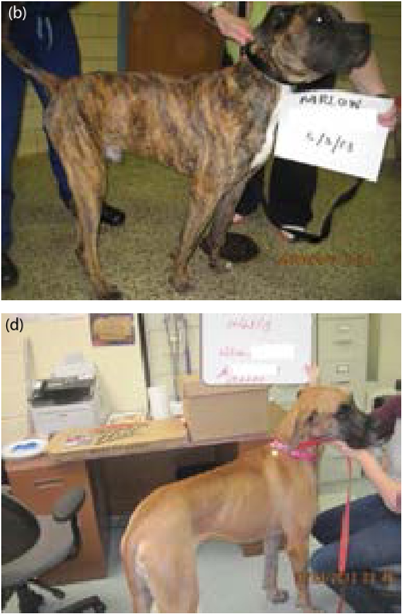
Figure 3.8 (a) Photograph of "Barlow" taken on the date of intake, (b) Photograph of "Barlow" following refeeding treatment, (c) Photograph of "Maddy" taken on the date of intake, (d) Photograph of "Maddy" following refeeding treatment. Photos taken upon intake and again following treatment, when combined with detailed veterinarian treatment records including test results, are necessary to demonstrate that an animal was deliberately neglected or maltreated.
fighting, breeding, or even hoarding, medications and supplements are frequently encountered. A veterinarian will also be able to determine which animals are in the most immediate need of treatment in cases of neglect, hoarding, and physical abuse. Forensic evaluations need to occur as soon as possible. In cases of cruelty, the animal is considered evidence. As previously mentioned, recording the animal in its in situ condition by way of photographs or video is proper evidence handling and will help the animal not only receive prompt treatment, but will allow the judge or jury to see the animal as it lived in what were most likely deplorable conditions. Video is an excellent means of documenting neurologic trauma, orthopedic injuries, or other conditions that may not be captured with still photography, or for depicting the perhaps countless animals at a hoarding or puppy mill scene. It is also good for recording an animal’s behavior on the scene or after initial seizure by officers, and this video footage can then be compared to footage taken following treatment or rehabilitation, as a type of “before-and-after” montage. This is an especially poignant way of documenting starvation: photographs of the animal emaciated when seized on scene or when first arriving at the hospital or care facility, at specific times throughout the refeeding treatment, and then once treatment has been completed, can help dispute claims from a defendant that the animal “just refused to eat’’ or, when accompanied by bloodwork and test results, that the animal “suffered from an underlying medical condition” (Figure 3.8a-d).
An HLE officer should treat all scenes as potential crime scenes. The same techniques a police officer uses to process a scene can and should be used in animal cases. Some HLE officers have little or no training in these techniques, but it doesn’t take a specialist to know some of the basics that can help ensure a solid case—wearing gloves to handle evidence, logging, labeling, and properly storing and processing evidence, making sure enough photographs are taken, limiting the amount of people on a scene, making appropriate statements to the press, and so on. Cases have been lost because of innocent “mistakes” such as logging all animals into a database at a certain time after seizure, but on a different day than (1) the day the warrant was executed, and (2) written statements regarding the date/time of the animals’ seizures. Above all, working with others is necessary and essential, especially police officers, veterinarians, and prosecuting attorneys. Meeting with attorneys on a regular basis following an on-scene investigation is crucial since the burden of proof is very high in cases of animal cruelty, as is determining the offender’s intent.
Whatever way an officer and attorney choose to handle a case from a legal standpoint, the animals should figure prominently in their minds from beginning to end. As mentioned, they should be documented, photographed and videotaped as they were when found, at regular increments following removal and treatment, and at the end of treatment, regardless of the severity of injury. Photographs are mandatory, and there is no such thing as too many photographs. Each animal must be photographed on scene, with each having a unique, identifying number. This can be accomplished by assigning the animal a number which then gets transcribed onto a card or dry erase board along with the date, time, and the officer’s name, case number, and address. This card or board should be photographed alongside the animal. This step is essential in cases of hoarding when there may be dozens of animals in one location.
Hoarding
Hoarding cases are difficult and time consuming. It may take hours, days, or even weeks to document everything on the property. It is especially important to have a veterinarian present on-scene to evaluate, photograph, and record each animal as it is captured or removed from its enclosure. The cages and enclosures themselves are evidence, and each animal needs to be associated via photographs and written records with its specific cage. Scene sketches and maps are valuable in this instance in order to obtain a more logical layout of the property than mere photographs can show, but if the animals are free roaming, it may not help (Figure 3.9a,b).
Puppy Mills
Similar in nature in some respects to hoarding cases, puppy mills have their own unique sets of circumstances. These cases often occur in relatively closed, close-knit communities where
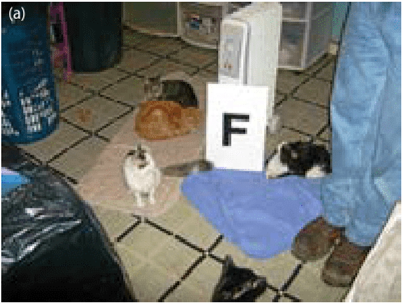
Figure 3.9 (a) All animals in a hoarding situation need to be photographed in situ with some type of identifying number or letter, (b) All animals in a hoarding situation need to be photographed again individually with an identifier that ties them to the in situ photo.
‘‘outsiders’’ are not welcome and law enforcement is scorned. Amish or Mennonite communities, where puppy mills are frequently encountered, typically frown on photography or are generally removed from popular culture, and it can take a great deal of skill on the officer’s part to be both respectful and courteous of a different way of life while still trying to obtain the facts and enforce the law.

